

Training for a marathon burns thousands of calories a week. It only makes sense that all that work would result in weight loss.
So why do some runners actually gain weight during marathon training?
If you’ve noticed the scale creeping up despite logging more miles than ever, you’re not alone. And in most cases, the weight gain is either a normal training adaptation or a fixable nutrition mistake.
So, in this article you’re going to learn the research-backed practical advice on…
- The 3 physiological reasons marathon training can cause weight gain (and why 2 of them are actually good signs)
- Why eating more during hard training blocks won’t make you gain fat
- The common post-run nutrition mistakes that undo your calorie deficit
- How to tell if your weight gain is muscle and glycogen or actual fat
Why Does Marathon Training Cause Weight Gain?
Three things happen in your body during marathon training that can push the number on the scale up.
Two of them mean your training is working.
Muscle Is Denser Than Fat
Distance running promotes muscle growth, especially in the legs.
Add any strength training or hill work and the effect is amplified.
Muscle tissue is denser than fat tissue, roughly 20% heavier by volume.
If your body looks the same or trimmer but the scale reads higher, you’re likely trading fat for muscle.
That’s a performance gain, not a problem.
Glycogen Storage Pulls Water In
One of the primary adaptations of marathon training is improving your body’s ability to store glycogen, the fuel your muscles use during long efforts.
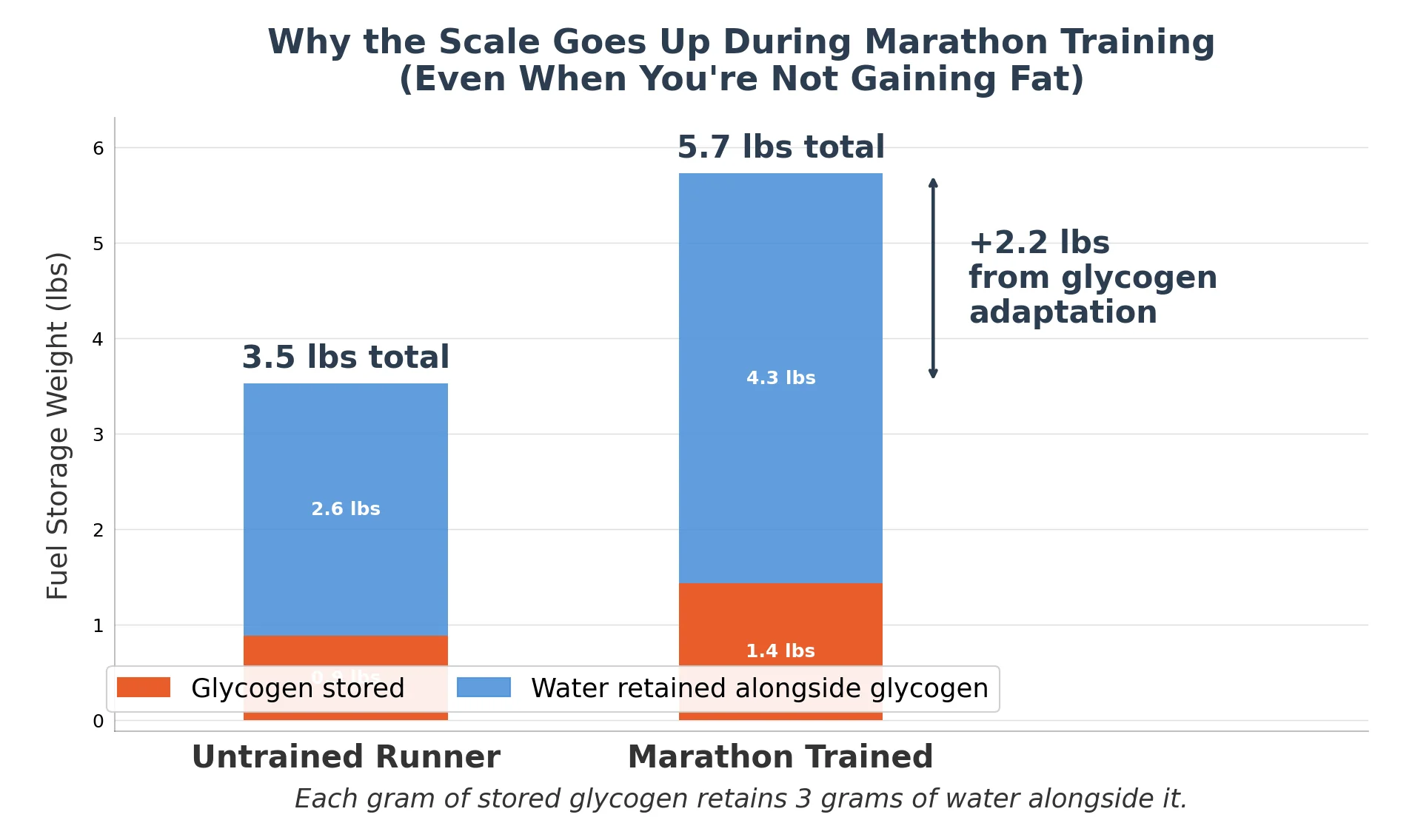
According to a review in Sports Medicine, endurance-trained athletes store significantly more glycogen in their muscles compared to untrained individuals, with capacity increasing 60 to 70% in the early months of a structured training program.
Research has shown that muscle glycogen and body mass are tightly linked: depleting glycogen stores reduces body weight, and restoring them raises it, because each gram of stored glycogen holds approximately 3 grams of water alongside it.
For every ounce of glycogen stored, your body also stores 3 ounces of water.
That extra water shows up on the scale.
Add in the increased hydration that comes with serious training and you can easily see a few pounds of fluctuation that has nothing to do with fat.
This is actually what you want heading into race day.
Being fully fueled and hydrated means your glycogen stores are topped off and ready.
More Mileage Raises Your Metabolic Rate
Many runners fear that eating more during heavy training blocks will lead to weight gain.
The opposite is usually true.
Your body adapts to increased energy demands by raising its metabolic rate.
Feed the system the right fuel and it burns hotter.
Adding 300 to 500 calories of nutrient-dense food on hard workout days gives your body the raw material it needs for recovery.
With increased mileage and harder sessions, your muscles need those calories to repair and adapt.
Without adequate fuel, recovery slows and your body starts conserving energy, which is the same metabolic downshift that makes extreme calorie-cutting diets plateau after a few weeks.
The key distinction: those extra calories need to come from quality sources, not junk food.
The metabolic boost works when the fuel matches the demand.
Can Running Cause Weight Gain Even Without Marathon Training?
Yes, and it happens for the same three reasons that apply to marathon training, just compressed into a shorter window.
When you start running regularly, or increase your mileage significantly, your body goes through the same adaptations: more glycogen, more muscle, more water retained alongside both.
Scale weight rises even as body composition improves.
There is one additional mechanism that catches casual runners off guard, and it has nothing to do with physiology.
Why Does Running Sometimes Increase Appetite Instead of Suppressing It?
Higher-intensity exercise is more effective at suppressing appetite than easy running.
Research has shown that appetite suppression from exercise follows a dose-response relationship with intensity, with ghrelin — the hunger hormone — suppressed significantly more by high-intensity intervals than by submaximal aerobic exercise.
For most recreational runners logging easy miles, that appetite-suppressing effect is modest.
The result: running increases hunger without delivering the intensity needed to curb it.
You burn 350 calories on a 45-minute jog, feel ravenous, and eat 600 calories in the hour after.
The gap between what you burned and what you ate doesn’t show up as fat immediately, but it accumulates.
What Causes the Scale to Rise in the First Weeks of Running?
In the first two to three weeks of a new running program, muscle soreness after a hard run is often accompanied by localized fluid retention.
Damaged muscle fibers draw fluid into the tissue as part of the repair process.
That fluid weighs something.
A runner who covers 20 to 25 miles in the first training week can realistically see 2 to 3 pounds of scale gain that is entirely water and adaptive response, not fat.
Give the scale three to four weeks before judging it: the early rise reflects adaptation, not fat gain.
Once that initial adaptation is complete, body composition improvements become visible even when the number on the scale stays flat or continues climbing slightly.
The clothes tell the real story.
What Are the Common Post-Run Nutrition Mistakes That Cause Real Weight Gain?
The physiological weight gain above is harmless.
The real problem is when runners overestimate how many calories they’ve earned.
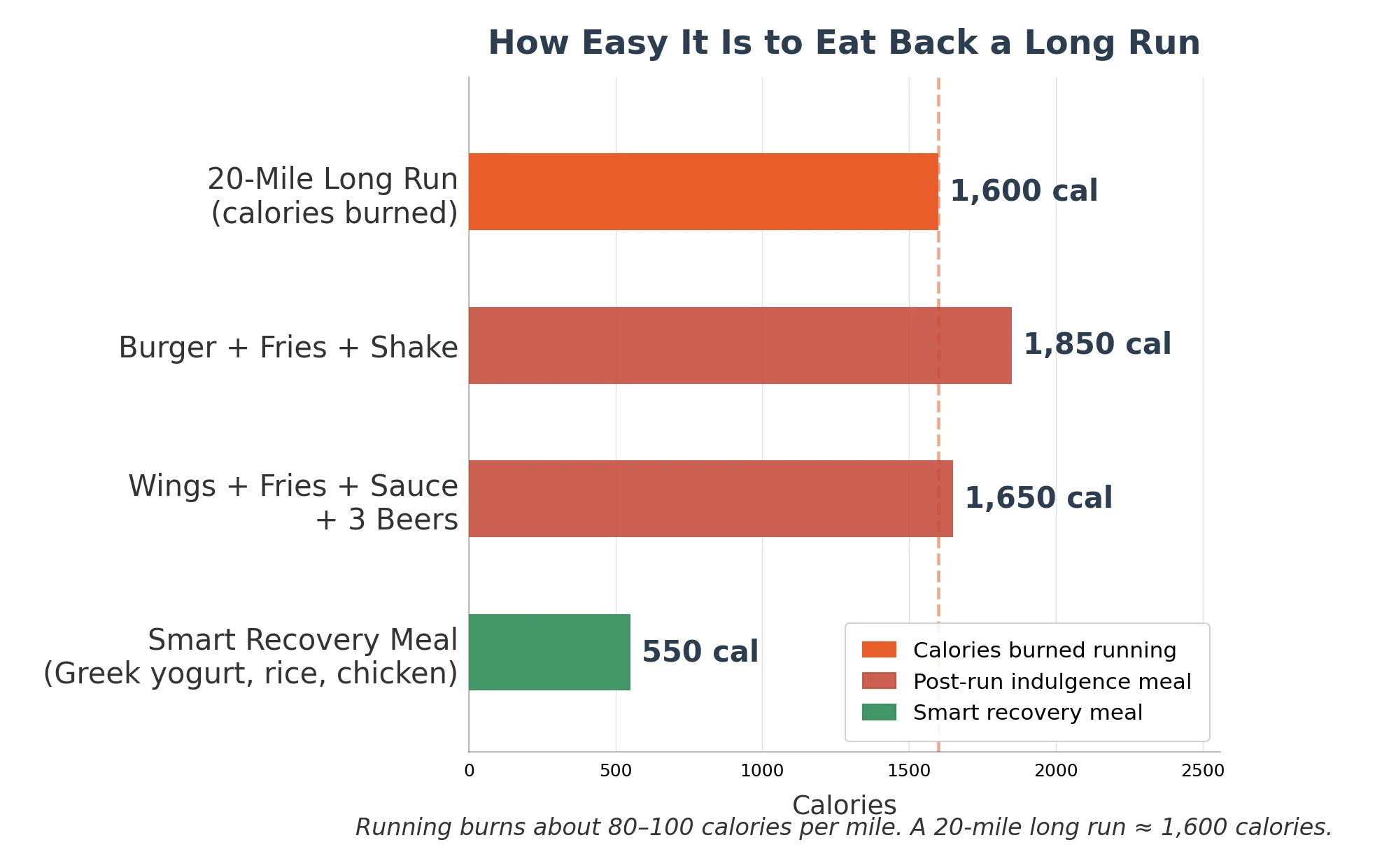
Running burns about 80 to 100 calories per mile, depending on your pace, weight, and conditions.
A 20-mile long run burns roughly 1,600 calories.
That sounds like a lot until you do the math on what comes after.
How Easy Is It to Overeat After a Long Run?
A basket of wings and fries at a restaurant runs 800 to 1,000 calories.
Add dipping sauce (200 to 300 calories) and 3 to 4 beers (400 to 500 calories) and you’re looking at 1,400 to 1,800 calories in a single sitting.
That’s the entire caloric cost of your 20-miler, wiped out with one meal.
If you fueled during the run with gels or sports drinks, you’ve already exceeded what you burned.
The issue isn’t indulging occasionally.
It’s the pattern of consistently overestimating what training earns you.
What Happens When You Wait Too Long to Eat After a Run?
The other trap is the opposite: not eating soon enough.
After a hard run, some runners pass out on the couch instead of refueling.
When hunger finally hits, it hits hard.
The longer you wait to replace what was lost, the more your body craves sugar and fat.
Those are the fastest energy sources, so they become irresistible when hunger gets out of control.
Three bowls of cereal and a pint of ice cream later, you’ve undone the calorie deficit without getting any of the recovery nutrients your muscles actually needed.
A 2026 meta-analysis found that consuming protein alongside carbohydrates within 30 to 60 minutes post-run significantly improves muscle recovery and reduces fatigue in subsequent sessions.
Eat something with protein and carbohydrates within 30 to 60 minutes after your run, even if you don’t feel hungry yet.
RunnersConnect Bonus
Download our FREE recovery foods guide, with the top 10 foods for each of the essential recovery vitamins, minerals and macro nutrients. Plus a sample 1-day meal plan!
How Do You Know If Marathon Weight Gain Is Good or Bad?
The scale is a blunt instrument.
It can’t tell you whether the extra pounds are muscle, glycogen, water, or fat.
Better indicators of what’s actually happening:
- How your clothes fit. If they’re the same or looser, the weight is likely muscle and glycogen.
- How you look. If you appear leaner or more toned despite a higher number, that’s a good sign.
- Body fat percentage, if you have access to that measurement.
- How your training is going. If paces are improving and recovery feels solid, the extra weight is fuel and fitness.
Get Your Ideal Weight Calculator
Based on your height, gender and body fat, researchers have developed a formula to determine what your “ideal running weight is“.
So, with just a few simple inputs, this calculator helps determine your ideal weight and how much over or under this ideal you are.
When you’re in the best marathon-specific shape, your body is carrying topped-off glycogen stores, extra hydration, and stronger muscles.
That version of you will weigh more than your untrained, dehydrated, glycogen-depleted self.
Don’t let the scale override what the mirror and your training log are telling you.
Should You Try to Lose Weight During Marathon Training?
In most cases, no.
Marathon training and aggressive weight loss don’t mix well.
Cutting calories during a high-volume training block compromises recovery, increases injury risk, and limits your body’s ability to adapt to the training stimulus.
If weight loss is a goal, the better approach is to focus on food quality rather than restriction.
Choose nutrient-dense foods, time your nutrition around workouts, and let the training handle the rest.
Save sports drinks and gels for long runs, hard workouts, and hot weather.
Outside of those situations, they’re just extra calories that don’t meaningfully help your training.
If you’re not losing weight despite consistent running, the issue is almost always in post-run nutrition patterns, not in your mileage.
| Type of Weight Gain | Cause | What to Do |
|---|---|---|
| Muscle mass | Training adaptation, stronger legs | Nothing. This improves performance. |
| Glycogen + water | Body stores more fuel as fitness improves | Nothing. This is race-day readiness. |
| Overcompensation | Eating more calories than training burns | Track post-run meals. Focus on quality over quantity. |
| Delayed eating | Waiting too long after runs triggers cravings | Eat protein + carbs within 30–60 min post-run. |
Why Do You Gain Weight After a Marathon or Long Run?
Finishing a marathon and stepping on the scale a few days later can be genuinely confusing.
You logged 18 weeks of training, ran 26.2 miles, and the number is higher than when you started your taper.
Three things are happening simultaneously, and all of them are temporary.
What Does Post-Marathon Inflammation Do to the Scale?
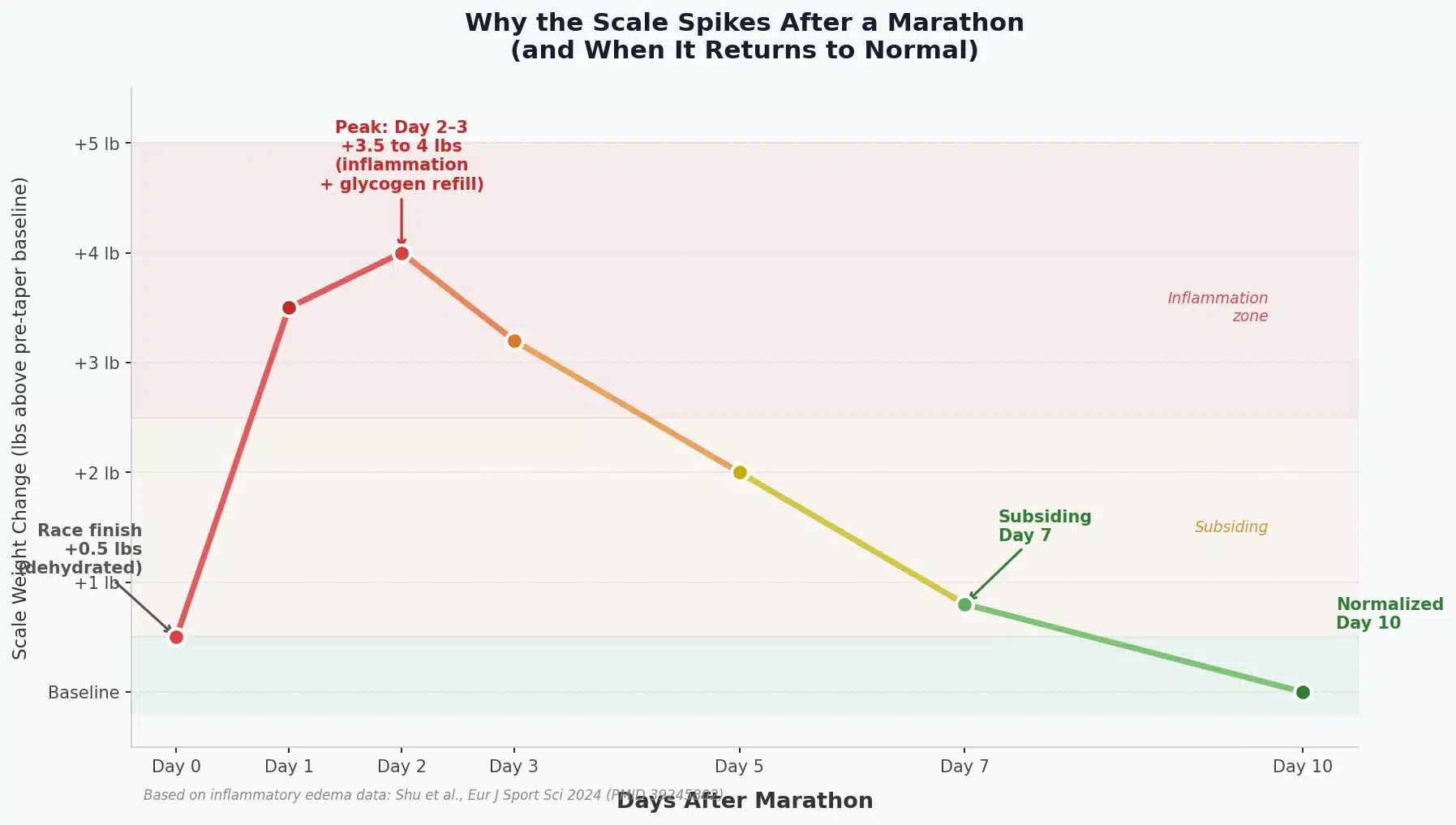
The muscle damage from a marathon produces an inflammatory response that peaks in the 24 to 72 hours after the race.
MRI imaging of recreational marathon runners found significant inflammatory edema in all thigh muscles at both 2 to 3 hours and 24 hours after a half-marathon, with T2 signal values remaining elevated across every measured muscle group through the following day.
That fluid retention is what the scale is reading.
The same damaged muscle fibers pulling fluid during your marathon recovery are pulling fluid into the tissue as part of the repair process.
At the same time, your body is aggressively restoring glycogen stores depleted during the race.
Each gram of glycogen rebuilt brings 3 grams of water with it.
That is the same refueling mechanism described in the training section above, now operating in reverse as depleted stores refill.
How Long Does Post-Marathon Weight Gain Last?
Most of the scale increase resolves within three to seven days as inflammation subsides and your body stabilizes its hydration.
A well-structured marathon recovery plan that prioritizes sleep, adequate protein, and controlled activity during that first week helps the process move faster.
By day seven to ten post-race, most runners return to their pre-taper scale weight or lower.
Weigh yourself no earlier than ten days after a marathon, because the number before then reflects temporary inflammation and glycogen loading, not your actual body composition.
If weight remains elevated past two weeks without returning to baseline, the more likely explanation is the recovery eating pattern: post-race meals that exceed what the body needed to repair.



12 Responses
Thank you for this article. As an avid exerciser and group fitness instructor I am used to being very lean and toned. I have maintained the same weight for a long time (5’6″ 106-107 pounds) and workout (admittedly) like a crazy girl! I am super interested in nutrition and cook all of my families meals from scratch and eat a GF diet and feel great. Then I started the long-run portion of training for my first marathon……….I have upped my calories a bit, upped my protein about 25%, and started really being good about my water (170oz/day) but have noticed a lovely 3-4 pound increase on the scale. Had my body fat tested and it was 10.1! Yikes! I have been wondering what I have been doing wrong and this article has been a great starting point to help me figure out how this change in training is affecting my body. BTW, I run about 40 mi/week and alternate with stair mill, xbike, bootcamp classes, weight lifting, interval training, bikram yoga, etc….
‘The average body fat percentage for U.S. females is around 32%, with the ideal at 22%. Athletic females should be around 15-20%. You could have an eating disorder if you are below 10%. Remember these are guidelines; your physician should help you determine the ideal weight and body fat for you.’
Thank you for the article! The article helped me recall what my intuition was telling me. I’m trainning for my 19 marathon and I want to qualify for the Boston Marathon. I am 36 and I need to qualify at 3:10… Anyhow, I weigh 185 and I realizing more and more that if I want to fulfill my dream, I need to empower myself with the knowledge of the basic numbers (calories burned, carbs needed, etc)
I am 100% discouraged that I don’t know what to do, so here I am. I’m training for a marathon in July and I have run a total of 32 miles in 6 days. Eating no more than 1300 healthy calories a day (if even that. e.g. fresh salads, cooked egg whites, onions, apples, bananas, fiber cereals, unsweetened almond milk, greek yogurt, veggie and roast beef sandwiches and pears).
I have gained 5 pounds and am at a weight I haven’t seen in 3 years!! This has never happened to me before, I feel like giving up and on top of everything my clothes are NOT fitting any better, so there’s no toning situation going on here. My clothes are actually tighter!! I’m just literally gaining weight everywhere.
My breathing has improved, but that’s about it. I’m exhausted and this makes no sense. My body is beyond stupid. I have trained and run before (for a half marathon), but this did NOT happen (I did not train as hard then though). Nonetheless, I am beyond discouraged.
The article above makes sense (and I have a background in science, so I understand how the body adapts), but what’s going on with me is just absolutely ridiculous. How can I be gaining weight (and inches) when I’m running so much?
At this point, I’m seriously considering canceling the marathon. I can’t afford 5 pounds of weight gain per week plus my clothes feeling even tighter!!… I’m so lost right now. I feel fat and maybe I should just sit in a corner and eat all I want. At least that way I would at least enjoy and know that I deserve the weight gain.
Is there any hope for me or do I have to starve myself to end this madness???
Hi Rachel, it is likely that you are not eating enough, and your body is in a state of starvation where it is holding on to everything as it is not sure what is happening. Try to include more good fats in your diet; avocados, nuts, salmon, and try to increase your protein intake to make sure your body is able to continue working. Your weight will fluctuate during training, and 5lbs is not something you really need to worry about as the weight will likely come back off soon as your training volume continues to increase. This post may also help you calculate how many calories you need to consume. You definitely need to increase your caloric intake as your training continues. https://runnersconnect.net/running-nutrition-articles/why-you-might-gain-weight-while-running/ Hope this helps!
Actually, one thing. You burned 1600 during the run, but you’re probably going to burn 2k from the run with the post exercise metabolism spike. Not only this, but your body would burn 2k calorires at rest. So your 2k calorie lunch is actually just the tip of the iceberg for what you’d need to meet the days caloric needs.
HI Rachel, I am feeling you right now. I went from sedentary to walking every day and starting the C25K program. My intention was to regain my health AND lose weight, at least 15 lbs. I am in Week 3 of C25K, and walking at or more than 10,000K steps per day and I am gaining weight. Like you, the scale is climbing. I want to cry. This is NOT what I signed up for. I also cut out fast food, and went back to a mostly paleo diet – and I try hard to only eat organic, non processed foods. After getting on the scale today and seeing several extra pounds, I want to quit. Maybe I’m not eating enough? I am sure I haven’t increased my calorie consumption. If anything, it’s reduced because I’m not hitting McDonalds anymore.
Hi Molly, thanks for sharing. Sorry to hear about your struggles, but it is good that you have found someone else who is going through the same thing as you. Do not give up just yet, as we explained in this post, sometimes this happens at the start of training, stick with it, and the results will come. You definitely want to make sure you are eating enough, as otherwise your body will go into starvation mode and will cause you to retain everything. Check out this post also, it may help you make the right choices https://runnersconnect.net/running-nutrition-articles/weight-loss-running-performance/ Can we help with anything else?
I’m struggling with this, half way through training for my first marathon and gaining weight despite being petty good about what I eat, not over doing the carbs or over compensating after long runs. I’ve gained 4-5pounds and I feel heavy and awful. I was wondering if this is because I’ve chsbged from mostly tempo -10k half marathon runs focused on speed to a much slower pace overall for marathon training. Would this have an effect. I’m hoping it’s just extra muscle showing on the scale but as I feel petty podgy round the Middle I’m guessing not. I hate the thought of lugging these extra pounds round for 26.2 miles
Hi Jo, thanks for reaching out. Sorry to hear you are struggling. Hopefully this article brought you some comfort, hang in there, and give your body some time to adjust. Make sure you are taking our recommendations into account, as you see, many other runners go through the same thing. Try to focus more on feeling good within your runs, and the weight will take care of itself, that stress will make your body feel something is wrong, and it will cling on to weight even more. The slowing down of your pace may make a little difference, but it will actually help you in the long run as you are going to feel better on your runs, which means you can handle more, and get to the higher intensity training that will help even more. Hang in there! Hope this helps.
I just finished my first marathon. I have gained a few pounds also during training and I have a theory. It may just pertain to me but here goes. I probably took in way too many calories which were primarily carbs. Also I don’t think my body responds well to steady state cardio. I have been running now for seven years and at first it helped me lose weight. Now my body has become so used to it that it no longer works for weight loss. I did some cross training but obviously not enough to make a difference. So now planning on focusing on circuit training, resistance training, and yoga with less running. Will be training for my second marathon beginning in January so I will try not to make the same mistake again. I don’t think I need all those carbs. Also factor in that I am 51 (years young :))
Hi Lorraine, you are correct, over time your body does adjust to exercise and you will lose less than you did initially. It would be greta for you to add in some intervals of intensity to kick starr your metabolism. You can back off the dense carbs a little, try to use lower calorie substitutes such as spaghetti squash instead of pasta noodles or cauliflower crust pizza instead of regular crust. Hope this helps, here is a little more on metabolism to show you that you were thinking in the right direction https://runnersconnect.net/running-nutrition-articles/weight-loss-and-metabolism/
We also can tailor a nutrition plan to you if you are interested in our program, we would be happy to direct you towards it if you like! Hope this helps!