
Mile 18 of your first marathon.
Your legs feel heavy and your breathing is ragged, and the finish line is still 8 miles away.
A month earlier, a coach at a clinic walked you through Jeff Galloway’s run-walk-run method: run for a set interval, walk for a short one, repeat from the start line.
So you settle into it. Run 90 seconds, walk 30 seconds, again and again.
By mile 24, runners who pushed straight through are shuffling. You’re still moving on rhythm, hitting your walk breaks on schedule.
You cross the line closer to your goal than you expected, and you’re not wrecked.
That outcome is what Jeff Galloway built the run-walk-run method to produce for everyday runners.
So, in this article you’re going to learn the research-backed practical advice on:
- Who Jeff Galloway is and where the run-walk-run method came from
- What the method actually is and the exact run:walk ratio to use for your pace and goal
- Whether strategic walk breaks reduce injury risk, and what the research says
- Whether run-walk slows your finish time, and what a marathon study found
- How to start run-walk training, choose your timer, and progress your ratio
Who Is Jeff Galloway and How Did the Run-Walk-Run Method Start?
Jeff Galloway is a 1972 US Olympian who ran the 10,000m in Munich and later became one of the most influential coaches in recreational distance running.
He developed the run-walk-run method in the mid-1970s while coaching beginning runners who kept breaking down when they tried to run every step of a long training block.
His idea was simple: insert short walk breaks from the very first mile, before fatigue arrives, so the walk becomes a planned tool rather than a collapse.
That approach turned into the Galloway method, now used by hundreds of thousands of runners through his training programs, books, and race groups.
His wife, Barbara Galloway, co-coaches the Galloway programs and helped build the women’s coaching side of the organization.
Barbara is a co-coach and program leader. Jeff is the runner who created the method and gave it his name.
The method grew from one observation Jeff made across thousands of runners: continuous running for 26 miles is not required to finish, and for most runners it raises injury risk without improving the result.
What Is the Run-Walk-Run Method?
The run-walk-run method is a pacing strategy where you break a run into repeating segments of running and walking from the start, instead of running continuously until you tire.
You run for a set time, walk for a shorter set time, then repeat that cycle for the whole distance.
The walk break is real walking at a natural pace, not a jog or a shuffle.
During that break your breathing settles, your running muscles get a short recovery, and your form resets before the next running segment.
The point is to take the walk break early and on a fixed schedule, while you still feel strong, rather than waiting until mile 20 forces you to stop.
Runners who wait until they’re exhausted are recovering from damage. Runners using Galloway’s method are preventing it.
Walk breaks work best when they’re planned from mile one, not saved as an emergency at mile 20.
RunnersConnect Bonus
Download your FREE Long Run and Aerobic Pacing Calculator now.
Need help converting your race times to your optimal easy and long run pace? Download our FREE calculator and we’ll do the math for you.
What Run-Walk Ratio Should You Use?
The right run:walk ratio depends on your current fitness, your goal pace, and the distance you’re covering.
A brand-new runner needs more walking. An experienced marathoner running 8:00/mi (4:58/km) needs only a brief, strategic break to hold pace late in a race.
The table below gives starting ratios by goal pace. Treat each one as a starting point to test on a long run, then adjust based on how strong you feel in the final miles.
| Runner / goal pace | Starting run:walk ratio | Best used for |
|---|---|---|
| New runner, slower than 12:00/mi (7:27/km) | 15–30 sec run : 30–60 sec walk | Building running tolerance safely |
| Beginner marathon, 10:00–12:00/mi (6:13–7:27/km) | 2:00 run : 1:00 walk | The classic Galloway starting ratio |
| Intermediate, 9:00–10:00/mi (5:35–6:13/km) | 4:00 run : 1:00 walk | Long runs and easy volume |
| Experienced, 8:00–9:00/mi (4:58–5:35/km) | 6:00–8:00 run : 30 sec–1:00 walk | Marathon race pace with recovery |
| Sub-4 marathon, faster than 8:00/mi (4:58/km) | 9:00 run : 1:00 walk, or 6:1 | Holding late-race pace strategically |
| Ultramarathon or very long day | 3:00 run : 1:00 walk, or 1:1 late | Preserving legs over many hours |
Faster goal paces call for a higher run-to-walk ratio, because the walk break becomes a strategic reset rather than a large share of your time.
The most common mistake is guessing your ratio and never testing it. Run two or three long runs at a chosen ratio and watch how your last few miles feel before you lock it in.
Pick your ratio by goal pace, then test it on long runs before you commit to it for race day.
Does the Run-Walk-Run Method Reduce Injury Risk?
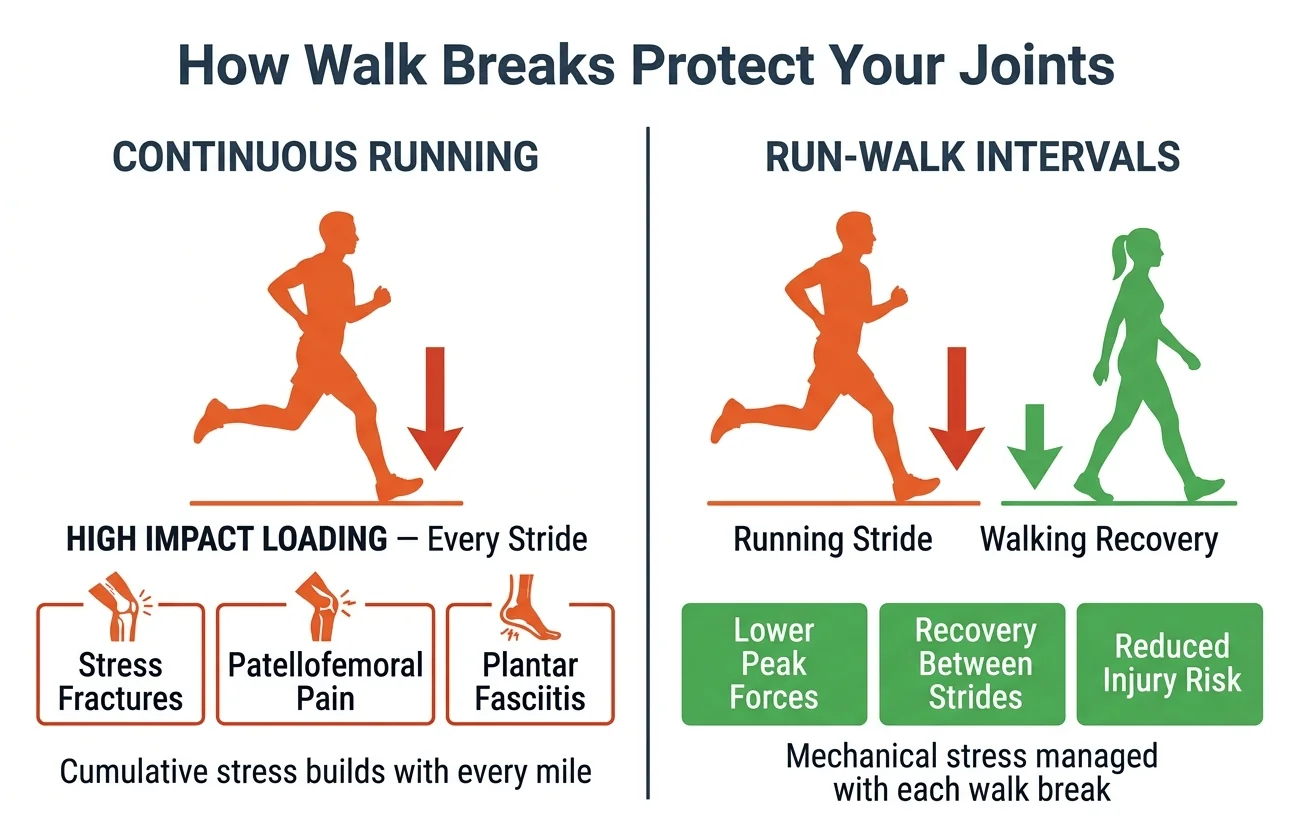
Strategic walk breaks lower the total mechanical load your legs absorb across a training block, which is the load that drives most overuse injuries.
Every footstrike in running sends a ground reaction force up through your feet, shins, knees, and hips.
Those forces add up mile after mile, and across a 16-to-20-week marathon build the cumulative load is what triggers stress fractures, tendon pain, and knee problems in runners who ramp up too fast.
Research has shown that higher vertical impact loading during running is linked to stress fractures, patellofemoral pain, and plantar fasciitis, the most common overuse injuries in distance runners.

Walking produces far lower peak impact forces than running.
Each walk break swaps a stretch of high-impact loading for low-impact loading, which gives your bones, tendons, and joints repeated windows of reduced stress across the run.
For a runner coming back from a bone stress injury, that lower-impact structure is why a graduated walk-run progression is a standard part of return-to-running programs.
A 2024 review of returning to running after a tibial bone stress injury supports a graded walk-to-run progression as the safe path back to full running.
That is why the method took hold in recreational marathon training. It manages the cumulative pounding of distance running instead of just spreading it out.
Does Run-Walk Actually Slow You Down? What the Research Shows
The fear that keeps runners from trying walk breaks is losing time, and a marathon study put that fear to a direct test.
In a study of 42 marathon runners, a run/walk group and a run-only group finished with statistically similar times, and the run/walk group reported significantly less muscle pain and fatigue afterward.
The run/walk finishers averaged 4:14 and the continuous runners averaged 4:08, a gap small enough that it was not statistically meaningful for these runners.
So for most non-elite runners, walk breaks cost little or no time on the clock while cutting how beat-up you feel at the end.
The reason ties back to fuel and fatigue.
A meta-analysis confirms that muscle glycogen is the primary fuel for endurance exercise and a key regulator of when fatigue sets in.
When you run continuously, you draw down glycogen at a steady rate, and by the late miles low fuel forces the slowdown most marathoners know as the wall.
Each walk break drops your intensity briefly, which slows how fast you spend glycogen and pushes that fatigue point later in the race.
The result is running segments that stay strong deep into the race instead of degrading into a shuffle by mile 22.
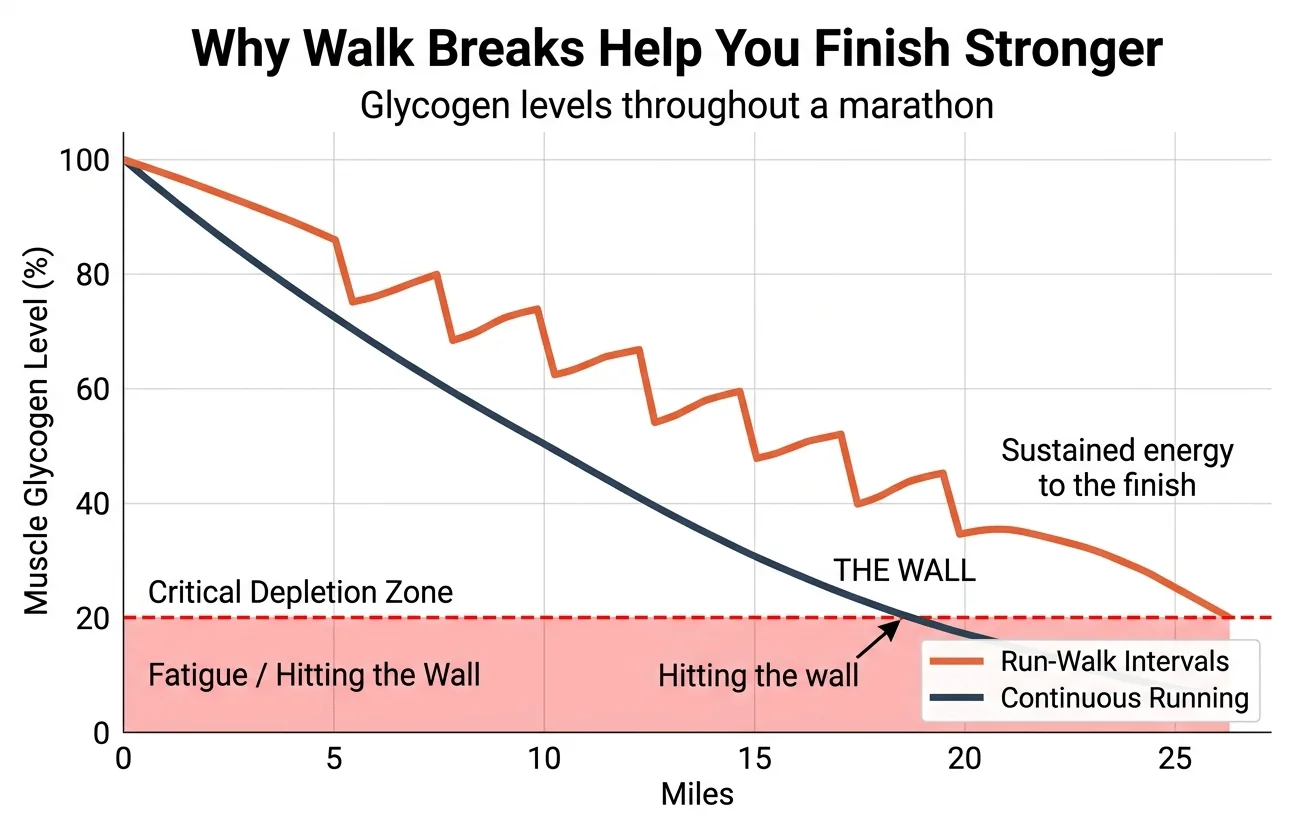
For most non-elite runners, planned walk breaks produce similar finish times to continuous running with far less late-race fatigue.
Who Benefits Most from Run-Walk-Run Intervals?
Run-walk-run is often labeled a beginner method, which is the misconception that keeps stronger runners from using it.
Walk breaks help runners across every experience level, for different reasons.
Beginners gain the most obvious benefit: lower injury risk while tendons and bones are still adapting to running stress.
Marathoners and ultramarathoners, including some with fast personal bests, use short strategic breaks to hold pace and protect their legs in the final miles.
Runners returning from injury use walk-run intervals during the graded comeback phase to rebuild aerobic fitness while tissue recovers.
Masters runners over 40 gain from the joint-friendly loading, which keeps them logging distance for more years.
The common thread is the same across all of them. Walk breaks lower cumulative mechanical load while keeping the aerobic system working.
The run-walk method serves competitive marathoners and ultrarunners, not only first-timers.
How Do You Start Run-Walk-Run Training?
Starting run-walk training comes down to three choices: your ratio, your timer, and your progression.
First, pick a starting ratio from the table above based on your goal pace, and begin with a conservative one if you’re unsure.
Second, set a timer so you never have to think about when to break.
A dedicated interval app like the Galloway app, a run-walk setting on your GPS watch, or a simple repeating interval timer all work.
Third, run your walk breaks as real walking, at natural walking pace.
Running your walk portions too fast is the most common error, and it erases the recovery that makes the method work.
For your running segments, use effort, not pace, as the guide. You should be able to speak in full sentences during the run portion.
Use run-walk intervals for easy runs and long runs, where staying healthy and aerobic is the goal.
Keep hard sessions like tempo runs and interval repeats as continuous efforts, since their job is to build threshold and VO2 max rather than accumulate distance safely.
Progress the ratio in 2-to-3-week blocks, shifting from 2:1 toward 4:1 or 5:1 only once you finish your long runs feeling strong.
For the full framework and sample structure, the run-walk method guide walks through it in detail.
Start conservative, walk your walk breaks at a true walking pace, and only increase the ratio once your long runs feel strong.
Run-Walk-Run vs. Continuous Running: Which Should You Choose?
Run-walk and continuous running are tools for different jobs, and the better choice depends on your goal and your current health.
Choose run-walk for long runs, marathon and ultra training blocks, and any phase focused on building base while protecting your body.
Choose continuous running for speed work, shorter races like the 5k and 10k, and stretches when you’re healthy and pushing fitness.
Most well-built plans use both: run-walk for the bulk of the weekly volume, continuous running for the harder quality sessions.
Some runners keep walk breaks through an entire cycle. Others use them only for their longest runs.
Match the method to the goal in front of you, and change it as your fitness and injury status change through the season.
The Bottom Line on the Galloway Run-Walk-Run Method
Jeff Galloway’s run-walk-run method is a research-supported way to cover distance with less impact stress and less late-race fatigue.
Planned walk breaks lower cumulative mechanical load, slow the glycogen drain that causes the wall, and for most runners cost little or no time on the clock.
That combination is why hundreds of thousands of recreational marathoners use it to finish strong and stay healthy.
If you’re building toward a first marathon, chasing a goal race, or returning from injury, choosing a ratio and running your walk breaks on schedule is one of the highest-return changes you can make.
Start conservative, test your ratio on long runs, and let the results in your final miles guide how you progress.