

Pain on the outside of your ankle or foot is hard to place, because it doesn’t match the running injuries you hear about most, like Achilles tendonitis or plantar fasciitis.
So it’s easy to keep running on it while the ache along the outer edge of your foot builds a little more each week.
When that pain sits just behind the bony bump on the outside of your ankle, or along the outer edge of your foot, the peroneal tendons are a likely source.
So how can you tell if you have peroneal tendonitis, and what should you do to get back to running?
To give an evidence-based answer, let’s look at the research on:
- What the peroneal tendons do and where peroneal tendonitis hurts
- How to tell it apart from a stress fracture in your foot
- Why high arches, old ankle sprains and fast running raise your risk
- The exercises and running changes that help the tendons recover
What Is Peroneal Tendonitis?
Peroneal tendonitis is an overuse injury to one or both of the tendons that run along the outside of your ankle.
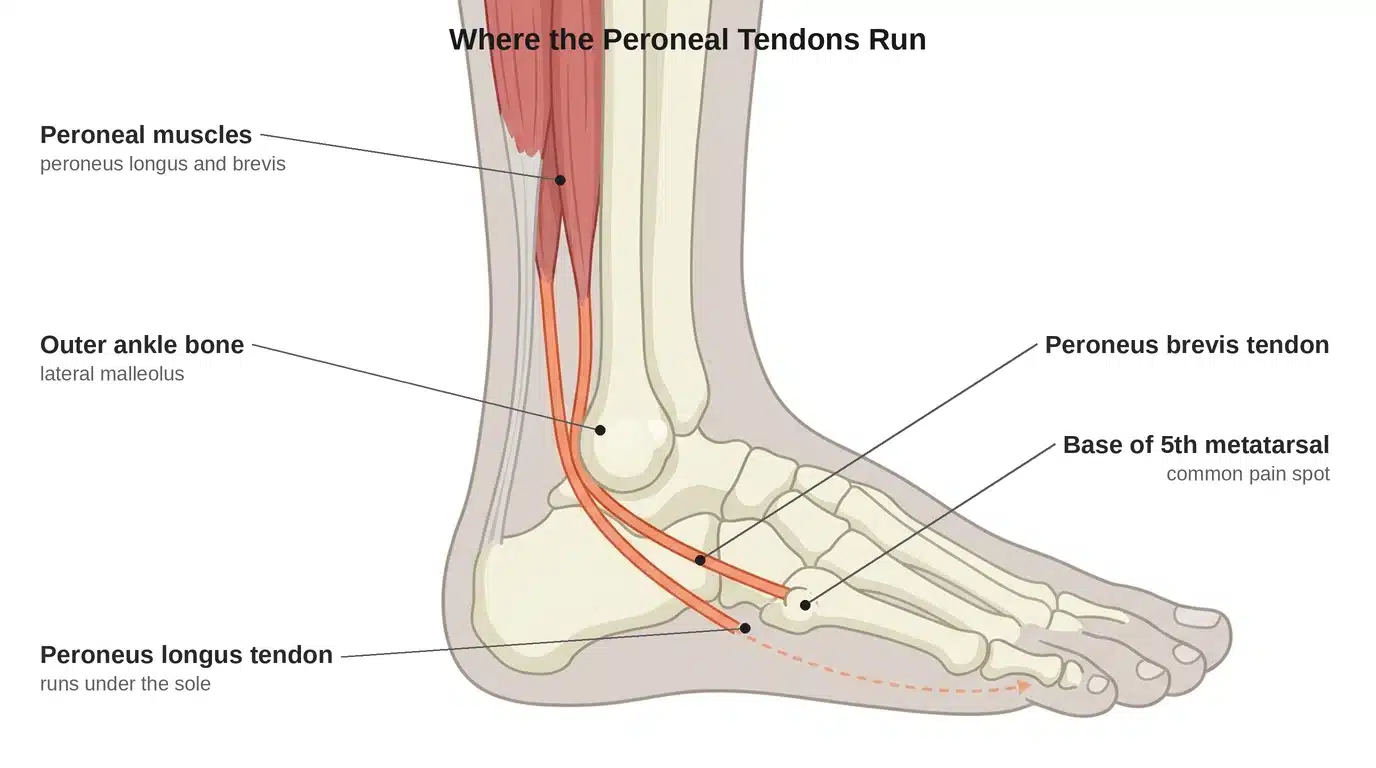
2 muscles on the outside of your lower leg, the peroneus longus and the peroneus brevis, turn into tendons just above your ankle.
Both tendons curve behind the bony bump on the outside of your ankle before they reach your foot.
The peroneus brevis attaches to the base of your fifth metatarsal, the long bone on the outer edge of your foot that leads to your little toe.
The peroneus longus runs underneath your foot and attaches near the base of your big toe.
Together, these 2 muscles turn the sole of your foot outward and help keep your ankle steady each time your foot hits the ground.
Tendon researchers argued in 2002 that painful overuse tendon injuries involve changes in the tendon itself rather than inflammation, which is why you’ll also see the term “tendinopathy.”
Both names describe the same injury, so this article uses peroneal tendonitis.
RunnersConnect Bonus
Download the Peroneal Tendonitis treatment exercises and plan.
It’s a PDF with the conservative and aggressive treatment options for runners suffering from peroneal tendonitis.
What Does Peroneal Tendonitis Feel Like?
Peroneal tendonitis usually feels like a sharp pain or a dull ache along the outside of your ankle and foot that gets worse as you run.
The most common signs are:
- Pain behind or just below your outer ankle bone, where both tendons curve around it.
- Pain along the outer edge of your foot that runs toward the base of your fifth metatarsal.
- Pain when you turn your foot outward against resistance, such as pushing the outside of your foot against a wall.
- Stiffness when you circle your ankle or stretch your foot inward.
The pain usually builds the longer and faster you run.
Is It Peroneal Tendonitis or a Stress Fracture?
Pain on the outer edge of your foot can also come from a stress fracture in your fifth metatarsal, which needs different treatment.
With peroneal tendonitis, the tenderness sits on the tendon behind or below your outer ankle bone, and the bone on the outside of your foot shouldn’t hurt when you press it.
A stress fracture is more likely when the bone itself is tender to touch, or when your foot aches while you’re standing or resting.
If pressing on the bone along the outside of your foot hurts, or your foot aches at rest, get checked for a stress fracture before you run on it again.
This guide on where runners are most likely to get a stress fracture covers the early warning signs.
What Causes Peroneal Tendonitis in Runners?
Research on what causes peroneal tendonitis comes from small groups of patients rather than large trials.
Even so, a few risk factors stand out, and you can manage each of them.
Do High Arches Cause Peroneal Tendonitis?
A high arch is the risk factor with the clearest link to peroneal tendon injuries.
A 2000 review of 22 people with peroneus longus tendon injuries found that 82% had a high-arched foot with the heel tilted inward, and the group as a whole sat in the top 10% of the general population for arch height.

In 17 of those 22 people, the damage sat where the peroneus longus turns under the outside of the foot.
About a third of the 22 people also had damage to the peroneus brevis, so rehab needs to work both tendons.
An international consensus statement from a panel of 16 specialists in 9 countries agreed that the constant load a high-arched foot puts on these tendons may set them up for injury.
Your arch also changes which shoes suit you, and this breakdown of how arch height affects your shoe choice and injury risk walks through the options.
Can an Ankle Sprain Lead to Peroneal Tendonitis?
Ankle sprains and peroneal tendon injuries often show up together, and the link runs in both directions.
A 2016 study of 58 runners who sprained an ankle after up to 4 weeks of pain over their peroneal tendons found tendon damage on MRI in 55 of them, or 95%.
The researchers concluded that treating peroneal tendon pain early may help prevent a sprain.
People whose ankles keep giving way after a sprain also tend to have weaker peroneal muscles.
A 2020 review of 20 studies found that people whose ankles kept giving way after a sprain had weaker muscles for turning the foot outward than people without ankle injuries.
Those are the peroneal muscles, which is why strengthening them is the core of the rehab below.
Does Fast Running Make Peroneal Tendonitis Worse?
Faster running asks more of the peroneus brevis than easy running does.
A 1993 study that recorded muscle activity in 15 runners found that the peroneus brevis worked significantly harder as their running pace increased.
That means a jump in interval sessions, tempo runs or races may overload the tendon even when your weekly mileage stays the same.
How Do You Treat Peroneal Tendonitis?
Exercise-based rehab is the first treatment to try.
The same consensus statement recommends conservative treatment for every peroneal tendon problem before anything else.
The panel also agreed that you should avoid locking your ankle in a boot or cast, and start loading the tendons with exercise once walking no longer hurts.
No controlled trial has tested a structured exercise program for peroneal tendonitis.
The closest model comes from the posterior tibial tendon, which runs along the inside of your ankle and does the opposite job of turning your foot inward.
A 2006 study of 47 people with posterior tibial tendon injuries found that 83% recovered with an orthotic and a high-repetition home exercise program, and only 11% needed surgery.
Patients in that study took a median of 4 months to finish the program.
The 3 exercises below adapt that high-repetition approach to the outside of your ankle.
How Do You Do Banded Eversions?
Banded eversions strengthen the peroneal muscles directly, because turning your foot outward is their main job.
Sit with your leg straight and loop a light resistance band around the ball of your foot, with the other end anchored to the inside of your foot.
Turn the sole of your foot outward against the band, then let it return slowly.
Work up to 200 repetitions a day, split into as many sets as you need, then move to a stronger band.
Should You Do Calf Raises for Peroneal Tendonitis?
Calf raises belong in your rehab, because the peroneal muscles help your calves point your foot down every time you push off.
Stand on the edge of a step on one foot, rise up onto your toes, then lower your heel slowly below the step.
The 2006 program used 50 single-leg heel raises with little or no pain as one of its goals for finishing rehab.
How Does Balance Training Help Peroneal Tendonitis?
Single-leg balance exercises train your ankle to hold steady on one foot, which is the peroneal muscles’ job on every running step.
Start by standing on your injured leg until you can hold it for 2 and a half minutes without stopping.
Then make it harder by closing your eyes, rotating your upper body, or standing on a foam pad.
Can You Keep Running With Peroneal Tendonitis?
You can often keep running while you rehab, as long as the pain stays mild and doesn’t get worse from week to week.
A 2007 trial of 38 people with Achilles tendon pain found that the people who kept running and jumping while tracking their pain improved as much over 12 months as the people who stopped for 6 weeks.
That trial was in the Achilles tendon, so use it as a guide for the peroneal tendons.
Mild pain that stays steady during a run is a sign the tendon is handling the load.
Pain that climbs as the run goes on, or that makes you change your stride, means you need to cut back.
Cut your fast sessions first and keep your easy running, since faster running loads the peroneus brevis more.
Once your rehab exercises and easy runs no longer hurt, add lateral line jumps to load the tendons at a quicker speed before you return to faster running.
When Should You See a Doctor for Peroneal Tendonitis?
See a doctor or physical therapist when rehab isn’t working, or when the pain doesn’t behave like a simple overuse injury.
Get your ankle checked if:
- You still can’t put full weight on your foot a week or two after a sprain.
- Your pain started with an ankle sprain and hasn’t settled, because a sprain can tear a peroneal tendon as well as a ligament.
- You feel a snap or pop behind your outer ankle bone, which can mean the tendons are slipping out of their groove.
- The bone on the outside of your foot hurts to touch, which points toward a stress fracture.
- You’ve done 3 months of rehab and your pain hasn’t improved.
A 2020 review of peroneal tendon injuries in athletes notes that rehab remains the first treatment for overuse injuries, but tendons that keep slipping out of place often need surgery.
For pain that lasts beyond 3 months, the consensus panel supported shockwave therapy, and it found too little evidence to recommend platelet-rich plasma injections.
If you feel a snap or pop behind the bony bump on the outside of your ankle, see a foot and ankle specialist before you run again.
An MRI can show whether a tendon is torn, and the 2000 review found that MRI findings closely matched what surgeons later saw, though MRI tended to overstate the damage.
What Should You Do About Peroneal Tendonitis?
Here’s a summary of how to spot peroneal tendonitis and what to do at each stage.
| Question | What the research shows | What to do |
|---|---|---|
| Where does it hurt? | Behind or below the outer ankle bone, or along the outer edge of the foot | Press the bone on the outside of your foot. If the bone hurts, rule out a stress fracture first |
| Who gets it? | 82% of people in a 2000 review had high arches, and 95% of runners who sprained an ankle after up to 4 weeks of peroneal pain had tendon damage on MRI | Treat early pain over the tendons rather than running through it |
| Does pace matter? | The peroneus brevis works harder as running pace increases | Cut intervals and tempo runs before you cut easy running |
| What is the first treatment? | Experts recommend exercise-based rehab and no boot or cast | Banded eversions up to 200 a day, single-leg calf raises and single-leg balance |
| Can you keep running? | Running with pain monitoring didn’t slow recovery in Achilles tendon pain | Keep running if pain stays mild and doesn’t build from week to week |
| When should you see a doctor? | Shockwave therapy is an option after 3 months, and slipping tendons often need surgery | Get checked after a snap or pop, a sprain that won’t settle or 3 months without progress |




8 Responses
My eyes didn’t want to believe when I saw this article, you describe point-by-point everything that I needed to know about this injury and a way to fix it that totally makes sense.
After almost 2 years in useless visits to doctors and physical therapists, this is a glace of fresh air and hope. I started yesterday the exercises and they feel so good, it really makes sense. Thank you so much.
There is another cause of peroneal tendinitis. While it seems pretty rare it’s something I’m dealing with right now. Some people have accessory navicular (an extra bone in their foot). Usually this “extra bone” is on the inside of the foot, but in my case it’s on the outside by the fifth metatarsal. It’s been there my entire life, but it hasn’t started causing issues with my peroneal tendon until recently.
The treatments you’ve documented are pretty much the same as what my doctor prescribed with one addition. Since I actually have a fairly low arch she recommended wearing a foot/ankle brace that helps to turn the foot outwards. That takes some pressure off the tendon.
I believe I have the exact problem you have. An extra bone in the upper part of my foot and a fairly arch. My pain started three months ago with first a painful calf strain, then to an achilles heel tear and now Peroneal Tendonitis pain on the inside and outside of my ankle. Went to a sports doctor who didn’t help. Who should I see. Can you recommend a special wrap or brace to help?
Anyone dealing with this injury? Post a comment and we’ll do our best to help you out.
i have been diagnosed with plantar fasciitis and peroneal tendonitis! I have had orthotics (cast) made, have had injections, MRI!! My podiatrist wants to build up my arch every time i go in or do more injections in my arch!! my arches, heels and outside of my foot on the 5th metatarsal and the pain runs up my calf, hurts every time I walk, weather standing or moving! I have tried taping my ankle with no relief! I wear brooks with my orthotics, i am having a hard time making it through my 12 hour shift at work the pain is unbareable!!
I am working through the issue right now. I have been using a trigger point foam roller on IT band and lower calf along along with a Rogue supernova ball for isolated treatment directly above and behind the ankle. Been at it for a week and noticing significant progress. This treatment approach also worked when I had intense knee pain that was a result of a tight IT band. I find most tendon issues can be addressed with mobility exercises on a roller as with some type of ball and the that pain is caused by an area without pain, so you have to go hunting for it.
I think I have a Peroneal injury in BOTH feet at the same time??? Is it even possible?
Last Saturday, I went for a run that was longer than my usual. I usually do 7-12K, and this time I did 16K. (Not bright…I know) . Felt fine that day and night. The next day mid morning, I was at the market and suddenly it felt like knives were being stuck in the sides of my feet with each step. I hobbled my way home, and have been using Ice and Ibuprofen every since. As of today (Wednesday) I feel a little better, but still not great. It hurts way more when I wear shoes. It hurts less if I walk on my toes and avoid my heel striking the ground.
I see other posts about this, but have not seen a case where both feet are affected. I talked to friends who train pretty hard and they have never heard of this happening in both feet. Could it be from my shoes since it is in both feet?
If anyone has any insight into this, I would really appreciate it. I am really bummed because I felt great after the run and was looking forward to doing longer runs, and now it feels like I will not be running for quite some time.
Thanks!
Arrived at this helpful page as I am into this mysterious injury week 5 now but to be clear there are three main factors that have given my Peroneal tendonitis condition:
1/ Arched foot
2/ Speed and interval training more than once a week
3/ Some of the interval course (a road) has a slight slant for a small bit. Not advisable a coach told me later
So being impatient and stubborn I thought after 3 days rest and icing I’d be fine and did jogging and speed walking for the first week after despite some pain. Major fail. I’ve had to start all over again from scratch and do the 2-3 weeks with no running and little walking. This injury plays with your head and you think ok let’s get back to running. Avoid this temptation!
Happy running all
My advice to anyone who even thinks they have this injury is to do absolutely no running for about a month. Do the exercises as outlined above. Even then you may think you are ready to hit the road with some 75-90% interval efforts. I’d stay clear of that for another month.