Training Articles

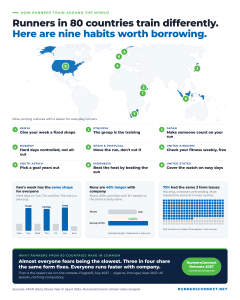
Lessons learned from runners in 20 countries
Over the last few years, about 240 runners from our coaching community in more than 20 countries came to our running retreats. They came from

Over the last few years, about 240 runners from our coaching community in more than 20 countries came to our running retreats. They came from


Hot packs warmed deep hamstring muscle just 0.4°C (0.7°F). Learn when heating pads, hot baths and Icy Hot help before a run, and when you should skip them.

Aerobic running means running easy enough to fuel your muscles with oxygen. Even a 1,500 m race is about 80% aerobic. Learn how to check your aerobic pace.

A slow jog warms you up for easy runs. Before workouts and races, add drills and strides. Get the routine, the stretching research and how long to warm up.


A short, easy run the day before a race beats a full rest day. Here is how far to run before a 5K, 10K, half marathon or marathon, and when to skip it.

Blood lactate can hit 15 to 25 mmol/L after a sprint. See why lactic acid burns when running, whether it makes you sore, and how to clear it. Learn more.


A 10% hill is only a 5.7-degree slope. See what hill gradient means, how to measure any hill, the best grade for hill sprints, and a beginner sprint plan.

Two groups of runners with the same 10K time ran 90 minutes at threshold. The group that never ran longer than 70 minutes lost nearly twice as much running economy. Here’s what that means for your pace and the training habits linked to holding it.

Double threshold training means 2 threshold sessions in 1 day. See what elites run and 5 single-session workouts that give you the same benefit. Learn more.

In Strava data from 158,000 marathoners, a strict 3-week taper was linked to a finish 5 minutes 32 seconds faster than a minimal taper, yet about 69% of runners let their mileage climb back up mid-taper. Here is how that relaxed taper affects your race, why a rest-only taper backfires, and how much to cut each week.