

Plyometrics, the quick jumping and bounding exercises you usually see sprinters do, have become one of the most common pieces of strength advice for distance runners.
And there’s good reason for it, because a 2003 study found that runners who added 6 weeks of plyometrics to their normal training ran a 3K 2.7% faster.
For a runner who covers 3K in 15 minutes, that’s about 24 seconds faster from 2 to 3 short jumping sessions a week.
But the newer research shows that jumps on their own aren’t what produce the biggest improvements.
So, do plyometrics make you faster, and how should you fit them into your training?
To give an evidence-based answer, let’s look at the research-backed practical advice on…
- Why runners who combined jumps with heavy lifting improved their race performance about twice as much as runners who only lifted heavy
- The paces where plyometrics improve your running economy the most, and why that’s good news if most of your running is slower than about 8:00 per mile (5:00/km)
- How many weeks it takes before plyometrics make a measurable difference
- The 5 plyometric exercises to start with, and when to keep or cut them based on your race distance
How Do Plyometrics Make You a More Efficient Runner?
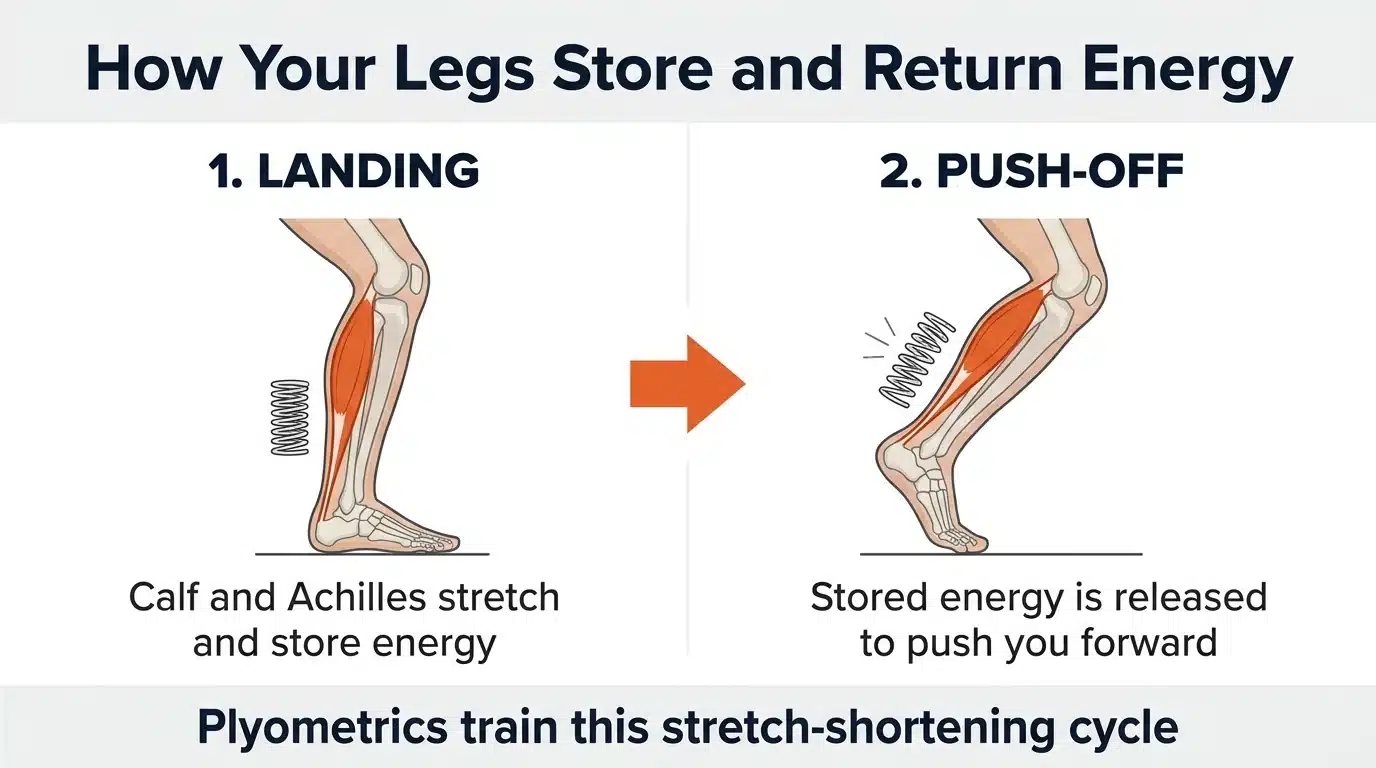
Plyometrics make you more efficient by training your legs to store energy when your foot lands and give it back when you push off.
This is called the stretch-shortening cycle, and it happens with every stride you take.
When your foot hits the ground, your calf muscles and Achilles tendon stretch under your body weight and store elastic energy, the same way a spring does when you press it down.
As you push off, that stored energy is released and helps propel you forward, so your muscles don’t have to produce all of that force on their own.
Plyometric exercises train this cycle directly, because each jump asks you to land and leave the ground again as quickly as possible.
The result is better running economy, which is how much oxygen you use to hold a given pace.
The less oxygen you need at a given pace, the longer you can hold it before you tire.
The runners in that 2003 study used less oxygen at every pace they were tested at after the plyometric program, and their lower legs got stiffer, meaning the muscles and tendons sprang back faster on each landing.
Their VO2max, the most oxygen their heart and lungs can deliver, didn’t change at all.
That means the 2.7% faster 3K came from their legs using energy more efficiently, since their heart and lungs were no fitter than before.
Do Plyometrics Make You Faster Without Heavy Lifting?
Plyometrics on their own have a smaller effect on race performance than heavy lifting does.
A 2024 review pooled strength training studies on 894 middle- and long-distance runners and compared plyometrics, heavy lifting, and programs that combined two or more methods.
Heavy lifting in this review meant lifting weights at 80% or more of the most you can lift for one rep.
The review found that runners who combined two or more types of strength training improved their race performance about twice as much as runners who only lifted heavy, while plyometrics alone produced no clear improvement.

That means jumps work best when you add them to a strength routine that already includes heavy lifting.
The simplest way to do this is to put your jumps at the start of your lifting session, while your legs are fresh, and follow them with your heavy lifts.
Get Your Strength Plan PDF & Video
Get a sample weekly plan so you can tailor your strength workouts to your race distance.
This PDF will give you a weekly calendar you can follow based on your race distance plus video links to specific strength routines you can try.
GET MY GUIDE
At What Pace Do Plyometrics Help Most?
The early research made it look like plyometrics only helped at fast paces.
In a 2006 study of highly trained distance runners, 9 weeks of plyometrics improved running economy by 4.1% at 5:22 per mile (3:20/km), but not at 6:54 or 6:02 per mile (4:17 or 3:45/km).
But, a 2024 review that pooled running economy studies from runners of every level found a different pattern.
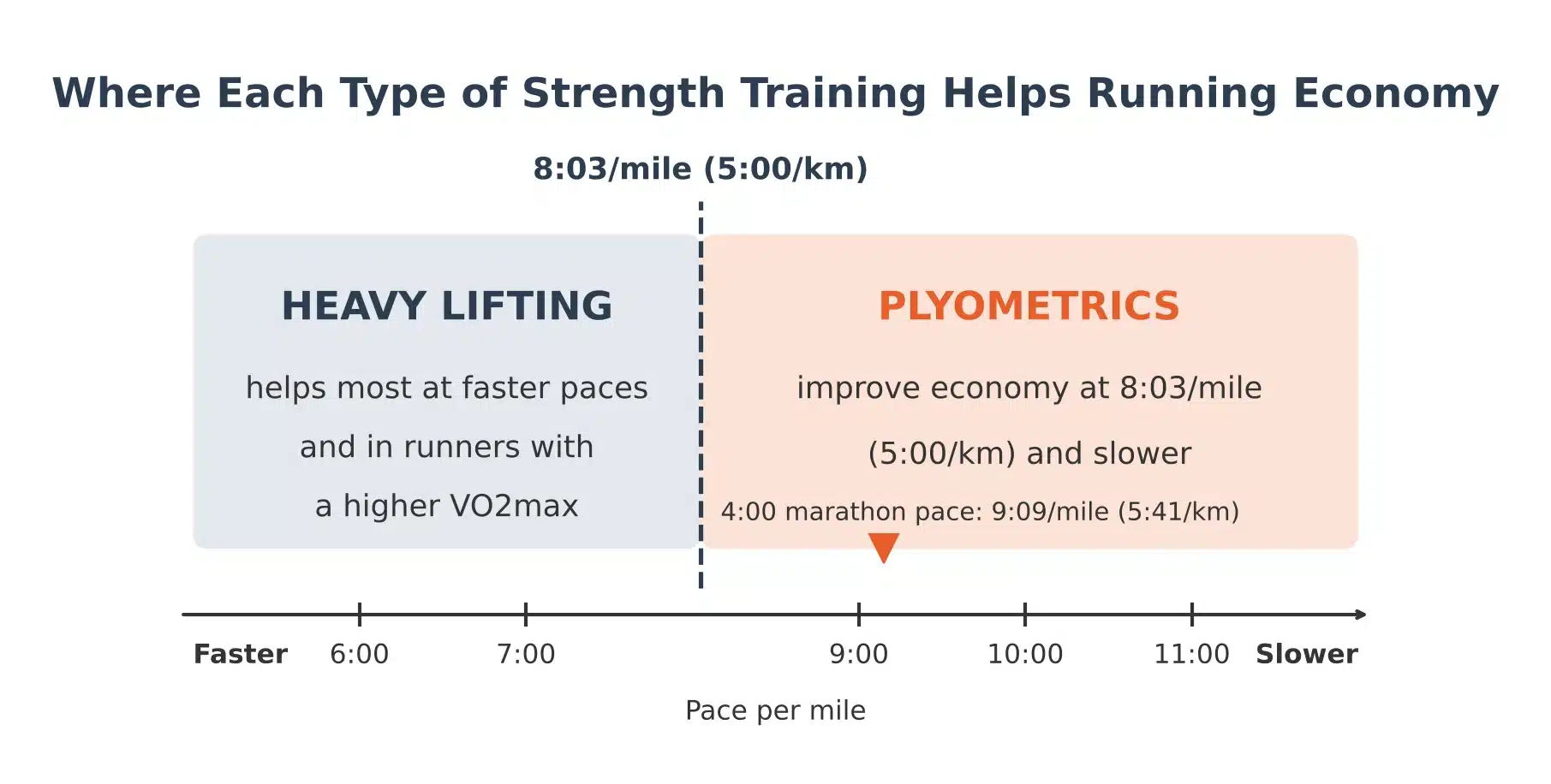
Research has shown that plyometric training improves running economy at paces of 8:03 per mile (5:00/km) and slower, while heavy lifting improves it most at faster paces and in runners with a higher VO2max.
That means plyometrics target the paces most everyday runners spend the majority of their miles at.
As an example, a 4:00 marathoner races at 9:09 per mile (5:41/km) and runs easy days slower than that.
So, if most of your running is slower than about 8:00 per mile (5:00/km), plyometrics improve your running economy at the paces you run most, and heavy lifting adds the most to your faster workouts.
How Often and for How Long Should You Do Plyometrics?
The plyometric programs that worked in research ran 2 to 3 times a week for at least 8 weeks.
A 2016 review of strength training in highly trained runners found that programs pairing 2 to 4 lower-body lifts with up to 200 jumps, done 2 to 3 times a week for 8 to 12 weeks, produced a large improvement in running economy.
How long you stick with it matters too.
A 2022 review comparing heavy lifting and plyometrics found that plyometric programs lasting 8 to 10 weeks improved running economy, while programs lasting 4 to 6 weeks had almost no effect.
That means a short 4-week block of jumps right before a race is unlikely to change how efficiently you run.
Plan on at least 8 weeks of plyometrics, 2 to 3 times a week, before you judge whether they’re working.
Put those sessions on the same days as your hard runs or workouts, so your easy days stay easy.
Start well below the 200 jumps used in the research programs, and add a few jumps or a new exercise each week.
Which Plyometric Exercises Should Runners Start With?
Start with two-footed jumps that keep you close to the ground, then progress to single-leg hops and bounds once those feel easy.
Two-footed jumps split the landing force between both legs, so your calves and Achilles tendons get used to the impact before one leg has to absorb it alone.
Ankle jumps are small, quick hops on both feet with your knees almost straight, where you bounce off the balls of your feet and spend as little time on the ground as possible.
Skips for height are an exaggerated skip where you drive your knee up and push off the ground to get as high as you can on each skip.
Lateral line jumps are quick two-footed hops side to side over a line on the ground, which train your ankles to land and push off in more than one direction.
Jumps for distance are standing broad jumps, where you swing your arms, jump forward as far as you can, and land softly on both feet.
Straight leg bounds are the most advanced of the five, where you bound forward with your legs nearly straight and pull the ground back under you on each stride, so save them until the other four feel easy.
When Should Plyometrics Fit Into Your Training Year?
Build a base of general strength before you start jumping.
If you haven’t been doing some weight lifting or body-weight strength exercises like lunges and squats, starting up with hurdle jumps and single-leg bounding is a recipe for injury.
Once you have that base, the weeks between races are the best time for a plyometric block, because there’s time to add jumps and weight every week before race training starts.
Keep strength training going once race training starts, and let your race distance set the focus of your strength training.
- 5K and 10K: Keep plyometrics and heavy lifting in your routine, because these races depend on power and speed.
- Half marathon: Shift your strength work toward muscular endurance, and keep one heavy or explosive exercise at the start of each session.
- Marathon and ultra: Cut the heavier and more explosive plyometrics so you have the energy for your long runs and longer workouts, and focus your strength work on injury prevention.
That structure is exactly why we built Strength Training for Runners, with 24 routines, race-distance prescriptions and beginner-to-advanced progressions, so the guesswork of when to add jumps and when to cut them is already done for you.
Get Your Strength Plan PDF & Video
Get a sample weekly plan so you can tailor your strength workouts to your race distance.
This PDF will give you a weekly calendar you can follow based on your race distance plus video links to specific strength routines you can try.
GET MY GUIDE
Add Jumps to Your Heavy Lifting Days for at Least 8 Weeks
Plyometrics make you a more efficient runner, but the biggest improvements in race performance come when you pair them with heavy lifting.
Start with two-footed ankle jumps and skips at the beginning of your strength sessions, 2 to 3 times a week on your hard running days.
Give the block at least 8 weeks, ideally between races, before you judge whether it’s working.
Once race training begins, keep the jumps for a 5K or 10K and cut the explosive ones for a marathon.
Here’s a chart summarizing what the research found and how to use it in your training.
| Question | What the research found | What to do |
|---|---|---|
| Do plyometrics alone make you faster? | Across 894 runners, plyometrics alone produced no clear improvement in race performance. | Pair jumps with heavy lifting in the same session. |
| What type of strength training works best? | Combining two or more methods improved race performance about twice as much as heavy lifting alone. | Do your jumps first, then your heavy lifts. |
| How long until plyometrics work? | Programs of 8 to 10 weeks improved running economy, while programs of 4 to 6 weeks had almost no effect. | Commit to at least 8 weeks, 2 to 3 times a week. |
| At what pace do plyometrics help most? | Plyometrics improved running economy at 8:03 per mile (5:00/km) and slower. | Expect the benefit on easy runs and at marathon pace. |