

You’ve finished your last long run and your training plan suddenly has white space in it.
The taper has arrived, and with it comes a strange stress. You’re moving less, your appetite hasn’t caught up, and the scale is creeping upward 2 weeks out from your goal race.
Marathon taper nutrition is the part of training most often left to improvisation, right when getting it wrong can undo months of work.
Eat too little and you show up to the start line with half-full glycogen stores. Eat the wrong things and you spend race morning in a portable toilet instead of on the course.
The good news is that fueling your taper well comes down to a handful of decisions you can plan now, during your hardest week of training and the 2 weeks that follow it.
Here’s what you’ll learn about eating during your taper:
- How to adjust your calories as your mileage drops
- How much to carb load, and when to start
- Why the scale goes up, and why that’s a good sign
- How to hydrate without risking your race
- What to eat the day before and the morning of
What should you eat during marathon taper week?
During your taper you keep the same foods you trained on and shift the ratios. Carbohydrate goes up, total calories come down a little, protein holds steady, and fluid stays high.
The taper exists to let your body finish repairing muscle fibers and top off the fuel it burns on race day.
That fuel is muscle glycogen, the stored form of carbohydrate. A consistent finding across taper studies is that muscle glycogen concentration rises when training volume drops and carbohydrate intake stays high.
Your job during the taper is to arrive at the start line with fully loaded glycogen stores and a gut you can trust.
Every recommendation below serves one of those 2 goals.
Should you eat fewer calories while you taper?
You’ll burn fewer calories during the taper because you’re running fewer miles, so a small reduction in total intake is normal.
The mistake is slashing calories to offset the drop in mileage. Your body is still repairing muscle damage from months of training and rebuilding glycogen, and both of those jobs need energy.
Let hunger guide the size of your meals rather than the clock. If you always grabbed a snack before a run, a taper day with no run may not need it.
When you do feel hungry, eat. That signal usually means your body is still recovering from the training block.
RunnersConnect Bonus
Download your FREE Marathon Nutrition During Your Taper Guide.
The guide contains a plan of exactly what you should be eating in the 5 days to 3 hours before your race. We give specific food recommendations to make sure you are ready on race day.
How much should you carb load before a marathon?
Carbohydrate loading means eating enough carbohydrate in the final 1 to 2 days to fill your muscles beyond their normal glycogen level.
The American College of Sports Medicine position stand puts the loading target at 10 to 12 grams of carbohydrate per kilogram of body weight each day for the 36 to 48 hours before a long race.
For a 155-pound (70 kg) runner, that works out to roughly 700 to 840 grams of carbohydrate a day. Most everyday marathoners do well at the lower end, closer to 8 to 10 g/kg, which is easier on the stomach.
You don’t need 3 days of pasta to get there. Trained runners reach maximal glycogen in about a day.
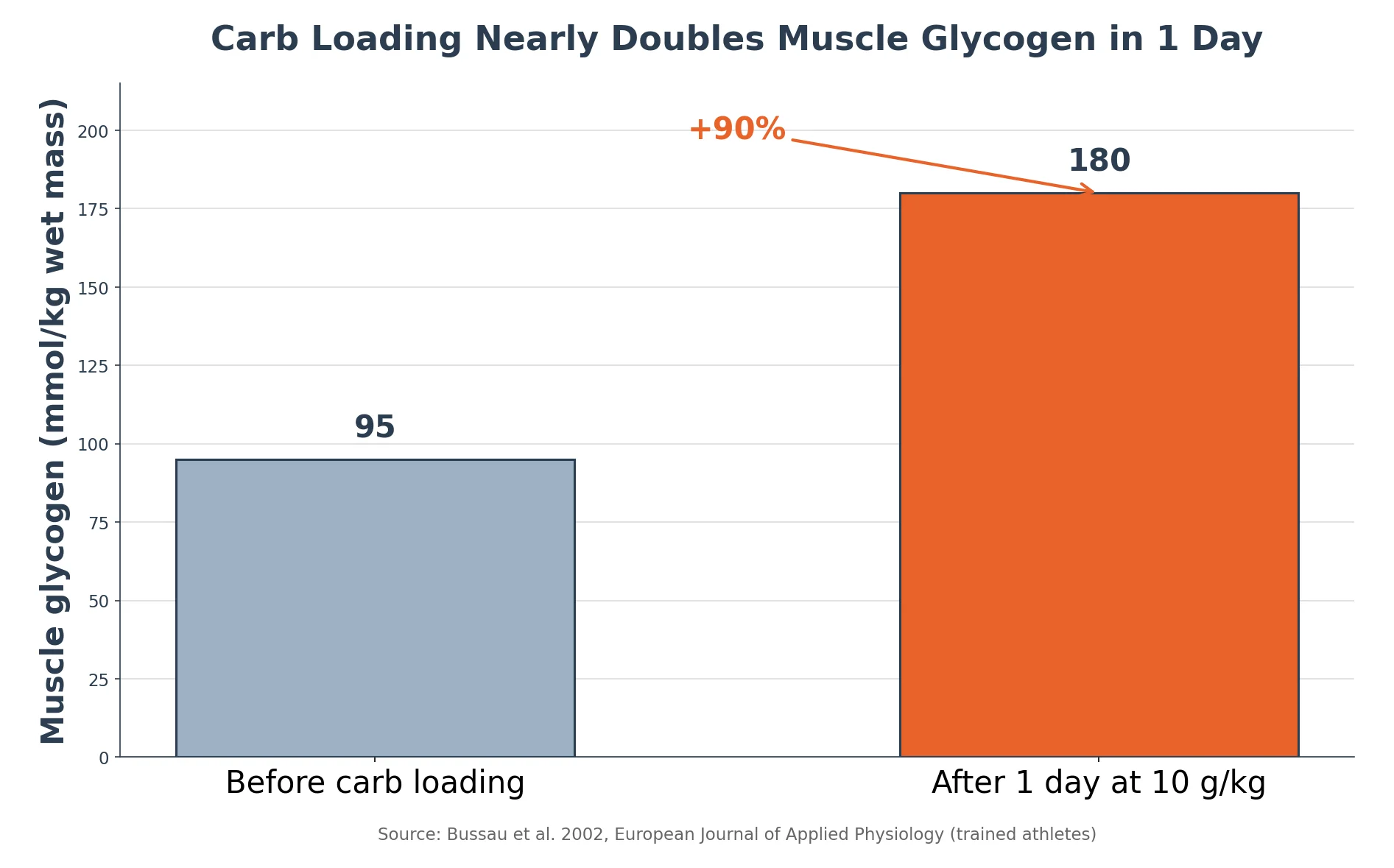
Researchers found that trained athletes nearly doubled their muscle glycogen, from 95 to 180 mmol per kilogram, after just 24 hours of high-carbohydrate eating combined with rest.

A 2024 meta-analysis confirmed that running followed by a few high-carbohydrate days raises muscle glycogen by about 156 mmol per kilogram of dry muscle.
Choose carbohydrate that comes with fewer empty calories. Swap creamy pasta sauce for tomato-based, and lean on everyday carbs: oatmeal, bread, rice, potatoes, fruit.
Aim for 8 to 10 grams of carbohydrate per kilogram of body weight each day across the final 1 to 2 days, spread over your normal meals.
Getting this right is what keeps you from running out of glycogen late in the race and slowing to a walk in the final miles.
Why does the scale go up during your taper?
Seeing 2 to 4 pounds appear during your taper is normal, and it shouldn’t worry you.
Your body stores glycogen alongside water. Every gram of glycogen you pack into muscle holds roughly 3 grams of water with it.
When you load several hundred extra grams of glycogen, the attached water shows up on the scale as a few pounds.
That weight is fuel and hydration, both of which you’ll use on race day. The water buffers you against dehydration, and the glycogen powers the miles.
A gain of 2 to 4 pounds during the taper is stored fuel and water, and it means you loaded correctly.
Weigh yourself at the start of the taper if you want a baseline, then stop reading the number as fat gain.
How much protein should you eat while tapering?
Protein stays on the plate during your taper because your muscles are still repairing damage from months of training.
Carbohydrate gets the spotlight before a marathon, and protein quietly does the rebuilding.
A 2025 review of protein for endurance athletes recommends around 1.6 to 1.8 grams per kilogram of body weight each day, spread across meals rather than stacked into one.
For that same 155-pound (70 kg) runner, that comes to 110 to 125 grams of protein a day.
Spreading it out matters because your muscles can only use so much at once. Two to four palm-sized servings across the day covers it.
Protein also keeps hunger down, which helps when your appetite hasn’t adjusted to running fewer miles.
How should you hydrate during race week?
Hydration during race week means drinking to a steady, pale-yellow urine rather than forcing down as much water as possible.
You want to arrive well hydrated so you don’t start bonking from dehydration two-thirds of the way through the race.
Urinating every 2 to 3 hours, with urine the color of light lemonade, tells you you’re there.
Overhydrating carries its own risk. Drinking far more than you lose dilutes the sodium in your blood, a condition called hyponatremia that can turn dangerous.
A New England Journal of Medicine study found that 13% of Boston Marathon runners finished with hyponatremia, and the main risk factor was gaining weight during the race from drinking more fluid than they sweated out.
Pair your fluid with sodium so the water stays where you need it. Salt your food normally during race week, and use an electrolyte drink rather than plain water for part of your intake.
Drink to a pale-yellow urine color and add sodium, and stop short of urine that runs completely clear.
Cutting back on alcohol during race week also helps your body retain fluid.
How do you avoid stomach problems on race day?
The fastest way to ruin a marathon is to introduce a new food or a high-fiber meal in the final 48 hours.
Fiber is healthy in training and a liability the day before a race, because it sits in your gut and can trigger cramping or urgent bathroom stops mid-race.
In the 1 to 2 days before the marathon, lower your high-fiber foods and lean on simpler carbohydrate: white rice, white bread, bananas, or peeled potatoes.
Runners with sensitive stomachs can go further and reduce high-FODMAP foods, the fermentable carbohydrates found in foods like onions, garlic, beans, or certain fruits.
One study of runners reported that 82% of those with a history of gut trouble saw fewer daily symptoms on a short low-FODMAP diet.
Never eat anything on race morning that you haven’t already tested during a hard training run.
Rehearse your exact race-morning breakfast before a few long runs during your build, so race day is a repeat of something your gut already handled.
What should you eat the day before and race morning?
Make your biggest meal lunch the day before the race, and keep dinner a normal size.
The old tradition of a huge pasta dinner the night before often leaves runners bloated and heavy on the start line, because that last load of carbohydrate doesn’t reach your glycogen stores before the gun goes off.
A large lunch gives your body the rest of the day to digest, so you go to bed comfortable and wake up light.
On race morning, eat a familiar carbohydrate-based breakfast 2 to 4 hours before the start.
Marathon fueling research supports a pre-race meal of about 1 to 4 grams of carbohydrate per kilogram of body weight, eaten early enough to digest.
Toast with jam and a banana, oatmeal with honey, or a bagel are reliable choices that most stomachs tolerate.
Sip fluid with electrolytes through the morning, and stop drinking large volumes about an hour before the start so you’re not searching for a bathroom in the corral.
Marathon taper nutrition at a glance
| Focus | Target during taper | Why it matters |
|---|---|---|
| Total calories | Slightly lower than peak weeks | You burn less, but still repair and refuel |
| Carbohydrate loading | 8 to 10 g/kg/day, final 1 to 2 days | Fills muscle glycogen for race day |
| Protein | 1.6 to 1.8 g/kg/day, spread out | Repairs muscle from the training block |
| Fluid | Pale-yellow urine, every 2 to 3 hours | Arrive hydrated without overdrinking |
| Sodium and electrolytes | Salt food, use an electrolyte drink | Keeps fluid in balance, lowers hyponatremia risk |
| Fiber | Lower it in the final 1 to 2 days | Reduces race-morning gut trouble |
| Day before | Big lunch, normal dinner | Digest before the start, wake up light |
| Race morning | 1 to 4 g/kg carbs, 2 to 4 hours out | Tops off fuel without a heavy stomach |
Fuel your taper with these targets and you’ll reach the start line with your muscles repaired, your glycogen full, and your stomach settled.




3 Responses
Hydration is VERY important!!! Tanks for the tips!!!
:):):);)
Glad you enjoyed it! We have lots of other articles you may find helpful too!