

You’re injured, and your first instinct is to find anything that keeps the fitness you’ve spent months building.
The elliptical feels wrong.
Swimming doesn’t use your legs the right way.
Cycling helps, but you can feel how different it is from running.
Aqua jogging is the answer most coaches reach for, and the physiology backs them up.
You’ll learn:
- Whether aqua jogging can actually maintain your running fitness
- Why heart rate works differently in the pool, and what to do instead
- Exactly how to do it with proper technique
- Specific workouts for easy, tempo, and interval efforts
What Is Aqua Jogging?
Aqua jogging means running in the deep end of a pool with your feet never touching the bottom.
You replicate the full running motion: knee drive, foot push-down, arm swing, using water resistance instead of ground force.
That’s what makes it different from swimming: you’re using the exact movement pattern your body knows from running.
Swimming uses a completely different motor pattern and largely neglects your running-specific hip flexors and glutes.
Aqua jogging keeps those muscles active, which is the core reason it outperforms every other cross-training option when you need to stay run-fit.
Aqua jogging is zero impact because your feet never contact a surface, making it safe for almost any running injury, including stress fractures.
Can Aqua Jogging Really Maintain Your Running Fitness?
The research is clear on this: exclusive aqua jogging maintains aerobic fitness for 4 to 6 weeks in trained runners.
A 2012 review of the deep-water running literature found that submaximal oxygen consumption values during pool running are strikingly similar to those measured during treadmill running at equivalent effort levels.

What this means in practice: a runner doing a hard effort in the pool is stressing the aerobic system nearly identically to a hard effort on land.
The earlier studies that built aqua jogging’s reputation told a consistent story.
One trial had 10 trained runners replace all land running with 4 weeks of exclusive deep-water running, then tested their 5K times before and after.
No statistically significant difference.
A second study split 16 runners into a pool group and an overland group, matched their training intensities and durations for 6 weeks, then compared markers including maximal blood lactate and body composition.
The two groups finished indistinguishable.
You can stay race-fit off cross-training, but the window matters.
That 6-week window covers most soft-tissue injuries and stress reactions.
If you’re facing a longer absence, the goal shifts from maintenance to damage control, and the workouts change accordingly.
Why Does Heart Rate Feel Lower in the Pool?
When you’re submerged to your chest, water pressure pushes blood from your extremities toward your heart.
Your heart fills more completely with each beat, which increases stroke volume and cardiac output at rest.
The result: your heart doesn’t need to beat as fast to move the same volume of blood.
This is why maximal heart rate and VO2max during pool running consistently test lower than on the treadmill.
Research from Liverpool John Moores University confirmed that while VO2max and heart rate are lower under maximal conditions in water, deep-water running still provides an adequate stimulus for cardiovascular training.
At submaximal intensities (your easy runs and tempo efforts) the gap mostly disappears.
Use perceived effort (RPE) rather than heart rate zones when aqua jogging. Targeting a land-based HR zone will leave you working harder than intended.
Your pool heart rate will run about 10 to 17 beats per minute lower than land running at the same perceived effort.
If you want a target, aim for 80 to 85% of your land-based max heart rate for what would be tempo effort on the road.
How to Aqua Jog: Technique and Equipment
Do You Need an Aqua Jogging Belt?
A belt is recommended when you’re starting out, especially if you’re not a confident swimmer.
The foam flotation belt keeps you upright without requiring constant energy to stay afloat, which frees your focus for form.
Once you’re comfortable, running beltless increases the training demand because your core works harder to keep you stable.
Start with the belt for your first 2 to 3 sessions, then try removing it once form feels natural.
Posture and Body Position
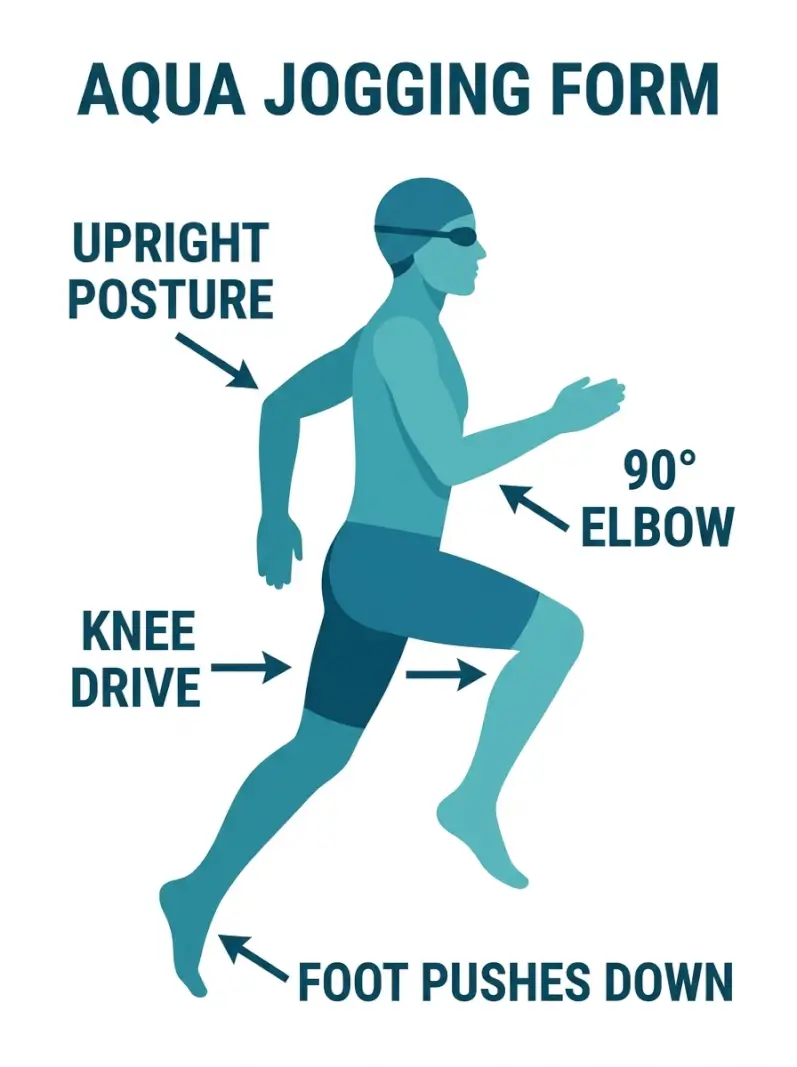
Stay more upright in the water than you would on land.
Land running uses a slight forward lean to let momentum help carry you forward.
In the pool, that lean pushes you through resistance and disrupts balance.
Keep your head level, chest tall, and shoulders directly over your hips.
Leg Motion
Drive one knee up while the opposite foot pushes straight down and back.
Your foot should not reach forward. There’s no ground contact in this motion.
If you can see your feet in front of you, you’re reaching too far.
The movement is compact: knee up, foot down, short stride.
Arm Action
Keep elbows bent at 90 degrees throughout.
Pull each elbow straight back until your hand reaches your hip pocket, then drive the opposite elbow forward.
Avoid crossing your arms across your chest. They should move parallel to your body’s centerline.
Shoulders stay level and stationary. Only the arms move at the shoulder joint.
The Most Common Mistakes
- Leaning forward: causes you to bicycle rather than run through the water
- Arms crossing midline: creates rotation that wastes energy and disrupts leg cadence
- Elbow bending and straightening: the elbow stays fixed at 90 degrees, movement only at the shoulder
- Shoulders rocking: the torso should be stable; only your limbs move
Aqua Jogging Workouts for Every Effort Level
The biggest mistake aqua joggers make is jogging easy laps without structure.
Your heart rate won’t climb as high as it does on land, so interval work is necessary to replicate the training stimulus of a quality run.
Easy Recovery Sessions
Use easy aqua jogging as a warm-up, cool-down, or to replace your recovery runs.
Aim for 65 to 70% of your land-based max heart rate, or an effort that feels genuinely conversational.
Duration: 20 to 45 minutes.
Tempo-Equivalent Workout: The Pyramid
This builds from 1 minute to 5 minutes of hard effort and back down, with 30-second recoveries throughout.
- 10 minutes easy warm-up
- 1:00 hard / 0:30 easy
- 1:30 hard / 0:30 easy
- 2:00 hard / 0:30 easy
- 2:30 hard / 0:30 easy
- 3:00 hard / 0:30 easy
- 3:30 hard / 0:30 easy
- 4:00 hard / 0:30 easy
- 4:30 hard / 0:30 easy
- 5:00 hard / 0:30 easy
- Descend back to 1:00 following the same pattern
- 10 minutes easy cool-down
Hard effort means 87 to 92% of your land-based max heart rate, or what feels like a sustained tempo run.
Interval Workout: The Fartlek
- 10 minutes easy warm-up
- 0:30 sprint (95 to 100% effort) / 0:30 medium / 0:30 rest
- Repeat 12 to 15 times
- 10 minutes easy cool-down
High-Intensity Workout: The Bungee Cord Method
The bungee cord turns pool running into a genuinely hard workout that replicates track intervals.
Tie one end of a sprinter’s resistance band to a fixed pool fixture (a ladder, a post, or a railing) and secure the other end around your waist.
Run away from the anchor point until the band creates significant resistance, then use that distance as your sprint marker.
Find a closer point where the resistance matches tempo effort.
A sample workout with the bungee:
- 10 minutes easy warm-up
- 90 seconds easy (moving out, stretching the band)
- 2 minutes at tempo resistance
- 1 minute at sprint resistance
- 1 minute rest (let the band pull you back)
- Repeat 10 times
- 10 minutes easy cool-down
With the bungee cord, the band pulling you back during rest acts as passive recovery. That rest quality is what makes the hard intervals repeatable.
When to Use Aqua Jogging vs. Land Running
The clearest use case is injury: any condition that makes impact painful or dangerous.
Stress fractures, shin splints, plantar fasciitis, and most soft tissue injuries respond well because aqua jogging removes ground reaction force entirely.
RunnersConnect Insider Bonus
Download our free Stress Fracture Treatment Outline.
It’s a PDF with the treatment options for runners with stress fractures.
The one exception is hip flexor injuries. The resistance of water against your leg during the drive phase can aggravate hip flexor pain.
When you’re healthy, aqua jogging earns a spot as a training supplement.
Replacing one or two easy runs per week with pool sessions reduces cumulative impact loading without sacrificing aerobic stimulus.
That trade-off is especially useful during high-mileage training blocks or when your legs are carrying fatigue from back-to-back hard days.
When you’re ready to return to land running, use the pool as a bridge.
Start with land running every other day and fill the gaps with aqua jogging sessions until your body adjusts to impact again.
That’s the approach covered in more detail in the guide to returning to running after an injury.


13 Responses
Thank you so much for this reassuring article. I was diagnosed yesterday with a stress reaction in my 4th metatarsal and really don’t want to lose my good fitness. I’m headed to the pool now to do one of the medium workouts in this article, and will do one of the hard ones tomorrow.
Sorry to hear Terzah. Hope you heal quick and when you’re ready to get back to training, make sure to read this article: https://runnersconnect.net/running-injury-prevention/how-to-return-to-running-after-a-stress-fracture/
Started aqua jogging after bilateral. Knee pain, I now aqua jog 10 classes per week clothes fitting better and no pain not sure I would return to running
Hi, I was aqua jogging a few times a week and doing hard workouts (intervals) while injured for 4months. My 1st race back was a 10k and I was surprisingly only 49seconds slower than the same race the previous year. So this proves if u work hard in the pool and get your heart rate up you can keep a great level of fitness during an injury
Sharon
Good aftrnoon, my personal trainer sent me the link to your website. I am a former marathoner now not after hip replacement surgery. Can water running be a good alternative fr someone like me?
Thanks, Matt
Absolutely. Should be no impact on the hip
Just strained my soleus (personal diagnosis) and I’m 5 weeks away from a marathon where I’ve been hoping to BQ. I don’t think it’s a terrible strain, but I’m supposed to do a fast finish 20 miles this weekend and that seems like a lot to ask of an iffy soleus. Suggestions for doing this in the pool? Do I just go for the 3 hours the 20 miles would take me at my long run pace, increasing effort for the 4 fast finish miles? Any advice to help me get to this marathon and keep my BQ pacd ability that I’ve spend the last 12 weeks working on would be much appreciated!!!!
Hi Chelsea, sorry to hear about your soleus. I have actually done that myself in the past, and I am glad to hear that you are being smart with it. I did pool running in the build up to my race (had to take a full month off running), and ended up racing very well at the end of it, so it works, as long as you make sure you are doing it correctly. I recommend you listen to this podcast episode on Cross Training https://runnersconnect.net/crosstrain which will give you more information on how to do it, and why it is important (and should give you confidence in your race). I would pool running or use a combination of cross training for the 3 hours this weekend, and yes, make the effort more intense the last 4 miles. Remember you will need to keep reminding yourself to keep that intensity up, as it is easy to slack in the pool. Hope this helps! Best of luck!
I was diagnosed with runner’s knee (IT Band issues with a terrible pain point at my knee). I have been training for a marathon which is on October 4th. My last run I couldn’t make it more than 4 miles without excruciating pain, and I was supposed to be doing a 20-mile training run. My doctor recommended aqua jogging from now until the race, and a cortisone shot to get me through.
Has anyone experienced this kind of injury/pain and been able to complete their long run/race because of aqua jogging?
Hi Laura, thanks for reaching out. Sorry to hear about your knee, it is quite common for runners to be able to aqua jog without pain for injuries as the impact is removed. If it does not cause your knee any pain, then it is definitely the best idea for you to let it calm down. Make sure you take a listen to this podcast episode and it will give you more confidence in what you are doing https://runnersconnect.net/crosstrain As for your pain, are you taking steps to treat the problem? We have a great post about runners knee, which we would recommend you read and start following the steps. Hope this helps https://runnersconnect.net/running-injury-prevention/runners-knee-symptoms-causes-and-research-backed-treatment-solutions-for-patellofemoral-pain-syndrome/
Hi,
Do you think this would be helpful for high hamstring tendinopathy?
Hi, I started acquajogging it happens that I had a huge backache the day after, I couldn’t even walk! Can you tell me what I’m doing wrong?
Hi Lemmert,
Are you currently using a belt for your AJ? It very well could be a postural issue. Because pool running is so demanding on the core and back to remain upright and stable, it can cause those muscles to get overworked.