

You follow your training plan.
You increase mileage gradually. You do the stretching, the foam rolling, the ice baths.
And then a shin starts aching, a knee flares, or a hip flexor seizes up. You’re back on the couch wondering what went wrong.
The frustrating truth is that most training advice runners follow was never designed to prevent injury.
The 10% rule was never validated in a peer-reviewed trial.
Weekly mileage tracking, according to a massive study of 5,200 runners, predicts injury no better than chance.
Stretching before you run has failed to reduce injury risk across decades of research.
What actually prevents running injuries comes down to a short list of evidence-based principles. Most runners have never heard the key one.
In this guide, you’ll learn:
- What the research says actually causes most running injuries (it is not what you think)
- Why the 10% rule fails and what metric actually predicts injury
- How to use long-run data to protect yourself using one simple calculation
- Why strength training is the single most powerful injury prevention tool available
- Which running form adjustments have genuine evidence behind them
- The warning signs that mean you should stop before a minor issue becomes a real injury
What Actually Causes Running Injuries?
Most running injuries come from a single category of error: you asked your body to absorb more stress than it could adapt to.
Research has confirmed that as many as 79% of runners experience at least one injury in a given year.
The cause is rarely a single catastrophic event.
Tendons, bones, and muscles have a stress tolerance. Each tissue can only absorb a certain amount of repeated mechanical loading before breakdown begins.
When training load exceeds that tolerance faster than the tissue can recover and adapt, injury follows.
Training errors account for 60-70% of all running injuries: doing too much, too soon, or with too sharp a jump in a single session.
The good news is that training errors are entirely within your control.
The remaining injuries come from biomechanical factors, which can be improved, and a smaller percentage from genuine anatomical issues.
Understanding this cause-effect relationship is the foundation of every strategy in this guide.
Does the 10% Rule Actually Prevent Running Injuries?
The 10% rule is the most commonly repeated injury prevention advice in running: never increase your weekly mileage by more than 10%.
It was also never backed by research.
No peer-reviewed trial has validated 10% as the correct threshold.
The rule emerged from coaching intuition in the 1980s and spread because it was simple and memorable, not because it was tested.
Weekly mileage totals are the wrong unit of measurement for injury risk, a finding confirmed by a landmark study tracking 5,200 runners across 87 countries.
A runner could complete three easy 4-mile runs and one 20-mile run in a week.
Their weekly mileage total looks fine. Their ACWR (acute:chronic workload ratio) looks acceptable.
But that 20-mile run might be double the longest run in the past month. That is the number that actually matters.
Weekly averages hide dangerous single-session spikes.
How Much Should Your Long Run Increase Each Week?
The study that shifted the conversation on running injuries was an 18-month prospective study of 5,205 runners across 87 countries, published in the British Journal of Sports Medicine.
Researchers tracked 588,071 running sessions via Garmin devices.
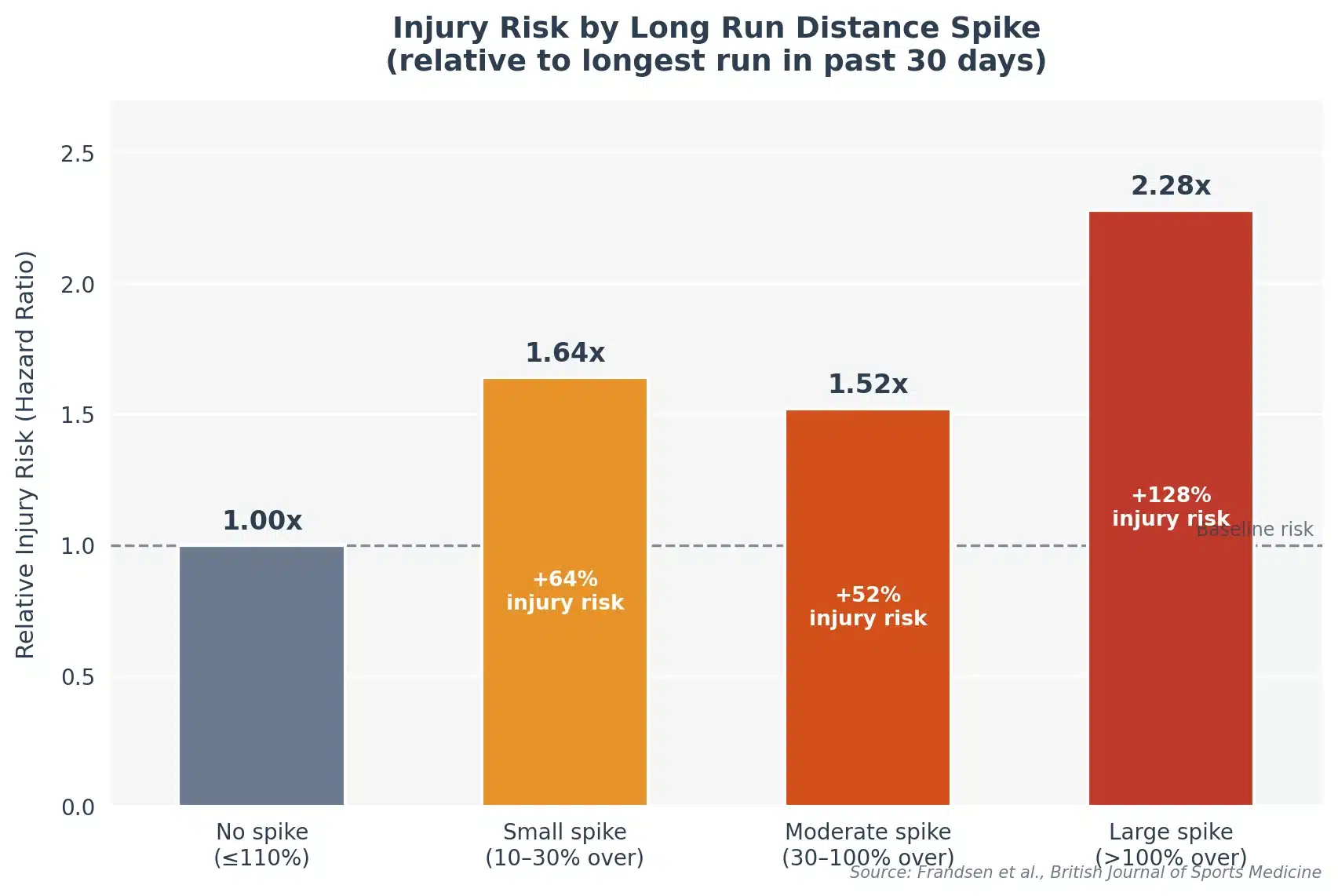
They tested three metrics: week-to-week mileage change, the acute:chronic workload ratio, and single-session distance relative to the runner’s longest run in the previous 30 days.
Only one metric predicted injury.
The study found that when runners exceeded 110% of their longest run in the past 30 days, injury risk increased sharply: a 30% spike raised risk by 64%, a moderate spike raised it by 52%, and doubling the longest recent run more than doubled injury risk (hazard rate ratio 2.28).

The practical calculation is straightforward: divide your planned run distance by your longest run in the past 30 days.
If that number is above 1.10, you are in the injury-risk zone.
If your longest run in the past month was 10 miles and you plan 13 miles this weekend, that 30% spike carries a 64% increase in injury risk according to the data.
This does not mean you cannot build your long run.
It means you build it in steps of 10% or less, measured against your recent longest effort, not against last week’s total mileage.
The rule applies to single training sessions. Easy runs and recovery runs can follow different progressions.
Does Strength Training Prevent Running Injuries?
Of all the injury prevention strategies available to runners, strength training has the strongest evidence base.
A systematic review and meta-analysis of 26 randomised controlled trials found that strength training reduced overuse running injuries by 50% and acute injuries by 30% compared to training without strength work.
The mechanism is tissue tolerance.
Eccentric loading increases the tensile strength of tendons, improves bone density, and strengthens the muscles that stabilize your hips and knees under running load.
Hip weakness is particularly consequential.
When the glutes and hip abductors cannot stabilize the pelvis during single-leg stance, which happens thousands of times per run, the femur rotates inward, the knee tracks medially, and the IT band, patella, and plantar fascia absorb abnormal stress.
Two targeted hip and glute sessions per week is enough for measurable injury prevention benefits, with no need to become a gym regular.
Focus on: single-leg squats, hip abduction work, calf raises, and Romanian deadlifts.
These exercises address the four most common weakness patterns in injured runners.
For a specific protocol, see these hip strengthening exercises for runners. They target the hip drop pattern directly and are backed by the same research literature.
What Running Form Changes Actually Reduce Injury Risk?
Running form is a legitimate injury prevention tool. There is one critical caveat.
Overhauling your form rarely ends well.
But two specific, small adjustments have consistent evidence behind them: increasing cadence and reducing forward trunk lean.
Research has found that increasing step rate by just 5-10% reduces peak knee joint loading by 16-34% and peak hip adduction moment by up to 32%, with no change required in running pace.
Cadence (steps per minute) is easy to measure.
Most GPS watches report it, or you can count steps for 15 seconds and multiply by 4.
Aim for 5-10% above your natural cadence. That is the target, not a fixed number like 180.
Most runners increase cadence naturally by focusing on “lighter feet” or imagining running across hot coals, technique cues that shift the pattern without requiring mechanical overthinking.
The footstrike debate (heel vs. midfoot vs. forefoot) is more complicated.
No single footstrike pattern has been proven to reduce injuries across all runners.
A higher cadence often shifts footstrike automatically, which is a better strategy than forcing a change to where your foot lands.
What Are the Warning Signs That You’re About to Get Injured?
Injury prevention is not only about what you do in training.
It is also about catching the early signals before a stress reaction becomes a stress fracture, or tendinopathy becomes full-blown tendon failure.
The most reliable warning sign is pain that changes how you move.
A general ache that loosens up after the first mile and disappears within an hour of finishing is low risk. The tissue is adapting under load.
Pain that causes you to change your stride, persists throughout the run, or gets worse as the run progresses is a different signal.
The day-after test: if yesterday’s run leaves you limping, altering your gait, or with localized bone tenderness rather than general muscle soreness, take the day off and reassess because tissue stress is accumulating faster than recovery.
Bone pain warrants an immediate reduction in running and professional evaluation.
Bone stress injuries follow a continuum from early stress reaction to complete fracture, and running through them accelerates the progression.
For soft tissue issues like tendons, muscles, and the IT band, the rule is simpler.
If pain is above a 3 out of 10 during your run, or if it climbs during the run rather than settling, cut the session short.
One skipped run never derailed a training cycle. Running through a developing injury has ended many.
RunnersConnect Bonus
Download your FREE Injury Assessment and Prediction Video now.
A good injury prevention program starts with assessing where you’re weak and where you might be tight or inhibited. In the video I’ll demonstrate the six mobility tests you need to perform to assess what you need to begin working on.