

Hills slow you down more than most runners account for.
They also build more fitness than almost any other tool in a training program.
Most runners relate to only one of those facts.
They know uphills hurt and downhills help, and they treat hills as terrain to manage rather than a training stimulus to seek out.
That approach leaves real fitness on the table.
The research is clear on both sides: hills carry a significant performance cost on race day, and they deliver specific physiological adaptations that flat training simply can’t replicate as efficiently.
Understanding both sides is what lets you use hills deliberately instead of just enduring them.
So, in this article you’re going to learn the research-backed practical advice on:
- What specific fitness benefits hill running delivers that flat training struggles to match
- Whether hills actually make you faster on flat ground
- Why uphill running costs so much more energy than it feels like it should
- Exactly how much specific grades will slow your race time, with numbers you can apply
- What downhill running does to your legs that the uphills don’t undo
- How to structure hill training to get the adaptations without breaking down the rest of your training week
What Are the Benefits of Hill Running?
Hill running delivers 4 physiological adaptations that flat-terrain training produces more slowly, or not at all.
Research published in the Journal of Strength and Conditioning Research found that uphill high-intensity interval training produced comparable improvements in VO2 max, velocity at VO2 max, and lactate threshold as level-grade intervals in well-trained distance runners, with the addition of measurable leg strength gains the flat group did not see.
That combination matters because it compresses two separate training needs, speed work and strength work, into one stimulus.
Here is what each benefit looks like in practice.
VO2 max development. Uphill running forces your cardiovascular system to work harder than flat running at the same perceived effort level, making it one of the most time-efficient ways to push your aerobic capacity toward its ceiling.
At a moderate 5% grade, the cardiorespiratory demand matches a flat-ground interval run at significantly higher speed, but at a pace where your form stays controlled and your injury risk stays low.
Leg strength without gym sessions. Uphill running requires your glutes, quads, and calves to generate active concentric force against gravity on every stride, rather than relying on the elastic energy return that drives efficient flat running.
That is essentially progressive resistance training built into your run, with no equipment required.
Reduced injury risk compared to track intervals. Uphill running shortens your stride and reduces the peak impact forces that accumulate during flat high-speed interval sessions.
For runners managing bone stress or recovering from lower leg injuries, replacing flat repeat sessions with uphill repeats on grass or trail preserves the cardiovascular stimulus while significantly lowering the loading on the tibia and metatarsals.
Running economy. The leg strength and neuromuscular coordination developed through hill running transfers directly to your flat running mechanics, reducing how much energy you burn per mile at a given pace.
More efficient mechanics means faster flat-ground times from the same level of fitness.
Does Running Hills Make You Faster on Flat Ground?
The short answer is yes, and the mechanism is more direct than most runners realize.
The VO2 max gains from hill training don’t stay on the hills.
Your aerobic ceiling is a whole-body adaptation: when uphill intervals push your cardiovascular system harder than flat intervals do at the same pace, the resulting improvements apply to everything you run afterward, including flat races and road 5Ks.
A runner who gains 2 points of VO2 max through a 6-week uphill training block will run faster at every distance, not just on hilly courses.
The leg strength gains transfer the same way.
Stronger glutes and quads don’t stop working on flat terrain.
They produce more force per stride, which means more propulsion from the same energy expenditure.
That translates directly into improved running economy: covering more ground per unit of oxygen consumed.
Every percentage point of improvement in running economy means faster flat-course times, which is why coaches who work with elite athletes consistently include hill training as a year-round staple, not just race-specific preparation.
This is the principle behind the Hansons Marathon Project’s well-known hill training approach.
When Brian Sell prepared for the 2008 Olympic Marathon Trials in New York, the Hansons group structured their entire training block around a hilly out-and-back route, giving Sell the race-specific fitness to make the Olympic team.
The practical implication: you don’t need a hilly race on your calendar to benefit from hill training.
The adaptations, including VO2 max gains, leg strength, and running economy, pay off at every distance and on every terrain.
RunnersConnect Bonus
Download your FREE Improvement Performance Calculator now.
This handy pace calculator helps you to determine what pace you should be running at in training and at each racing distance based on a recent race result.
Why Does Running Uphill Feel So Hard?
Running uphill costs significantly more energy per mile than running on flat ground, and the mechanism is more specific than most runners expect.
You don’t need extreme grades for the impact to be meaningful.
Even the rolling hills you’d encounter in a typical road race carry a real physiological cost.
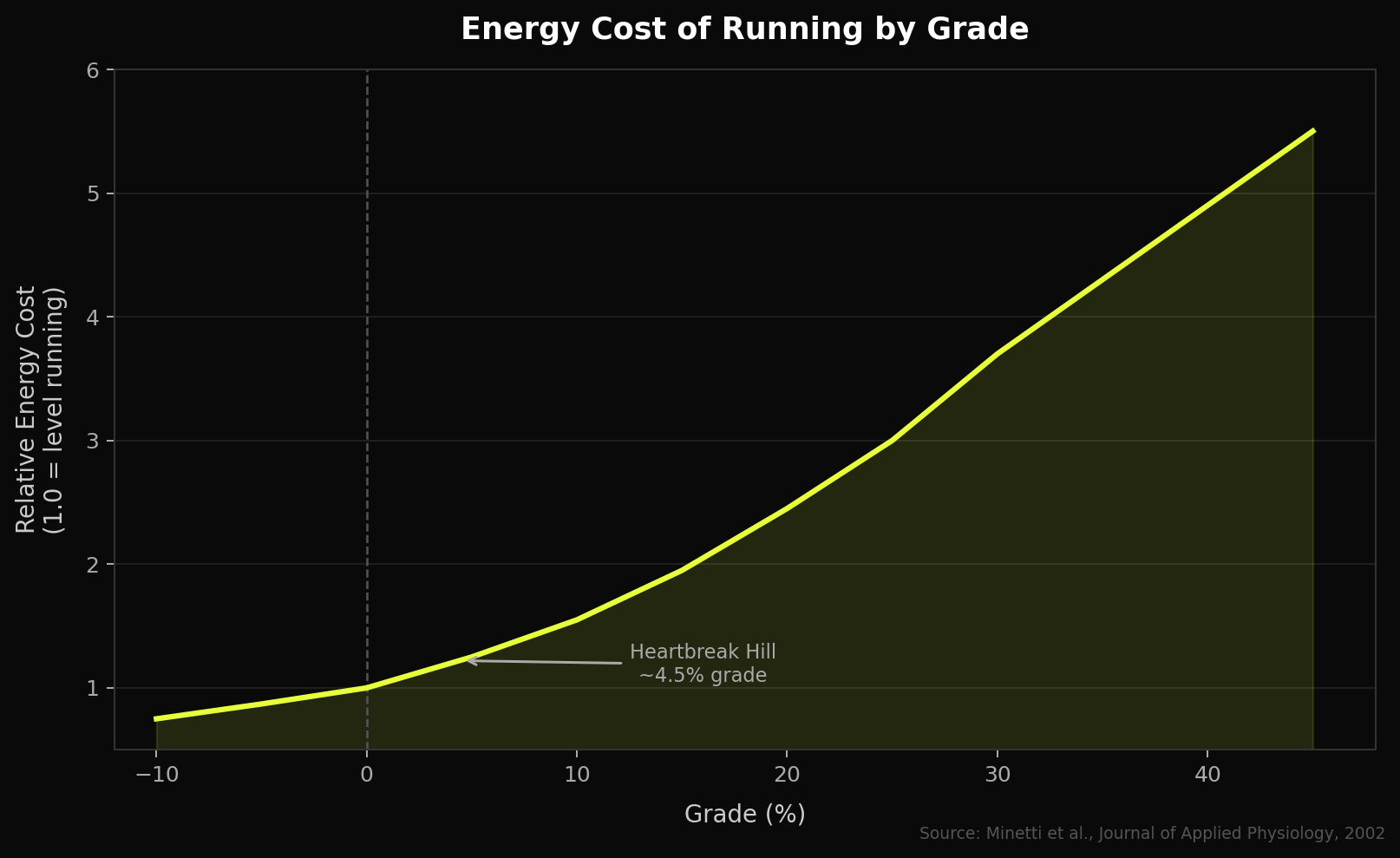
On flat ground, your leg muscles act partly like springs, storing and returning elastic energy with each stride.
Going uphill disrupts that spring mechanism.
Research has shown that uphill running compromises elastic energy return, forcing your muscles to generate more active concentric force to lift your body against gravity with each step.
Your cardiovascular system responds accordingly: heart rate climbs, oxygen demand surges, and you burn through your aerobic capacity faster than the equivalent flat-ground pace would require.
The pacing implication is direct: most runners don’t slow down enough on uphills.
Going anaerobic on a climb doesn’t just hurt on the hill itself.
It depletes glycogen faster and compromises your ability to hold pace for the remaining miles, costing you far more total race time than the conservative pace on the hill would have.
Adjusting your running form on hills can offset some of that energy cost by shortening your stride and keeping your effort even across the grade.
How Much Does Elevation Affect Your Running Pace?
2 well-known estimates exist for calculating how much a hill will cost you, and both lead to the same uncomfortable conclusion for race planning.
Jack Daniels of Daniels’ Running Formula estimated that every 1% gradient of incline costs approximately 12–15 seconds per mile (7–9 seconds per km), while every 1% gradient of decline gives back roughly 8 seconds per mile (5 seconds per km).
A simpler approach from coach John Kellogg states that every 10 feet (3 meters) of elevation gain costs approximately 1.74 seconds, regardless of the horizontal distance covered.
Both rules point to the same conclusion: the math doesn’t balance.
Uphills cost roughly 12–15 seconds per mile per 1% grade, while downhills return only about 8 seconds per mile, so you permanently lose time on every grade you climb.
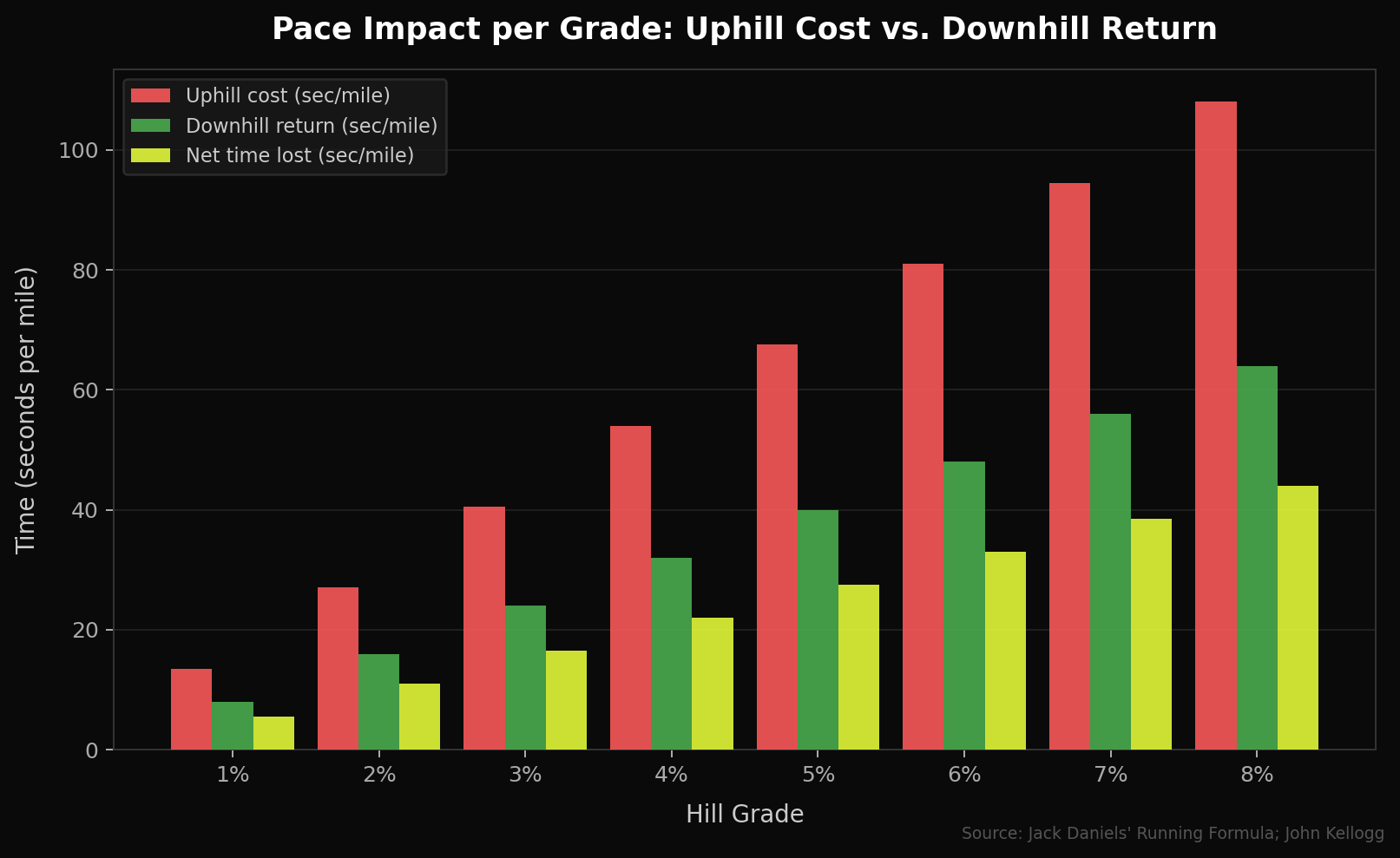
A concrete example shows how quickly this adds up.
Heartbreak Hill at the Boston Marathon is approximately 0.4 miles (600 meters) long and rises about 27 meters, putting it at a grade of roughly 4.5%.
Over that stretch, you’d expect to lose 21–27 seconds compared to running the same distance on flat ground, even when you’re pushing hard.
Multiply that by every significant climb on a hilly course, and you can see why hilly races consistently produce times well short of what a flat-course race predictor would suggest.
Race conversion calculators assume flat, even terrain. They will consistently overestimate your performance on a hilly course, and the steeper the course, the wider the gap.
What Does Downhill Running Do to Your Body?
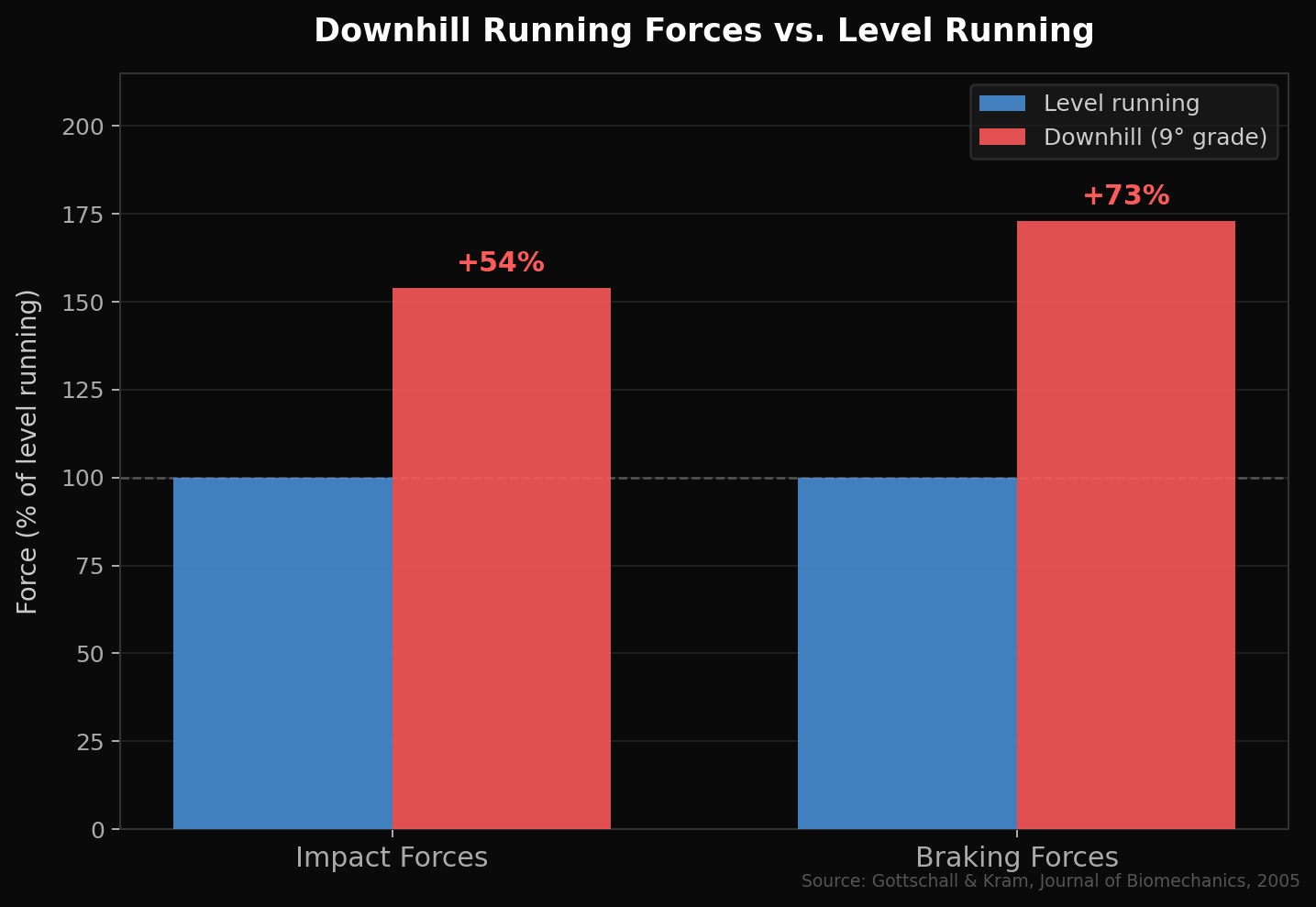
Downhill running feels easier because gravity does some of the propulsive work.
But your muscles are working harder than they appear to be, and the damage accumulates in a way that flat running doesn’t produce.
Those forces have to go somewhere.
Your quads absorb them through eccentric contractions, where the muscle lengthens under tension as it brakes your body’s descent.
Eccentric contractions are uniquely damaging to muscle tissue compared to the concentric contractions that drive flat running.
A comprehensive review in Sports Medicine found that downhill running induces significant exercise-induced muscle damage, with maximal force production in the quadriceps declining by 16–37% in trained runners, with those impairments persisting for up to 4 days post-race.
Longer downhills and steeper grades amplify the damage.
Runners who haven’t specifically practiced downhill running are more vulnerable, because untrained muscles absorb more structural damage per eccentric contraction than adapted ones.
This explains the asymmetry between uphill and downhill: uphills cost more energy than downhills return, and downhills add eccentric damage and reduce efficiency in ways the uphills don’t cause in reverse.
A hilly course with perfectly equal elevation gain and loss will almost always be slower than a flat course of the same distance.
Research examining trail race outcomes found that running efficiency decreased by 3.2% in the 48 hours following a prolonged downhill run, meaning runners burned more energy per mile at the same pace even after the descent was finished.
How Should You Structure Hill Training?
Hill training requires 2 distinct approaches, and most runners only use 1 of them.
How Do Short Hill Repeats Build Speed and Power?
Short repeats of 30–90 seconds at high effort are excellent for building VO2 max and leg power.
The physiological demand of driving hard up a steep 6–8% grade for 60 seconds stresses your cardiovascular system in a way that produces rapid adaptation.
Race hills are typically longer and at a more moderate grade, run at a conservative effort level rather than an all-out sprint.
The adaptations from short hill repeats, namely VO2 max, leg strength, and running economy, are genuinely valuable, but pairing them with a second approach is what actually prepares you to race over a hilly course.
For a complete breakdown of how hill sprints build flat-course speed, this RunnersConnect guide covers the specific protocols and recovery structure behind the adaptation.
Why Do Rolling Hills in Long Runs Matter?
Incorporating rolling hills into your long runs and threshold workouts provides the specific stimulus a hilly race demands: sustained pacing over gradual terrain, teaching your legs to maintain effort through repeated smaller climbs.
This is the approach elite groups use when preparing for hilly marathons.
The Hansons Marathon Project routed all their workouts over a hilly out-and-back loop when preparing for the 2008 Olympic Trials in New York, giving Brian Sell the race-specific fitness to eventually make the Olympic team.
If your goal race has significant downhill sections, you also need to practice running downhills specifically.
How Do You Train for Downhills Without Getting Injured?
Because downhill running causes greater eccentric muscle damage than uphill or flat running, introducing it too aggressively in training leads to injury.
Start with short, gradual descents on softer surfaces like grass or packed trail early in your training block.
Progress to longer and steeper descents on pavement only as your goal race approaches, and avoid combining hard downhill training with other high-stress sessions in the same training week.
The repeated eccentric loading from hill training is also where creatine provides a meaningful edge for distance runners.
That’s why we partnered with MAS Creatine. Research shows creatine supports training adaptation and repeated sprint capacity from high-intensity interval sessions, including the kind of hard hill repeat work that drives the biggest fitness gains.
It’s formulated specifically for endurance runners and delivered as a gummy to avoid the GI issues that traditional creatine powder causes during training.
Pair your hill repeats with rolling hills in long runs and specific downhill practice: the 3 adaptations are distinct, and you need all of them to race well on a course with meaningful elevation change.
| Hill Factor | What the Research Shows | Practical Implication |
|---|---|---|
| Hill training benefits | Uphill HIIT improves VO2 max, velocity at lactate threshold, and leg strength simultaneously | Hill repeats replace both a speed session and a strength session in one workout |
| Flat-speed transfer | VO2 max gains and running economy improvements apply to all terrain types | Hill training builds fitness for flat races, not just hilly ones |
| Uphill pace cost | ~12–15 sec/mile per 1% grade (7–9 sec/km) | Run by effort, not pace. Slow down early on climbs. |
| Downhill pace recovery | ~8 sec/mile per 1% grade (5 sec/km). Net gain is less than the uphill cost. | You gain back less than you lost. Adjust your goal time for hilly courses. |
| Downhill impact forces | 54% increase in impact force, 73% increase in braking force at a 9-degree grade | Run descents at controlled effort to protect your quads |
| Eccentric muscle damage | 16–37% reduction in quad force production, persisting up to 4 days | Train downhills specifically; build gradually early in the training block |



9 Responses
Very interesting, especially considering an upcoming race I am doing with a lot of downhills in it.
Perhaps a question with no answer…. How do you train for a hilly race when you live close to sea level and it’s flat everywhere? Treadmill is not an option.
Use stairs in high buildings!
You can also try parking garages that have multiple stories.
Thanks for the tips I am a cross country runner and I have a big race coming up.
Happy to help! Hope you are able to power up the hills to a great finish!
Anyone who has run hills, knows most of this to be true, experientially. The question is what can be done to mitigate the negative effects? For example – uphill is pretty straight forward – push up hard, full rearward leg stretch and hold a pace you can sustain (aerobically). Downhill is the trixy one – short stride and brakes, or longer stride and faster – but for endurance runners, on a mountain marathon – which is better, which is less fatiguing?
Hi Nic, thanks for reaching out. We have actually written a few articles on correct form for up and downhills, and this one explains it in detail https://runnersconnect.net/running-training-articles/how-to-run-hills/ this is the best way to negate the effects like you said, but like you said, downhill can be the tricky one. We explained it best in the article I just sent you and it has an image, which seems to be most helpful for runners. Hope this helps, best of luck with your training!