

You’re standing at mile 6 of your planned 12-mile long run when your legs feel heavy and your schedule suddenly tightens. A question crosses your mind: could you just run 6 miles now and another 6 miles this evening instead?
It’s a question almost every runner asks at some point, especially those juggling training with work, family, or injury.
The intuition is understandable: total running volume should matter more than whether it arrives in one session or two.
The short answer is more nuanced than yes or no.
What makes a long run “long” isn’t just the total distance: it’s the sustained metabolic stress that emerges only during continuous effort, triggering specific adaptations that split sessions cannot replicate.
So, in this article you’re going to learn the research-backed practical advice on:
- Whether long runs can actually be split without losing key training benefits
- Why easy runs and long runs respond so differently to splitting
- The specific physiological adaptations you lose (and when you don’t) by breaking runs into two sessions
- When splitting your run makes genuine sense, and when it defeats your training purpose
- The recovery timing you need between split sessions
Is Splitting Your Long Run a Bad Idea?
The answer depends entirely on which type of run you’re splitting.
When runners talk about “splitting” a run, they typically mean breaking one session into two shorter sessions on the same day, with a recovery period between them. This is different from simply doing two separate training days or running twice a week as part of regular periodization.
Your instinct about total volume is partly correct. The cumulative training effect does depend on how much you run over a week.
But the training stimulus from a 12-mile continuous run is fundamentally different from 6 miles plus 6 miles with a gap between them, even if the total mileage is identical.
That difference matters most for long runs.
Easy runs, by contrast, can be split without losing the core training benefit because the adaptation you’re seeking (improved aerobic capacity and steady-state fuel utilization) doesn’t require the metabolic stress of sustained, uninterrupted effort.
The distinction between these two types of runs shapes everything about how you should approach splitting. Understanding why they respond so differently to the split-versus-continuous question is what separates smart training decisions from well-intentioned mistakes.
What Makes a Long Run “Long”? The Physiology of Distance
A long run isn’t defined by a specific distance or time. It’s defined by the sustained physiological demands that trigger adaptations unique to prolonged effort.
Most runners think of long runs as simply “high volume.” But the real training effect comes from what happens to your body during that sustained effort, not from the total miles themselves.
The first major shift occurs around 60 to 90 minutes into continuous running.
Your muscle glycogen stores (the carbohydrate energy stored directly in your muscle tissue) begin to deplete significantly at this point, depending on your pace and fitness level.
The glycogen depletion that occurs around the 60 to 90-minute mark activates fat oxidation pathways and develops metabolic flexibility, your body’s capacity to switch efficiently between carbohydrate and fat as fuel sources.
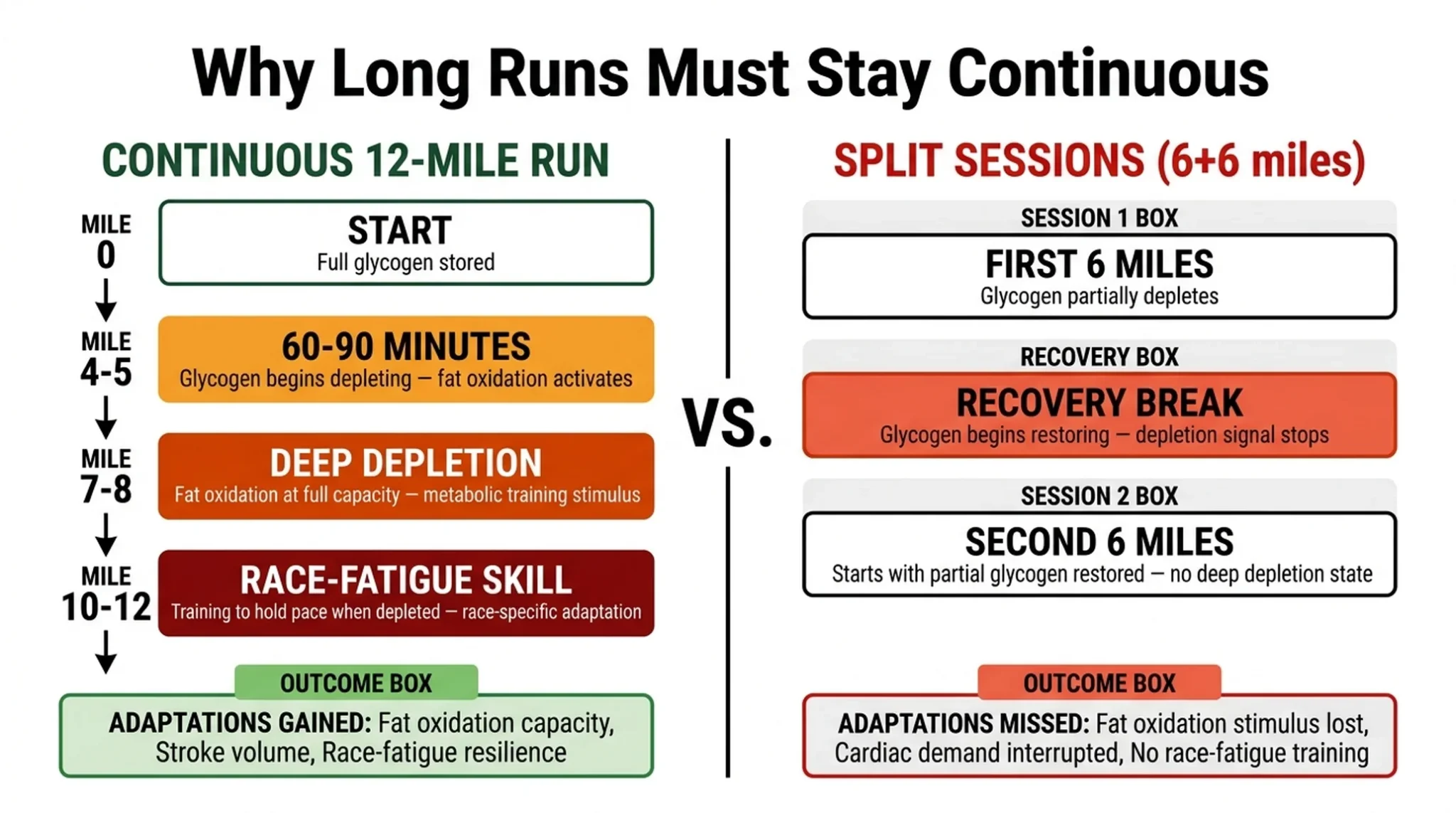
When you split your run, you interrupt this signal.
If you run 6 miles, recover for an hour, eat some carbohydrate, then run another 6 miles, your second session starts with replenished glycogen. Your body never spends sustained time in the energy-depleted state that drives these adaptations.
Research in recreational runners found that training with periods of glycogen depletion improved running economy at lactate threshold, while continuous high-carbohydrate training with no glycogen depletion produced no such improvement.
Beyond fuel metabolism, sustained effort also drives cardiovascular adaptations that require continuous demand on your heart.
Your stroke volume (the amount of blood your heart pumps per beat) increases in response to the sustained cardiac output demands of long, uninterrupted running.
Split the session, and you reduce the total duration of high cardiac demand, which weakens this adaptation stimulus.
There’s also a neural and psychological component to long-run training that researchers describe as “training the anaerobic threshold under fatigue.”
Your body learns to maintain lactate clearance and hold your goal pace even as glycogen depletes and mental fatigue sets in.
This specific adaptation (running strong when truly depleted) is a skill that only emerges during continuous effort long enough to create genuine depletion.
Split sessions don’t teach this skill because the second session starts fresh.
RunnersConnect Bonus
Download your FREE Long Run and Aerobic Pacing Calculator now.
Need help converting your race times to your optimal easy and long run pace? Download our FREE calculator and we’ll do the math for you.
Can You Split an Easy Run?
Yes, without hesitation.
Easy runs serve a different training purpose than long runs, and they respond to a different stimulus.
With easy runs, the goal isn’t to trigger the specific adaptations that require sustained metabolic stress. The goal is to accumulate aerobic training volume at an intensity that improves your cardiovascular base without creating excessive fatigue.
Aerobic capacity improves through consistent training stimulus applied over time, not through any single session’s duration.
What matters most for the adaptations you’re seeking from easy runs is total volume per week, the frequency of moderate-intensity sessions, and appropriate recovery.
The adaptations themselves (increased capillary density, improved mitochondrial function, enhanced fat oxidation at lower intensities) all respond to the cumulative stimulus of many moderate efforts, not to the uninterrupted duration of a single session.
Two 4-mile easy runs on the same day, separated by 6 to 8 hours, produce essentially the same aerobic training stimulus as a single 8-mile easy run, provided you’ve allowed adequate recovery between them.
Proper carbohydrate intake between sessions becomes the critical variable when you split.
Your muscles need roughly 4 to 6 hours to restore significant glycogen following an easy run. If you’re only 2 hours apart, your second session starts with incomplete glycogen stores, which changes the training stimulus even if only slightly.
The practical answer: if you need to split an easy run due to time constraints, injury management, or heat concerns, you can do so without losing the core training benefit.
Easy runs can be split without losing training benefit because aerobic adaptation responds to total volume and training frequency, not to continuous session duration.
Schedule the second session at least 6 to 8 hours after the first, refuel with carbohydrate-rich food between sessions, and the aerobic training signal is essentially the same as a continuous run of that distance.
What Do You Actually Lose When You Split a Long Run?
Splitting a 12-mile long run into two 6-mile sessions removes the physiological trigger that makes the long run uniquely valuable.
The most direct loss is the depletion state itself.
When you stop running, your muscles begin restoring glycogen almost immediately, even before you lace up for the second session.
The metabolic signal that drives fat adaptation depends on sustained, progressive depletion, not on covering a certain total distance.
Your first 6-mile session partially depletes glycogen, then recovery interrupts the process.
Your second 6-mile session starts with partially restored fuel stores, so your body never reaches the deep depletion state that forces fat oxidation adaptation.
Your heart also adapts differently to sustained demand than to two shorter, interrupted bouts.
Stroke volume (the amount of blood pumped per beat) increases in response to prolonged, uninterrupted cardiac output demand.
Split sessions compress that sustained demand into two shorter windows, which weakens the cardiac adaptation stimulus relative to continuous running.
Beyond fuel and cardiac changes, there’s a race-specific skill that develops only during continuous long runs.
As glycogen depletes deep into a long run, your running mechanics shift in ways that challenge your ability to hold pace and form.
Training through that depletion state is what prepares you to hold goal pace in the final miles of a race.
Split sessions skip this entirely because your second session starts fresh, before meaningful depletion occurs.
A race is a continuous effort. Long run training that doesn’t match that demand leaves race-specific adaptations on the table.
When Does Splitting a Run Actually Make Sense?
There are situations where splitting is the right call, but they’re specific and limited.
Is It Safe to Split Runs in Extreme Heat?
In extreme heat or humidity, splitting your run reduces your total heat stress exposure while still accumulating meaningful training volume.
Physiological safety always outweighs optimal adaptation.
Can Splitting Help During Injury Recovery?
If you’re navigating a bone stress reaction, tendinopathy, or soft-tissue load issue, two shorter sessions may impose less cumulative mechanical stress than one continuous long session.
Running shorter and protecting the injury is a smarter trade-off than skipping the run entirely.
What About Time Constraints on Easy Runs?
If you can’t fit a 6-mile easy run into one block on a busy day, split it.
The aerobic adaptation from easy runs doesn’t require uninterrupted duration.
Splitting is never the right answer for:
- Your weekly long run during a normal training block
- Quality workouts like tempo or threshold runs, where fatigue accumulation is part of the stimulus
- Any run during peak training weeks when the long run is central to your race preparation
Use splitting as a practical tool for genuine constraints, not as a regular substitute for continuous long run training.
How Long Should the Gap Be Between Two Split Sessions?
The gap between split sessions matters more than most runners account for.
Glycogen resynthesis happens fastest in the first few hours after exercise.
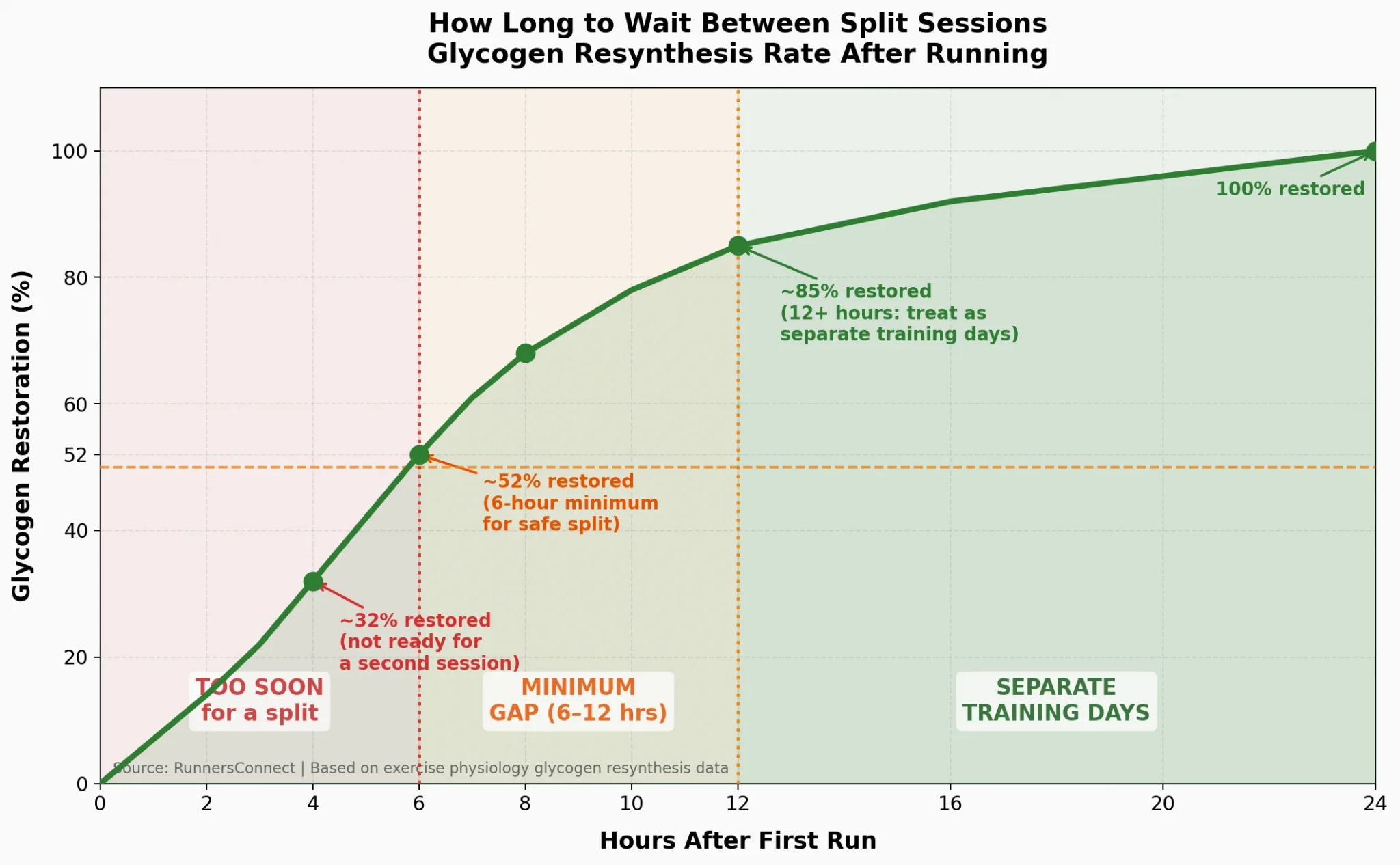
Your muscles restore approximately 5 to 7 percent of glycogen per hour in the early recovery window, reaching roughly 50 percent restoration by 4 hours and approaching full replenishment only after 20 to 24 hours.
If you run your second session 2 hours after the first, you’re starting that session with significant glycogen deficit.
That may occasionally be a training goal (running on low fuel to train fat utilization), but for most runners, it’s unintentional and creates disproportionate fatigue without the targeted adaptation of a designed low-fuel workout.
Six to 8 hours is the practical minimum gap for a same-day split to function as intended.
This window allows meaningful glycogen restoration and hormonal recovery (cortisol levels, which spike during exercise, need time to normalize before a second session).
At 12 or more hours between sessions, your body essentially treats them as two separate training days.
That’s fine for easy runs, and it’s worth knowing because the distinction changes how you plan nutrition and warm-up.
If you’re splitting with less than 6 hours between sessions, refuel aggressively with fast-digesting carbohydrates immediately after the first run to close the glycogen gap before the second session begins.
What Elite Endurance Athletes’ Training Structure Tells You About Long Runs
The best endurance runners in the world typically train 5 to 6 days per week, accumulating very high total mileage.
Despite this volume, they do only one extended long run per week.
The reason isn’t lack of ambition or recovery capacity.
The specific adaptations from a long run carry a high recovery cost that requires 48 to 72 hours to process fully.
Doing a second long run (or splitting one into two “long” sessions) before recovery completes doesn’t double the adaptation.
It increases injury risk, elevates fatigue, and often reduces the quality of the week’s other training sessions.
Elites have also learned through practice and coaching that the long run’s value comes from doing it right, not doing it more often.
One well-executed, continuous long run per week delivers more training value than two split sessions or two shorter “long” runs combined.
One well-executed continuous long run per week delivers more training value than multiple split or shortened long-run sessions of the same total distance.
RunnersConnect Bonus
Download your FREE Long Run and Aerobic Pacing Calculator now.
Need help converting your race times to your optimal easy and long run pace? Download our FREE calculator and we’ll do the math for you.
| Run Type | Can You Split It? | What You Lose by Splitting | Minimum Gap If You Do |
|---|---|---|---|
| Easy run | Yes | Nothing significant (with proper recovery) | 6 to 8 hours, with carbohydrate refueling |
| Long run | Not recommended | Glycogen depletion adaptations, sustained cardiac demand, race-fatigue skill development | Not a substitute regardless of gap |
| Quality workout (tempo, threshold) | Only in structured formats | Fatigue accumulation that makes the workout effective | Requires specific coaching guidance |