
The surface under your feet changes how hard every step hits your body.
Concrete delivers the highest impact forces of any common running surface.
Asphalt runs about 10% softer. Grass and trails absorb more still, but create their own injury trade-offs.
Tracks return energy to your stride in a way roads never can.
None of that makes one surface universally best.
The research shows that surface selection matters most when matched to your training goal, injury history, and what’s available in your area. Here’s what the science actually says about each option and how to use them strategically.
You’ll learn:
- Which surface reduces impact forces the most, and why that doesn’t always translate to fewer injuries
- The concrete vs. asphalt difference, and when it actually matters
- What trail running does to acute injury risk that road runners should know
- Why grass costs more energy than pavement despite feeling softer
- How to match surface type to specific workout goals
- The best surface options for runners dealing with knee pain
- Whether treadmill running is easier on your joints than road running
Which Running Surface Puts the Least Stress on Your Body?
Surface hardness affects the peak impact force your body absorbs with each foot strike.
A 2023 systematic review and meta-analysis that pooled 42 studies found that running on softer, more compliant surfaces reduces peak impact forces compared to harder surfaces, with the magnitude depending heavily on surface type and shoe cushioning.

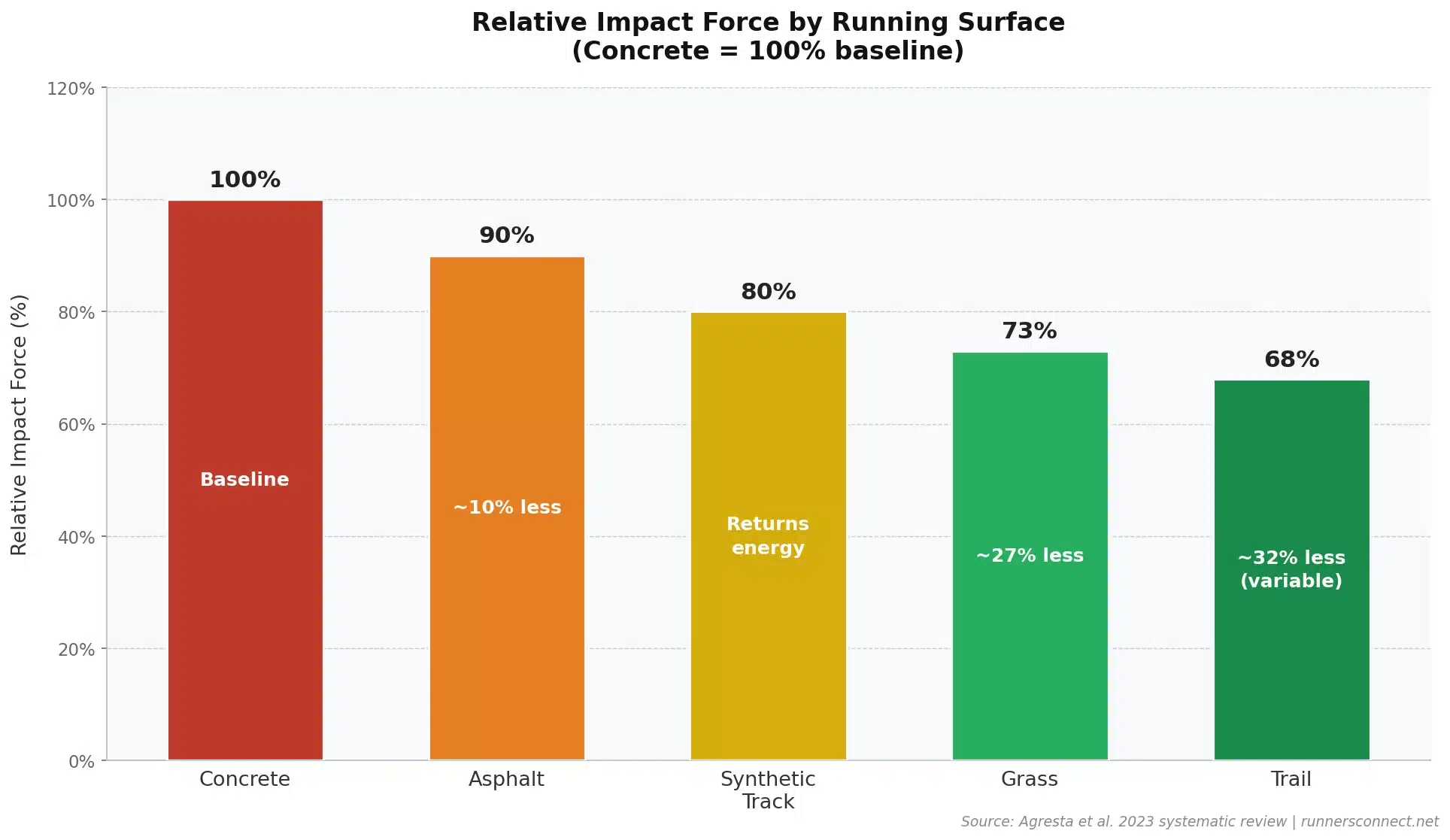
The order from highest to lowest impact force, across most research: concrete, asphalt, synthetic track, grass, dirt trail.
What makes this complicated is something called the “preferred movement path” effect.
Your body doesn’t passively absorb impact. It actively adjusts leg stiffness, foot strike angle, and stride mechanics within a few steps of landing on a new surface.
On softer surfaces, your legs stiffen up. On harder surfaces, they soften slightly.
The result is that the difference in impact force your tissues actually experience is often smaller than the raw surface hardness numbers suggest.
The surface matters, but your body is constantly compensating. Switching to a softer surface doesn’t automatically reduce injury risk if you ramp up mileage at the same time.
That said, the compensation effect is partial, not complete. Harder surfaces still deliver more cumulative stress over long training blocks, which is why surface selection matters most during high-volume phases.
Does Running on Concrete Cause More Injuries Than Asphalt?
Concrete is the hardest common running surface, with essentially no energy return during the loading phase.
Asphalt is meaningfully softer.
Research on running surface properties shows asphalt reduces peak impact forces by approximately 8 to 12% compared to concrete, due to its bituminous composition allowing slight deformation under load.
An 8 to 12% force reduction adds up over thousands of foot strikes in a training week.
If you run on roads and have the option to choose, asphalt is the better default for easy and long runs.
Sidewalk running gets a bad reputation for a reason. Sidewalks are nearly always concrete, often uneven, and frequently cambered in ways that create asymmetrical loading on your hips and knees.
When you can, move your road miles to asphalt.
For most recreational runners, swapping concrete sidewalks for asphalt roads during weekly long runs is the single most practical surface change you can make.
The practical limitation is that for most urban runners, surface choice is constrained by geography.
You run where the sidewalks and paths go. The goal is to make better choices when options exist, not to obsess over what’s underfoot when no choice is available.
RunnersConnect Bonus
Download your FREE Injury Assessment and Prediction Video now.
A good injury prevention program starts with assessing where you’re weak and where you might be tight or inhibited. In the video I’ll demonstrate the six mobility tests you need to perform to assess what you need to begin working on.
Is Trail Running Better for Preventing Overuse Injuries?
Trail running reduces your risk of certain overuse injuries while increasing others.
The surface variety on trails constantly changes your foot strike angle, stride length, and landing mechanics. Your hip stabilizers, ankle stabilizers, and proprioceptive systems all work harder.
That neuromuscular demand is actually a training benefit.
Research from the Journal of Experimental Biology found that runners on uneven terrain demonstrate significantly greater activation in hip stabilizing muscles, suggesting trail running builds the neuromuscular resilience that protects against injury on any surface.
The trade-off is acute injury risk.
Trail runners have higher rates of ankle sprains, knee ligament strains, and falls. The same surface variability that builds strength also creates opportunities to roll an ankle or catch a root.
The practical implication depends on where you are in training.
During base building, 20 to 30% trail running provides neuromuscular stimulus without high intensity demands. During race-specific training for road events, shifting back toward roads makes sense for pace-specific preparation.
Trail running isn’t categorically better or worse for injury prevention. It shifts the risk profile from repetitive stress injuries toward acute traumatic injuries.
Is Running on Grass Better Than Running on Pavement?
Grass reduces the impact forces on your legs, but it does not make running easier on your cardiovascular system.
The surface deformation that makes grass feel softer absorbs energy from each foot strike without returning it to your stride.
Research comparing running on natural grass versus asphalt found that runners expend approximately 5% more energy on grass at equivalent speeds, despite the lower ground reaction forces.
That gap matters in practice.
A tempo run at your threshold pace on grass will push your heart rate 4 to 6 beats per minute higher than the same pace on asphalt, making it harder to accurately target training intensity.
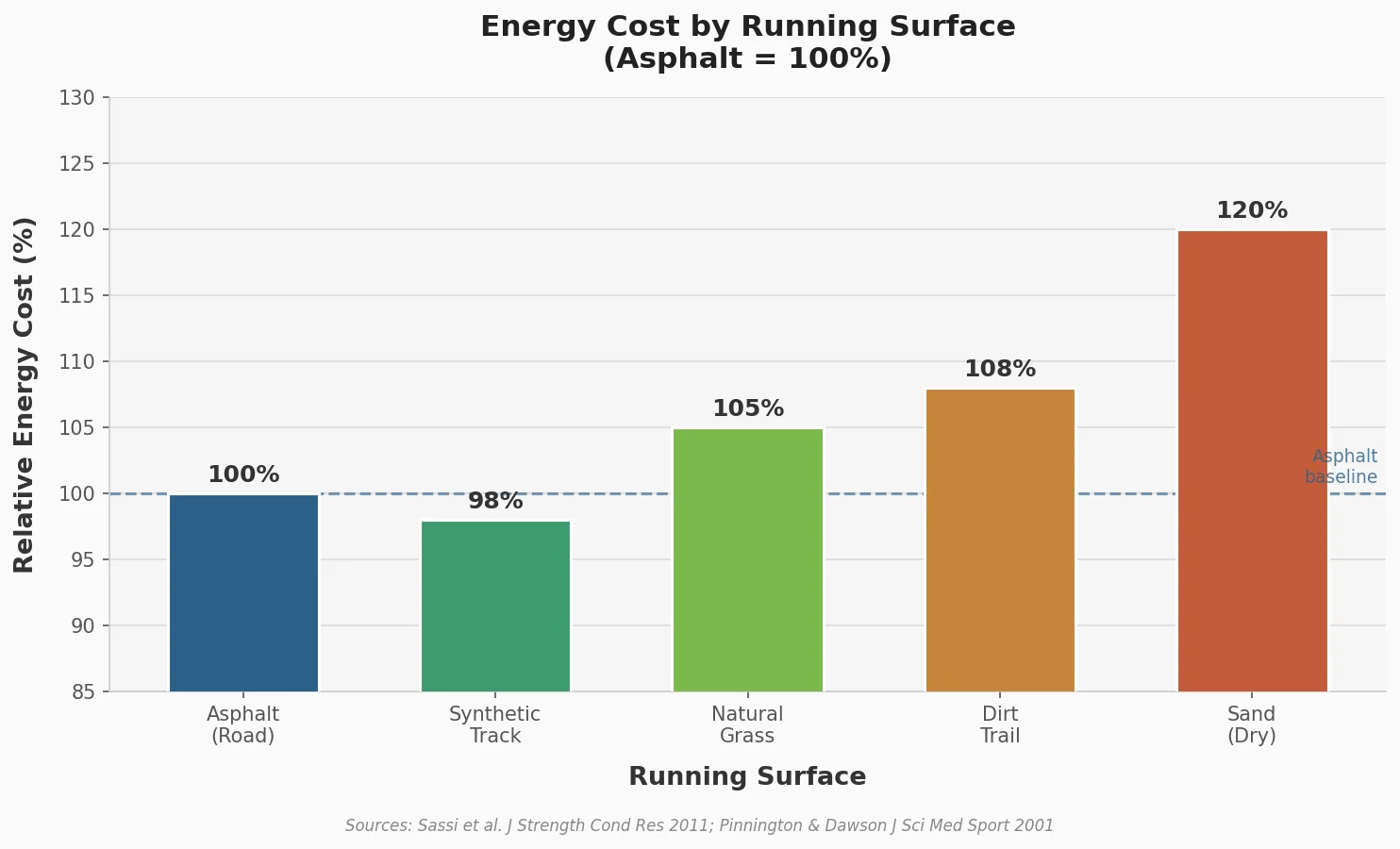
For recovery runs, that trade-off works in your favor.
The lower impact forces on grass reduce cumulative bone and cartilage stress, which is the primary goal of a recovery session, not pace or heart rate accuracy.
Use grass for easy runs and recovery days. For tempo runs, threshold sessions, or long runs where pace and effort accuracy matter, stay on asphalt or a flat path.
Grass also varies significantly in surface quality.
Firm, dry grass on a sports field behaves differently from soft, wet grass after rain.
Wet grass increases surface compliance further and raises ankle-turning risk, especially on sloped ground or near field edges.
The 5% energy cost difference assumes consistent grass surface quality. On real parks and playing fields, actual energy cost can run higher depending on turf conditions.
Do Synthetic Running Tracks Reduce Impact Forces?
Synthetic tracks are engineered specifically to return energy to your stride rather than just absorbing it.
This is different from a soft surface like grass that reduces impact force by absorbing energy and dissipating it. A track surface is designed to store energy during the loading phase and return it during push-off.
The result is that tracks can support faster times for equivalent effort, which is why interval training on tracks is standard for speed development.
Track surfaces are best for quality speed sessions where you want accurate pace feedback and minimal resistance variation, not for high-volume easy days.
One consideration for runners using tracks heavily: the consistent left-hand turn loads your inside leg differently from your outside leg.
Rotating direction every few laps, or running some of your track sessions on straight sections, reduces that asymmetrical loading over time.
How to Pick the Best Running Surface for Your Training Goal
Matching surface to workout type gets more out of each training session.
Easy runs and long runs: Asphalt or firm dirt paths.
The goal is cardiovascular stimulus with low musculoskeletal cost. Trails work here too if you’re not chasing a specific pace.
Tempo runs and threshold work: Asphalt or track.
You need a consistent surface to hold pace precisely. Trails add terrain variability that makes it hard to sustain a target effort.
Interval sessions: Track.
The energy return helps you hit target paces. Lap structure makes distance measurement exact.
Recovery runs: Grass, soft dirt, or trails if available.
Lower-intensity days benefit most from surface softness. The reduced impact force is a genuine recovery tool here, not just preference.
Base building weeks: Mix asphalt (majority) with 20% trail or grass.
The neuromuscular variety from trail work improves injury resilience without disrupting aerobic development.
The 80/20 rule is a reasonable starting point: 80% of weekly miles on roads, 20% on softer or varied surfaces. Adjust based on what’s accessible and what your injury history suggests.
What’s the Best Running Surface for Knee Pain?
The answer depends on what kind of knee pain you’re dealing with.
For runners with patellofemoral pain (runner’s knee), softer surfaces reduce cumulative impact. Moving regular runs from concrete sidewalks to asphalt, grass paths, or dirt trails lowers the repetitive load on the kneecap cartilage.
For IT band syndrome, the bigger issue is often cambered roads, not surface hardness.
Running along road edges where the asphalt tilts toward the curb creates asymmetrical hip and knee loading. Moving to the middle of the road or a flat path matters more than surface softness for ITBS management.
For tibial stress injuries, soft surfaces are a meaningful management tool.
Grass, dirt trail, and treadmills all reduce peak impact compared to roads. A runner managing bone stress through a return-to-run protocol benefits from understanding how leg stiffness adapts to surface changes as they rebuild mileage carefully.
The Run Clever randomized trial found that both rapid volume increases and rapid intensity increases independently predict injury in recreational runners, meaning surface change alone isn’t enough if training load is also climbing.
The surface is one variable. Training load progression is the bigger one.
If you’re managing knee pain, run on the softest available surface while also slowing any mileage buildup. Both levers matter.
RunnersConnect Insider Bonus
Download our free Top 5 IT Band Prevention Exercises guide.
It’s a PDF with the 5 best exercises to help you prevent IT band syndrome.
Is Treadmill Running Easier on Your Joints Than Running Outside?
Treadmill running sits between asphalt and grass on the impact spectrum.
The rubber-cushioned belt and suspended deck absorb shock differently than any outdoor surface.
Research published in Medicine and Science in Sports and Exercise found that peak tibial acceleration during outdoor field running was measurably higher than during indoor treadmill running at equivalent speeds, confirming that the treadmill deck provides genuine shock reduction at the bone level.
For runners managing bone stress injuries or recovering from shin-related conditions, that difference is meaningful.
Shifting training volume to a treadmill during a return-to-run protocol provides a lower-impact environment than roads without requiring access to trails or grass.
One calibration is required: running on a flat treadmill at 0% incline underestimates the metabolic demand of outdoor running.
A 1% gradient closely matches the energy cost of outdoor running at the same pace by compensating for the belt’s forward assist and the absence of air resistance.
For healthy runners without injury history, whether a treadmill changes your running experience depends more on personal preference and training goals than on surface mechanics.
The biomechanics of overground and treadmill running converge closely enough at moderate speeds that surface choice becomes a practical decision rather than a physiological one.
Use a treadmill during bone stress injury recovery, in extreme weather, or when you need a controlled surface for pace work. Set 1% incline for outdoor-equivalent eff
| Surface | Impact Level | Primary Injury Risk | Best Training Use |
|---|---|---|---|
| Concrete | Highest | Stress fractures, plantar fasciitis | Unavoidable in cities; minimize when possible |
| Asphalt | High (8-12% less than concrete) | Repetitive stress (lower than concrete) | Default for easy, long, and tempo runs |
| Synthetic track | Moderate (energy-re
 Jeff Gaudette, M.S. Johns Hopkins UniversityJeff is the co-founder of RunnersConnect and a former Olympic Trials qualifier. He began coaching in 2005 and has had success at all levels of coaching; high school, college, local elite, and everyday runners. Under his tutelage, hundreds of runners have finished their first marathon and he’s helped countless runners qualify for Boston. He's spent the last 15 years breaking down complicated training concepts into actionable advice for everyday runners. His writings and research can be found in journals, magazines and across the web. 
|