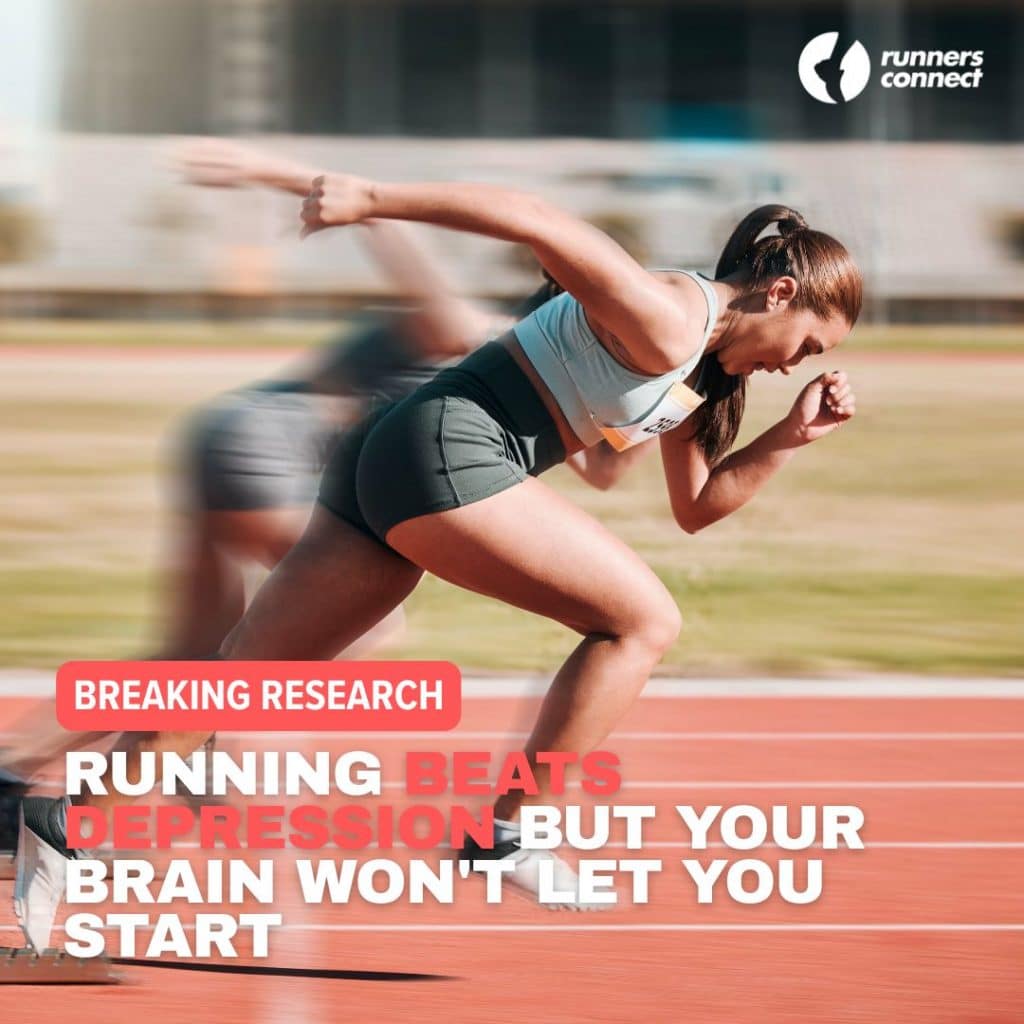

If you’re a runner who’s ever stood at a starting line with sweaty palms, a racing heart, and thoughts spiraling toward worst-case scenarios, you’re dealing with one of the most common yet under-addressed aspects of running performance.
Pre-race anxiety.
And you’re not alone. Research shows that up to 78% of runners experience significant pre-race anxiety.
Even worse this research indicates that performance anxiety affects their race results more than inadequate training or poor pacing strategies.
Anxiety doesn’t just make racing unpleasant, it actively undermines your performance through physiological and psychological mechanisms that can cost you minutes in longer races.
In this article, we’ll explore…
- The science behind running anxiety and how your fight-or-flight response actually works in competitive settings.
- Examine evidence-based techniques backed by sports psychology research for managing pre-race nerves
- And provide a systematic approach to building race-day confidence.
The Hidden Performance Killer Most Runners Ignore
Most runners spend countless hours perfecting their training plans, analyzing their splits, and optimizing their nutrition.
Yet they completely ignore the mental component that can derail months of preparation in a matter of minutes.
A landmark study by Raglin and Hanin [1] found that anxiety-related performance decrements in athletes can be equivalent to being undertrained by 10-15%.
Think about that for a moment.
All those missed workouts you stressed about? They might have less impact on your race performance than unmanaged pre-race anxiety.
The problem isn’t that you’re weak or mentally unprepared.
The problem is that most runners treat anxiety as something to “just push through” rather than understanding it as a manageable physiological and psychological response.
Understanding Your Fight-or-Flight Response in Racing
Your body’s anxiety response evolved for immediate physical threats, not the complex psychological pressure of hitting a PR in front of hundreds of strangers.
But your nervous system doesn’t know the difference.
Research from the Journal of Sports Sciences [2] demonstrates that the fight-or-flight response in competitive settings involves the same physiological cascade as facing a genuine threat.
Here’s what happens in your body when race anxiety kicks in:
The Sympathetic Nervous System Activation:
Your hypothalamus triggers the release of stress hormones, primarily cortisol and adrenaline.
Heart rate increases beyond what’s optimal for your race pace.
Blood flow redirects away from your digestive system toward major muscle groups.
Your breathing becomes shallow and rapid.
Muscle tension increases, particularly in your shoulders, neck, and jaw.
Why This Hurts Your Performance:
A study by Martens, Vealey, and Burton [3] found that moderate anxiety can improve performance, but high anxiety consistently impairs endurance performance through several mechanisms.
Elevated cortisol levels interfere with glycogen utilization and fat oxidation.
Increased muscle tension wastes energy and disrupts your running economy.
Shallow breathing reduces oxygen efficiency when you need it most.
Cognitive resources get diverted from pacing strategy to anxiety management.
The Cognitive Component:
Your fight-or-flight response isn’t just physical.
Research published in the International Journal of Sport Psychology [4] shows that anxiety triggers predictable thought patterns that compound the physiological effects.
These include catastrophic thinking (“I’m going to embarrass myself”), perfectionist demands (“I have to hit my goal time”), and attentional narrowing that makes you hyperfocus on discomfort rather than strategy.
The good news?
Understanding these mechanisms gives you specific targets for intervention.
Evidence-Based Techniques That Actually Work
Cognitive-behavioral therapy (CBT) techniques have been extensively researched in sports psychology, with consistent evidence for their effectiveness in managing performance anxiety.
The key is understanding that your thoughts, feelings, and physical sensations are interconnected, and you can influence all three.
Cognitive Restructuring: Changing Your Internal Dialogue
A systematic review by Bühlmayer et al. [5] found that cognitive restructuring techniques significantly reduced competitive anxiety in endurance athletes.
Here’s how to apply this practically:
1. Identify Your Anxiety Triggers:
Start by tracking your pre-race thoughts for several weeks before races or hard workouts.
Common patterns include all-or-nothing thinking (“If I don’t PR, this training cycle was worthless”), mind reading (“Everyone will think I’m slow”), and fortune telling (“I know I’m going to blow up at mile 20”).
2. Challenge Irrational Thoughts:
Research from the Journal of Applied Sport Psychology [6] shows that questioning the evidence for anxious thoughts reduces their emotional impact.
Ask yourself: “What evidence do I have that this thought is true?” “What would I tell a friend having this same thought?” “What’s the most realistic outcome based on my training?”
3. Develop Coping Statements:
Replace anxiety-provoking thoughts with evidence-based, realistic affirmations.
Instead of “I have to run a perfect race,” try “I’m prepared to handle whatever comes up and adjust my strategy accordingly.”
Breathing Techniques: Regulating Your Nervous System
Controlled breathing is one of the most researched anxiety management techniques, with particular relevance for athletes.
A study by Bellenger et al. [7] demonstrated that specific breathing patterns can rapidly shift your nervous system from sympathetic to parasympathetic dominance.
Box Breathing Protocol:
Inhale for 4 counts, hold for 4 counts, exhale for 4 counts, hold for 4 counts.
Practice this for 5-10 minutes daily during training to build familiarity.
Use it for 2-3 minutes before races or hard workouts.
Research shows this technique reduces cortisol levels and heart rate variability within minutes.
4-7-8 Breathing for Acute Anxiety:
Inhale through your nose for 4 counts, hold for 7 counts, exhale through your mouth for 8 counts.
This technique is particularly effective for the intense anxiety spikes that can occur in the final minutes before a race start.
Progressive Muscle Relaxation: Releasing Physical Tension
Studies consistently show that progressive muscle relaxation (PMR) reduces both physical tension and cognitive anxiety in athletes.
Research by Pineschi and Di Pietro [8] found that PMR practice improved both anxiety levels and performance outcomes in competitive runners.
Modified PMR for Runners:
Focus on the muscle groups most affected by running anxiety: shoulders, neck, jaw, and legs.
Tense each muscle group for 5 seconds, then release and notice the contrast.
Practice this regularly during easy runs to build body awareness.
Use abbreviated versions (focusing just on shoulders and jaw) in race situations.
Building Confidence Through Systematic Desensitization
Systematic desensitization is a behavior therapy technique that gradually exposes you to anxiety-provoking situations while maintaining a relaxed state.
For runners, this means progressively challenging yourself in race-like conditions while practicing anxiety management techniques.
A landmark study by Wolpe [9] established the theoretical foundation, while more recent research by Moran [10] has demonstrated its specific effectiveness for sports performance anxiety.
Creating Your Anxiety Hierarchy
The first step is identifying specific situations that trigger your running anxiety, then ranking them from least to most anxiety-provoking.
Common Running Anxiety Triggers (Mild to Severe):
- Registering for a goal race
- Telling others about your time goals
- Picking up your race bib
- Warming up on race morning
- Lining up in your corral
- The final countdown to the start
- The first mile of a goal race
- Hitting halfway in a challenging race
- The final miles when fatigue sets in
Your Personal Hierarchy:
Rate each situation from 0-10 based on how much anxiety it typically causes you.
Start with situations rated 3-4 on your anxiety scale.
Only progress to higher levels once you can handle lower levels with minimal anxiety.
Gradual Exposure Protocol:
Research by Kendall and Chambless [11] shows that gradual exposure is most effective when combined with relaxation techniques and cognitive restructuring.
Phase 1: Visualization Practice
Start by imagining yourself in mildly anxiety-provoking race situations while practicing breathing techniques.
Spend 10-15 minutes daily visualizing yourself successfully managing race scenarios.
Progress from easy situations (warming up calmly) to more challenging ones (maintaining composure when falling behind goal pace).
Research by Martin, Moritz, and Hall [12] demonstrates that mental practice reduces anxiety and improves actual performance outcomes.
Phase 2: Controlled Exposure
Gradually expose yourself to real race-like conditions during training.
Start with low-stakes situations: time trials on your own, small local 5Ks, or running with faster training groups.
Practice your anxiety management techniques in these settings.
Only progress to higher-stakes races once you can maintain composure in easier situations.
Phase 3: Race Application
Apply your skills in goal races, starting with less important events.
Use A, B, and C race periodization, practice anxiety management in B and C races before applying it to your A race.
Continue using breathing techniques, cognitive restructuring, and progressive muscle relaxation throughout the process.
Building Race-Day Routines
A study by Czech et al. [13] found that athletes with established routines showed significantly lower anxiety levels and more consistent performance outcomes.
Developing Your Routine:
Create a structured timeline for race morning, including specific times for:
- Wake-up and breakfast
- Arrival at race venue
- Warm-up protocol
- Final bathroom stop
- Breathing exercises
- Positive self-talk cues
Practice this routine during B and C races and hard workout days.
The familiarity reduces uncertainty, which is a major contributor to competitive anxiety.
When Anxiety Becomes More Than Pre-Race Nerves
It’s important to recognize when running anxiety crosses the line from normal nervousness to something more significant.
If your anxiety consistently interferes with training, causes you to avoid races entirely, or creates significant distress in other areas of your life, consider working with a sports psychologist.
Research by Reardon and Factor [14] indicates that approximately 15-20% of competitive athletes experience anxiety severe enough to warrant professional intervention.
The techniques we’ve discussed are evidence-based and effective for typical race anxiety, but they’re not a substitute for professional treatment when anxiety becomes debilitating.
Your Action Plan: Implementing Anxiety Management Strategies
Here’s how to systematically implement these evidence-based techniques into your training and racing:
Week 1-2: Assessment and Foundation Building
- Track your pre-race and pre-workout anxiety patterns
- Begin daily box breathing practice (5-10 minutes)
- Start identifying and challenging anxious thoughts
- Create your personal anxiety hierarchy
Week 3-4: Skill Development
- Add progressive muscle relaxation to your routine
- Practice visualization of successful race scenarios
- Begin gradual exposure to low-level anxiety triggers
- Develop your race-day routine framework
Week 5-8: Integration and Testing
- Apply techniques during hard workouts and time trials
- Test your race-day routine in B or C race settings
- Continue gradual exposure progression
- Refine techniques based on what works best for you
Ongoing: Maintenance and Advancement
- Regular practice of all techniques, not just before races
- Continued exposure to challenging race situations
- Adjustment of techniques based on experience and changing goals
The bottom line?
Running anxiety isn’t a character flaw or something you need to “tough out.”
It’s a normal physiological and psychological response that can be effectively managed through evidence-based techniques.
The research is clear: runners who systematically address performance anxiety don’t just feel better on race day, they consistently perform better too.
Your next race doesn’t have to be dominated by anxiety.
With consistent practice of these techniques, you can transform nervous energy into focused performance and actually enjoy the competitive experiences you’ve worked so hard to prepare for.