
You reach for your headphones before almost every run without really thinking about it.
You know music makes runs feel better, but you probably haven’t stopped to ask whether the playlist you’ve been using for the last two years is actually working for you, or whether a few tweaks could meaningfully change how hard your training feels.
The research on music and running has matured considerably over the last decade, and the findings are more specific than most runners realize.
If you’re like most runners I coach, you’re leaving real performance benefit on the table by not thinking strategically about what you listen to, when you listen, and how loud the beat actually is.
So, in this article you’re going to learn the research-backed practical advice on…
- Why music genuinely makes hard runs feel easier, and the physiological mechanism that explains it
- The BPM range that research has validated as optimal for running pace and effort perception
- How syncing your footstrikes to the beat can make your running form more efficient without consciously thinking about it
- When music stops helping, and how to use that knowledge to structure your training week smarter
Why Does Running With Music Make Hard Efforts Feel Easier?
Music reduces how hard a run feels by competing directly with fatigue signals for your brain’s attention.
Your brain processes a limited number of competing inputs at any given moment.
When you’re running, those inputs include the sensation of burning legs, elevated breathing, and rising discomfort, all of which register as perceived effort.
Music occupies the same attentional channels those signals travel through.
The result is that some of the effort signals get crowded out, and your run feels measurably less hard even though your physiology is identical.
A multilevel meta-analysis of 139 studies found that music was associated with meaningful improvements in physical performance and significant reductions in perceived exertion across a range of exercise types.
This analysis, led by Terry and Karageorghis at the University of Southern Queensland and Brunel University London, drew on data from over 3,500 participants.
The performance improvement and effort reduction were consistent enough across studies that the researchers described music as producing a reliable ergogenic effect, meaning it genuinely helps you work harder for the same perceived cost.
A review by Karageorghis and Priest found that music can reduce ratings of perceived exertion by approximately 10% during physical tasks.
For a runner, a 10% reduction in how hard a run feels is significant.
On a long run where fatigue compounds over two hours, that perceptual buffer can be the difference between holding your target pace through the final miles and backing off early.
The effect is strongest at low-to-moderate intensities, a point that matters for how you structure your playlist strategy, which the final section of this article covers directly.
RunnersConnect Bonus
Download your FREE Improvement Performance Calculator now.
This handy pace calculator helps you to determine what pace you should be running at in training and at each racing distance based on a recent race result.
What BPM Should Your Running Playlist Be?
Tempo is the single most studied musical variable in exercise research, and the findings consistently point to a specific target range for runners.
That same 139-study meta-analysis found that performance benefits of music were moderated by tempo, with fast music producing greater effects than slow-to-medium music.
The validated motivational range used across most research sits between 125 and 140 beats per minute.
Music in this band creates enough rhythmic stimulation to elevate arousal and distract from effort, without the tempo becoming so fast that it feels disconnected from your running pace.
Does the Type of Music Genre Matter, or Just the Tempo?
Genre matters less than most runners assume, and tempo matters more.
Research comparing 90 BPM versus 140 BPM music during self-paced walking found significant differences in both how hard the effort felt and average pace between the two conditions, with the 140 BPM group walking faster and rating the effort as lower.
The genre of the music was pop in both conditions.
The tempo was the active variable, not the style.
That said, music you actually enjoy tends to produce stronger effects than unfamiliar tracks at the same BPM, because emotional engagement adds a motivational layer on top of the basic rhythmic signal.
Pop, hip-hop, and electronic music all sit comfortably in the 120–140 BPM range by default, which is one reason they dominate most runners’ playlists.
What Happens if Your Playlist Is Too Slow?
Slow-tempo music below 100 BPM consistently produces the worst psychological outcomes in exercise research.
Across multiple studies, low-BPM tracks were associated with decreased arousal, lower positive mood, and in some cases, performance that was no better than running in silence.
If your playlist mixes high-energy tracks with slow-tempo ballads or podcasts at conversational speed, you’re cycling in and out of the attention-management benefit that makes running with music useful.
Keeping your playlist in the 125–140 BPM band throughout a run maintains the dissociative effect more consistently than an unfiltered queue of whatever comes up next on shuffle.
How Does Syncing Your Steps to the Beat Improve Your Running Form?
When your footstrikes naturally align with the beat of your music, your cadence becomes more consistent, and consistent cadence is one of the clearest markers of efficient running form.
Research published in PLOS ONE found that runners lasted significantly longer and maintained more consistent cadence when running to beat-matched music compared to silence, with the beat helping runners couple their footfalls to a prescribed tempo.
This coupling between the musical beat and your movement is called auditory-motor synchronization.
Your brain is wired to lock physical movement to rhythmic auditory cues.
It’s the same mechanism that makes you tap your foot to a song without deciding to.
When your running cadence aligns with the beat, you stop making micro-decisions about pace and rhythm on every step, which frees up attentional resources and reduces mechanical variability in your stride.
A more consistent cadence translates directly to better running economy, because your body covers the same ground while using less energy per step.
You don’t need to consciously try to run to the beat for this effect to work.
The synchronization tends to happen spontaneously when the music tempo is close to your natural cadence, which is why matching your BPM to your steps per minute matters more than just picking fast music.
A 2022 study published in the European Journal of Sport Science followed everyday runners through a 4-week training program using music set 7.5–10% above their natural cadence, and found that the runners’ step rate increased without the researchers having to instruct them to consciously change how they ran.
Over time, the rhythmic cue does the retraining work for you.
Does It Help to Listen to Music Before Your Run?
Listening to music before you start running, during your warmup or in the minutes leading up to a hard session, primes your nervous system in a way that carries into the effort itself.
A 2023 controlled study found that fast-tempo pre-task music significantly increased self-reported arousal and produced more positive mood states compared to silence, before any exercise had begun.
Fast-rhythm music stimulates the central nervous system directly, increasing physiological arousal regardless of whether you’re consciously paying attention to the music.
This rise in arousal translates into higher motivation, faster reaction time, and a more activated baseline state going into your workout.
The practical application is simple: 5–10 minutes of high-BPM music before a tempo run, interval session, or race serves as an arousal primer that your warmup jog alone can’t replicate.
Many everyday runners underuse this tool entirely, saving their headphones for the run itself while doing their warmup in silence.
Using the pre-run window strategically gives you a psychological edge that’s already in place when the hard effort starts.
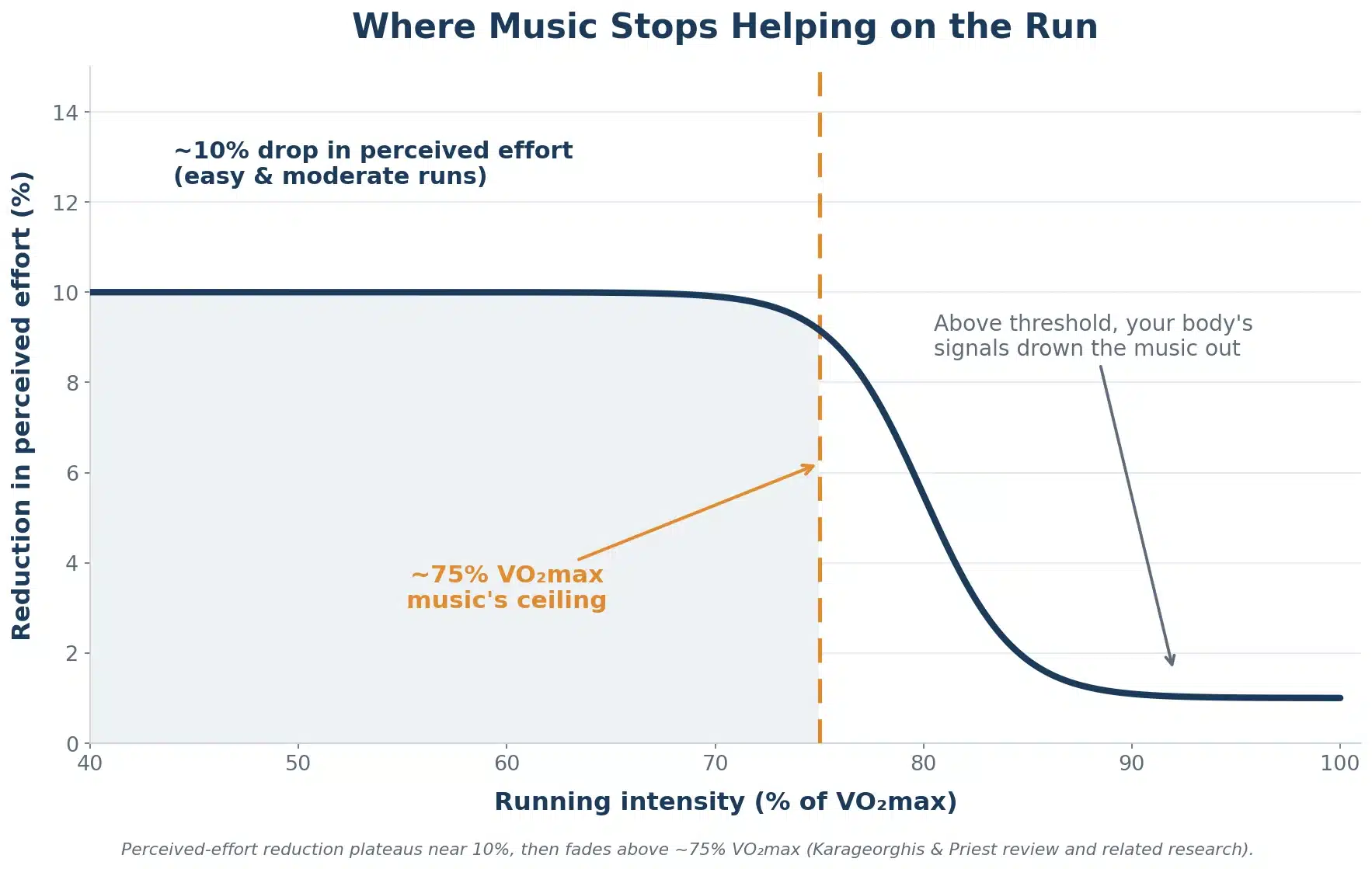
Does Music Stop Helping When You Run Hard?
Music’s ability to reduce perceived effort has an intensity ceiling, and understanding where that ceiling sits changes how you should think about music across different training sessions.
Research indicates that music reduces perceived exhaustion up to approximately 75% of maximal oxygen consumption, and these effects diminish quickly when intensity rises above that threshold.
Above the anaerobic threshold, your body’s physiological signals become too loud for music to compete with: surging heart rate, burning muscles, heavy breathing.
Attention shifts from the external (the music) to the internal (the effort), and the dissociative mechanism that makes music effective at easier paces stops working.
This has two practical implications for your training.
- First, music is most powerful on your easy runs, long runs, and moderate aerobic sessions, where you’re working below the intensity ceiling and the dissociative effect can operate fully.
- Second, on hard threshold workouts and race-effort sessions, your body’s feedback signals are exactly what you need to manage pace correctly, and music that drowns those out can lead to going out too hard or missing the pacing cues your effort level is sending.
Some experienced runners choose silence on hard workout days for exactly this reason.
On race day for road events, music is typically permitted, and it can be a useful tool in the later miles of a marathon or half when attention drifts and perceived effort climbs.
Its effect will be smaller at race pace than it was on your training runs.
How Should You Build Your Running Playlist for Better Workouts?
The research gives you a clear framework for building a playlist that actually works, rather than just filling the silence.
Start by knowing your cadence.
Most everyday runners take between 150 and 170 steps per minute on a normal training run.
A free tool like a metronome app, or a GPS watch with cadence tracking, will give you your number after one easy run.
Once you know your cadence, target music with a BPM that matches or slightly exceeds it.
Spotify’s desktop app shows BPM in the song details panel, and several running apps including Cadence (by Fit Radio) and RockMyRun auto-match your playlist to your step rate in real time.
Beyond matching cadence, here is how to structure music across the different types of runs in your training week:
- Easy and recovery runs: 120–140 BPM music works well here and makes these runs feel genuinely enjoyable without pushing you to run too fast.
- Long runs: High-BPM playlists are particularly valuable in the final third of a long run when mental fatigue compounds. Save a fresh playlist or an album you’ve been holding for those miles.
- Tempo and threshold sessions: Consider music for the warmup and cooldown, but run the hard segments by effort feel rather than relying on music to manage how hard it feels.
- Pre-run: 5–10 minutes of 130–140 BPM music before any hard session primes your arousal state before the effort begins.
| Run Type | Optimal BPM Range | Primary Benefit | When to Use It |
|---|---|---|---|
| Easy / recovery run | 120–135 BPM | Reduces perceived effort and makes easy days enjoyable | Throughout the run |
| Long run | 125–140 BPM | Attention management and delays mental fatigue | Especially miles 10+ when attention drifts |
| Tempo / interval session | 130–140 BPM (warmup/cooldown) | Arousal priming before hard efforts | Use for warmup and cooldown. Skip music during hard intervals |
| Pre-run (any session) | 130–140 BPM | CNS arousal primer that elevates motivation baseline | 5–10 min before a hard workout or race |
| Race day | 125–140 BPM | Attention management in later miles | Second half of the race when effort compounds |