
Fewer than 1% of people will ever run a marathon.
Ask the ones who never sign up why, and you hear the same reason again and again: “I’m too slow.”
If that thought has ever stopped you, the numbers tell a different story than the one in your head.
The average finisher takes well over 4 hours, most major races give you 6 to 7 hours to get it done, and the only pace that truly disqualifies you is the one that never leaves the start line.
Here’s what you’ll learn about slow and average marathon times:
- What actually counts as a slow marathon time
- The real average marathon time for men and women
- How generous course cutoff times really are
- Whether a 5, 6, or 7-hour finish counts as slow
- Why the health payoff has nothing to do with your finish time
What Counts as a Slow Marathon Time?
No governing body defines a “slow” marathon time.
The only hard number that matters is the course time limit, and at most races that limit sits between 6 and 7 hours.
Cross the line inside that window and your result is a marathon finish, recorded the same way as everyone else’s.
Any finish inside the course time limit counts as a marathon, no matter what the clock reads.
The idea of a “slow” time is a comparison you invented, usually against the fastest runners you follow online.
The runner posting a 3:15 is in the top few percent of all finishers, not the middle of the pack.
What Is the Average Marathon Time?
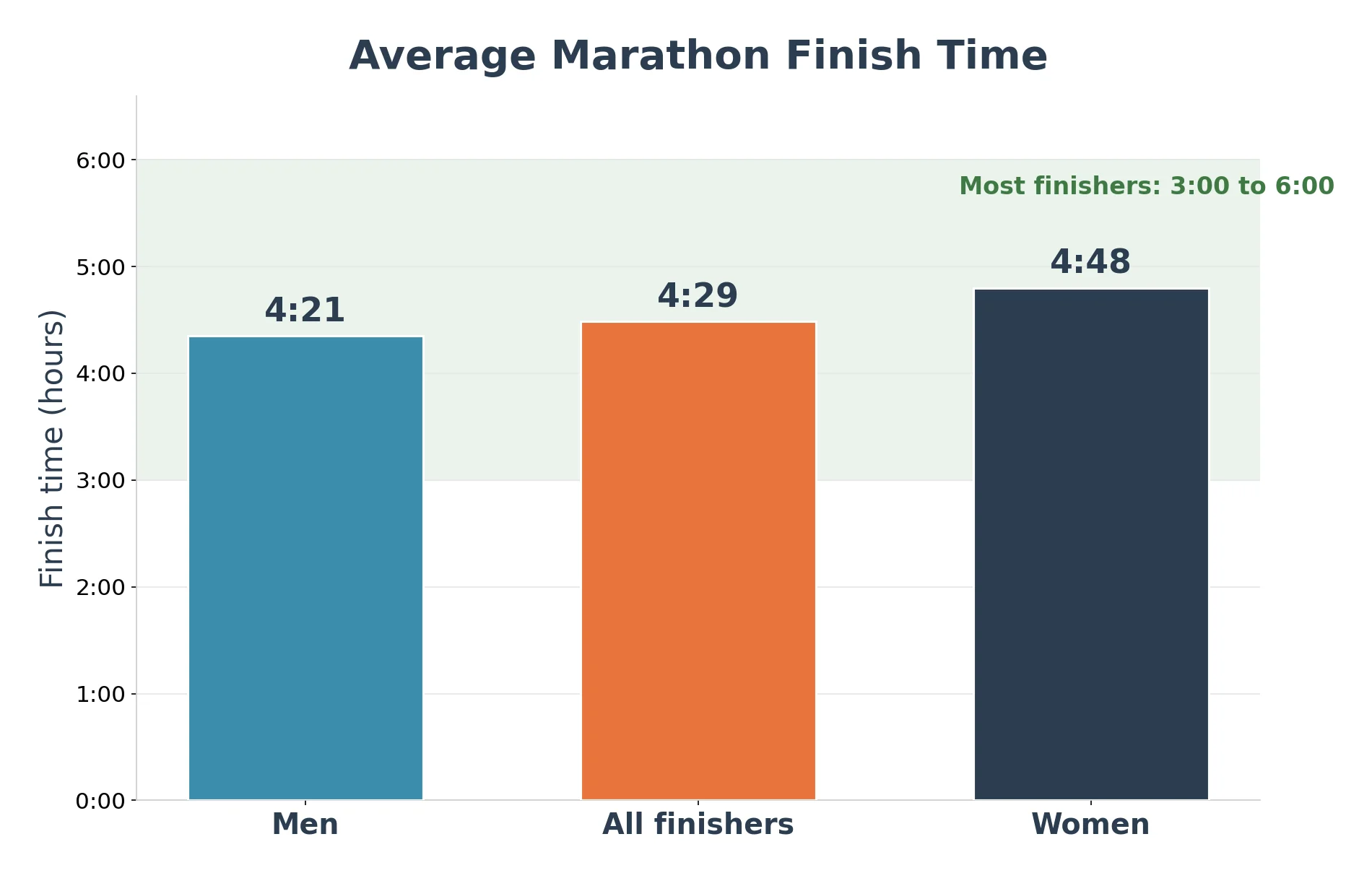
The average marathon finish time lands around 4 hours and 30 minutes across large databases of race results.
For men that average sits near 4:21, which works out to about 9:57 per mile (6:11/km).
For women it sits near 4:48, or roughly 10:59 per mile (6:50/km).
The majority of everyday runners finish somewhere between 3 and 6 hours, a range that covers almost everyone who trains for the distance.
| Group | Typical finish time | Approx. pace |
|---|---|---|
| All finishers (average) | 4:29 | 10:16/mi (6:23/km) |
| Men (average) | 4:21 | 9:57/mi (6:11/km) |
| Women (average) | 4:48 | 10:59/mi (6:50/km) |
| Most finishers fall between | 3:00 to 6:00 | 6:52 to 13:44/mi (4:16 to 8:32/km) |
These figures come from large-scale analyses of marathon results and are approximate, but the pattern holds across countries and races.
A peer-reviewed synthesis of one of the world’s biggest marathons reinforces the point.
A 2026 systematic review of New York City Marathon research documented that mass-participation fields are dominated by non-elite runners finishing well outside elite times.
A 5:30 marathon sits comfortably inside the normal range of finishers.
What Are the Marathon Cutoff Times?
This is the question pace-anxious runners most need answered, and the answer is more forgiving than you expect.
Most established marathons set a course time limit of 6 to 7 hours, which is roughly 13:44 to 16:01 per mile (8:32 to 9:57/km).
The Chicago Marathon allows 6 hours and 30 minutes, a pace of about 14:52 per mile (9:15/km).
The New York City Marathon keeps its finish line open late into the evening, giving most starters well over 8 hours on the course.
The table below shows what common finish times mean in pace terms.
| Finish time | Pace per mile | Pace per km |
|---|---|---|
| 4:00 | 9:09 | 5:41 |
| 4:30 | 10:18 | 6:24 |
| 5:00 | 11:27 | 7:07 |
| 5:30 | 12:35 | 7:49 |
| 6:00 | 13:44 | 8:32 |
| 6:30 | 14:52 | 9:15 |
| 7:00 | 16:01 | 9:57 |
A Boston Qualifying time is a separate thing, and you do not need one to run a marathon.
Qualifying standards earn guaranteed entry into specific races through speed, while most marathons offer entry by lottery, charity place, or general registration with no time standard at all.
The only cutoff you have to plan around is the course time limit, and at most races it is generous enough for a run-walk finish.
RunnersConnect Bonus
Download your FREE Long Run and Aerobic Pacing Calculator now.
Need help converting your race times to your optimal easy and long run pace? Download our FREE calculator and we’ll do the math for you.
Is a 5, 6, or 7-Hour Marathon Slow?
A 5, 6, or 7-hour marathon is a full marathon, run by someone on their feet longer than most of the field.
Spending 6 or 7 hours moving forward asks for mental staying power that faster runners rarely have to find.
Walking through aid stations or using a run-walk pattern is a normal race strategy, and it changes nothing about your result.
Research on 208,760 marathon and half-marathon finishers found that runners in the lower performance groups slow down more over the closing miles, a pacing pattern tied to how the body manages fuel rather than any lack of grit.

Planning to slow down in the second half is a reasonable strategy when you know the finish is hours away.
The Galloway run-walk method has carried millions of runners to a finish line they might never have reached at a flat-out run.
Does Your Finish Time Affect the Health Benefits?
The health payoff of marathon training does not depend on how fast you cross the line.
First-time runners in the research trained at everyday paces and still saw measurable changes in their arteries.
A 2020 study in the Journal of the American College of Cardiology found that training for a first marathon reversed aortic stiffness by an amount equal to about 4 years of aging, in first-time runners finishing at ordinary paces.
That benefit belongs to the 6-hour finisher as much as the 3:30 finisher, because both put in the training weeks.
A 2025 review in Sports Medicine Open that pooled 329 studies concluded that marathon training benefits the cardiovascular system, bone, and metabolic health across a wide range of ages and ability levels.
Lower resting heart rate, better circulation, and reduced blood pressure build up over a training block regardless of your finishing time.
How Long Is a Marathon and How Long Does Training Take?
A marathon is 26.2 miles, or 42.195 km, the same distance at every certified race in the world.
Most first-timers need 16 to 20 weeks of training to prepare for it safely.
That block builds your weekly mileage gradually and stretches your long run out toward the 20-mile (32 km) mark.
The distance never changes, so the training is what carries an everyday runner across the same finish line as a faster one.
A steady 16 to 20 week build prepares you to finish 26.2 miles at whatever pace your training supports.
How Do You Know You’re Ready to Run a Marathon?
Readiness for a marathon comes down to preparation, not a number on your GPS watch.
You can answer three honest questions to know if you are ready to register.
- Time on feet: Can you run or run-walk for 3 or more hours without serious distress?
- Easy effort: Can you hold a conversational pace for most of your long runs?
- Long-run range: Have you built long runs into the 16 to 20 mile (26 to 32 km) range in a recent block?
Three yes answers mean you are ready, whatever pace those runs happened at.
If finishing comfortably is your main goal, choose a race with a 7-hour cutoff or longer.
Smaller regional marathons often have generous limits and a welcoming back-of-pack culture, while big city races like New York and Chicago run pace groups and keep medical support out past the final walkers.
Your fitness and preparation are the real qualifying standard for a marathon.
The average finisher takes 4 to 5 hours, races are built to support you at every speed, and the reward of covering 26.2 miles belongs to anyone willing to start.