
You’ve dragged yourself out of bed for the third day in a row feeling like someone replaced your legs with concrete blocks.
Your alarm goes off and instead of the excitement you felt in week two of training, you’re calculating exactly how many more alarm clock mornings stand between you and race day.
Last week’s easy pace now feels like you’re slogging through mud, and that 16-miler on the schedule this weekend might as well be Everest.
If you’re nodding along thinking “that’s exactly where I am right now,” here’s something you need to hear: you’re not falling apart.
You’re exactly where you’re supposed to be.
Research by exercise physiologist Dr. Milica McDowell shows that this feeling, what she calls “cumulative training load”, is the intentional accumulation of fatigue that separates recreational joggers from actual marathoners.
A study from the University of Limburg tracking Dutch marathon runners [1] found that 60% arrived at the start line with muscle damage and depleted glycogen stores.
That’s not surprising if you’ve been training for any number of years.
The question isn’t whether you’ll feel exhausted during peak week, it’s whether you understand why it’s happening, how to recognize when you’ve crossed from productive fatigue into dangerous burnout, and most importantly, how to trust that the taper will bring you back.
Here’s what you need to know about surviving the hardest part of marathon training.
The Science Behind Feeling Like Complete Garbage
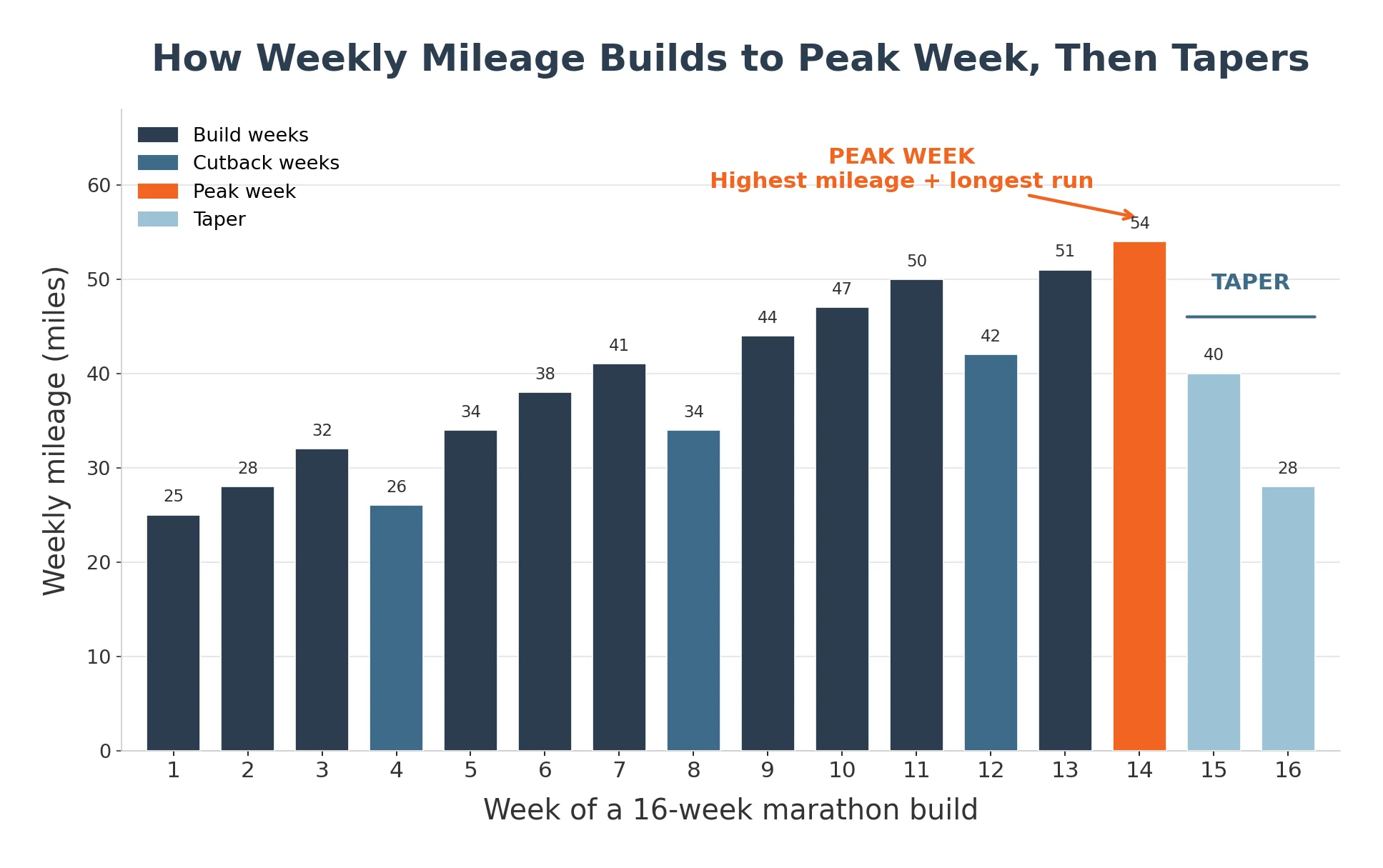
Peak week typically hits 2-4 weeks before race day, bringing your highest weekly mileage, longest long run, and most demanding speed workout all into one brutal seven-day stretch.
This isn’t accidental torture.
The Hansons Marathon Method defines cumulative fatigue as [2] “the accumulation of fatigue over days, weeks, and even months of consistent training.”
Your body is learning to run when it desperately doesn’t want to, exactly what you’ll need for miles 20 through 26.2.
Think of it like a bank account where you spend $10 but only deposit $9 each week for months.
Eventually, you’re running a deficit, and that’s the point.
Research demonstrates [3] that strategic fatigue teaches your body to conserve glycogen stores and utilize fat as fuel more efficiently, adaptations you can’t develop if you’re always fully recovered.
When your legs feel heavy on easy runs and your pace drops 30-60 seconds per mile, that’s not failure.
That’s your neuromuscular system, glycogen stores, and central nervous system all operating in a controlled state of depletion while your fitness continues to build underneath.
What Should Your Peak Week Actually Look Like?
Your peak week is the single highest-volume week of your entire training block, stacking your biggest mileage total, your longest run, and your hardest workout into the same seven days.
Research on marathon runners links weekly volume above roughly 65 km (40 miles) to faster finish times, while volume under 40 km (25 miles) tracks with slower ones.

For most everyday marathoners, peak mileage lands somewhere between 10 and 20 percent above a normal training week.
The centerpiece is your longest run, usually 18 to 22 miles (29 to 35 km) depending on your goal time and experience.
That single effort trains your legs and your mind to keep moving long after the fuel runs low, which is the exact demand of the final 10K.
Alongside it you run one quality session, either a marathon-pace effort or a tempo, rather than two hard workouts crammed together.
| Peak-week piece | Typical target for everyday marathoners |
|---|---|
| Weekly mileage | Highest of the cycle, about 10 to 20 percent above a normal week |
| Longest run | 18 to 22 miles (29 to 35 km) |
| Quality workout | One marathon-pace or tempo effort, not two hard sessions |
| Timing | 2 to 4 weeks out, right before the taper begins |
Everything after this stretch gets lighter, because peak week is the last heavy load your body carries before the taper lifts it off.
RunnersConnect Bonus
Download your FREE Marathon Nutrition During Your Taper Guide.
The guide contains a plan of exactly what you should be eating in the 5 days to 3 hours before your race. We give specific food recommendations to make sure you are ready on race day.
The Rule of Thirds: Permission to Feel Terrible
Olympian Alexi Pappas learned something crucial from her coach Ian Dobson before the 2016 Rio Olympics: when you’re chasing a big goal, you’re supposed to feel good about one-third of the time, okay one-third of the time, and crappy one-third of the time.
If you’re roughly in that ratio, you’re doing it right.
If you feel good all the time, you’re not pushing hard enough.
If you feel terrible more than one-third of the time, you’re approaching burnout and need to dial back immediately.
During peak week, feeling like garbage on some days isn’t just normal, it’s required.
The good days build your confidence.
The okay days form the foundation of consistency.
The crappy days build the patience and mental resilience you’ll need when your quads are screaming at mile 23.
Track your training experiences for a week and see where you fall.
If every single session feels like a slog, that’s not cumulative fatigue, that’s your body waving a red flag.
When Life Stress Meets Training Stress
Here’s the problem: your body can’t distinguish between the stress of a 20-mile run and the stress of a work deadline, family crisis, or bad night of sleep.
Research on university athletes [4] found that academic stress during exam periods significantly decreased perceived energy levels and increased muscle soreness even when training loads were reduced.
Studies show [5] that mentally fatigued half-marathon runners finished approximately four minutes slower than control groups, with heart rates three percent lower throughout, they ran at lower physical intensities while feeling equally exhausted.
Your brain was already tired before you laced up your shoes.
During peak week, when work stress spikes, your training stress needs to come down.
That’s not weakness, that’s intelligent coaching.
Communication becomes critical here.
Tell your family you need earlier bedtimes during peak weeks.
Block your long run on the calendar like an unmovable meeting.
Meal prep on Sunday so you’re not making dinner decisions on Tuesday when your brain is fried from both a tempo run and a budget review.
Accept that something has to give, and it probably shouldn’t be sleep or nutrition.
One Runner’s Connect athlete skipped social events during peak weeks, scheduled runs in her calendar like appointments, and let go of making lunch every day (buying it instead) because sometimes you need to choose your battles.
How Do You Recover During Peak Week Without Losing Fitness?
Recovery during peak week is the part of training that actually converts all that accumulated load into fitness.
Research on endurance runners found that sleep quality is one of the strongest drivers of day-to-day recovery and running performance.
Sleep is your highest-leverage recovery tool during your hardest week.
Aim for 7 to 9 hours, and add 30 to 60 minutes on the nights after your long run or a hard session.
Fuel is the second lever, because the heavy legs of peak week are partly just empty glycogen stores.
Eat enough carbohydrate across the day and start refueling within the first hour after long runs, when your muscles restock fuel fastest.
Your easy days then have to stay genuinely easy, which means running slow enough to hold a full conversation.
For most runners that sits 60 to 90 seconds per mile (about 35 to 55 seconds per km) slower than goal marathon pace.
Push easy runs faster than that and you quietly steal recovery from the sessions that matter.
Protect one true rest or cross-training day even when the schedule tempts you to bolt on extra mileage.
Do these four things well and your body absorbs peak week instead of breaking under it.
The Line Between Fatigue and Burnout
Normal cumulative fatigue means heavy legs but, you can still complete workouts and hit prescribed paces with appropriate effort.
Overtraining syndrome means persistent fatigue lasting more than a few days, inability to hit paces despite maximum effort, and performance declining in workouts you could handle two weeks ago.
Research indicates [6] the warning signs include elevated resting heart rate (5-10 beats per minute above normal), sleep disturbances, mood changes, frequent illness, and training feeling like a burden instead of a goal.
A 2023 study [7] showed that even 10 days of low energy availability downregulated muscle protein synthesis in trained female athletes, meaning inadequate fueling can sabotage your training even when everything else is perfect.
If you’ve crossed into overtraining, immediate action is required: cut weekly mileage by 30-50% for 5-7 days, eliminate intensity and keep only easy runs and long runs at marathon pace, and consider a full rest week if symptoms are severe.
Listen to your body’s whispers before they become screams.
Trusting the Taper When Everything Feels Wrong
Here’s what will save you: the taper.
A meta-analysis by Bosquet et al. [8] examining 27 studies found that an effective 2-3 week taper can improve endurance performance by approximately 2-3%, that’s 3-6 minutes for a 3-hour marathoner.
A study of 158,000 recreational marathoners [9] found that a strict taper of up to three weeks was associated with approximately five-minute improvements in finish times compared to minimal tapers.
During the taper, your muscle glycogen stores replenish, inflammatory markers decrease, hormonal balance returns, and your central nervous system, which has been suppressed for months, finally recovers.
You’ll feel sluggish at first because your body is shifting into recovery mode.
This is temporary.
That phantom knee pain that suddenly appeared during taper week?
Probably “maranoia”, the pre-marathon paranoia that affects nearly every runner when training volume drops and you finally have mental space to obsess about every sensation.
Trust the process anyway.
Elite runners take a full month off after marathons, you’re giving yourself two to three weeks before the race, and it will be enough.
The fatigue you’re feeling right now is masking your true fitness.
When the taper strips away that accumulated exhaustion, you’ll discover what all those peak week miles built.
The Bottom Line
Peak week exhaustion means you’re doing marathon training correctly.
Your body is learning to run on tired legs, conserve fuel, and push through discomfort, all skills that matter more in the last 10K than any workout you’ll ever do.
The Rule of Thirds gives you permission to feel terrible roughly one-third of the time during this journey.
Managing life stress alongside training stress requires communication, boundaries, and strategic decisions about what gets your energy during these critical weeks.
Know the difference between normal fatigue and dangerous overtraining, persistent symptoms require immediate action, not gutting it out.
And when you can barely drag yourself through one more recovery run, remember this: the taper is coming, and research proves it works.
You’ve spent months building fitness.
Now you get to rest just enough to reveal what you’ve become.
Race day is worth every heavy-legged, exhausted, “why am I doing this” moment of peak week.
Trust the process, trust the science, and trust that feeling like garbage right now means you’re exactly where you need to be.