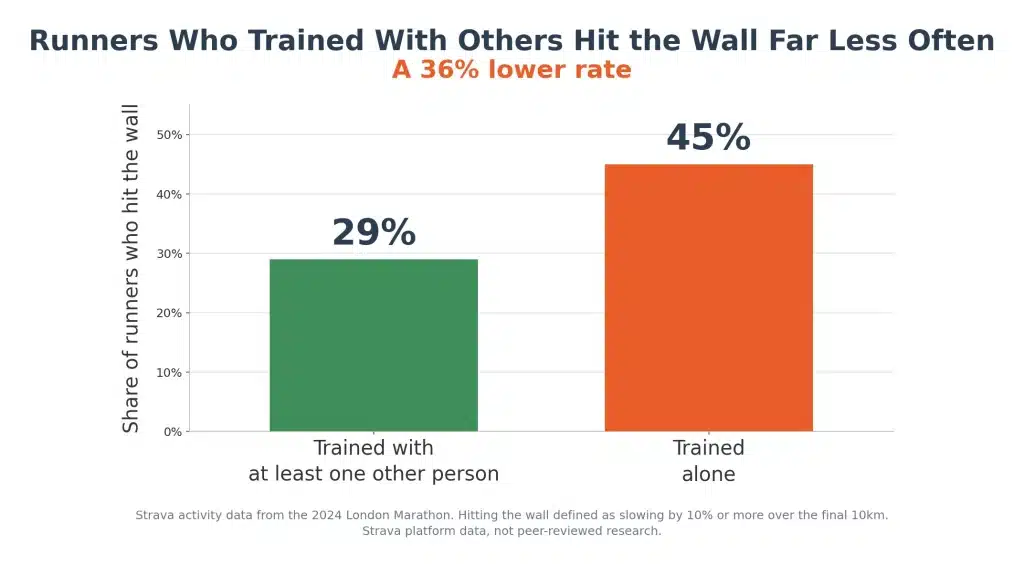

Most marathon runners don’t lose their race in the final miles.
They lose it in miles 1 through 8, when the crowd energy and fresh legs push them 20 to 30 seconds per mile faster than their goal pace.
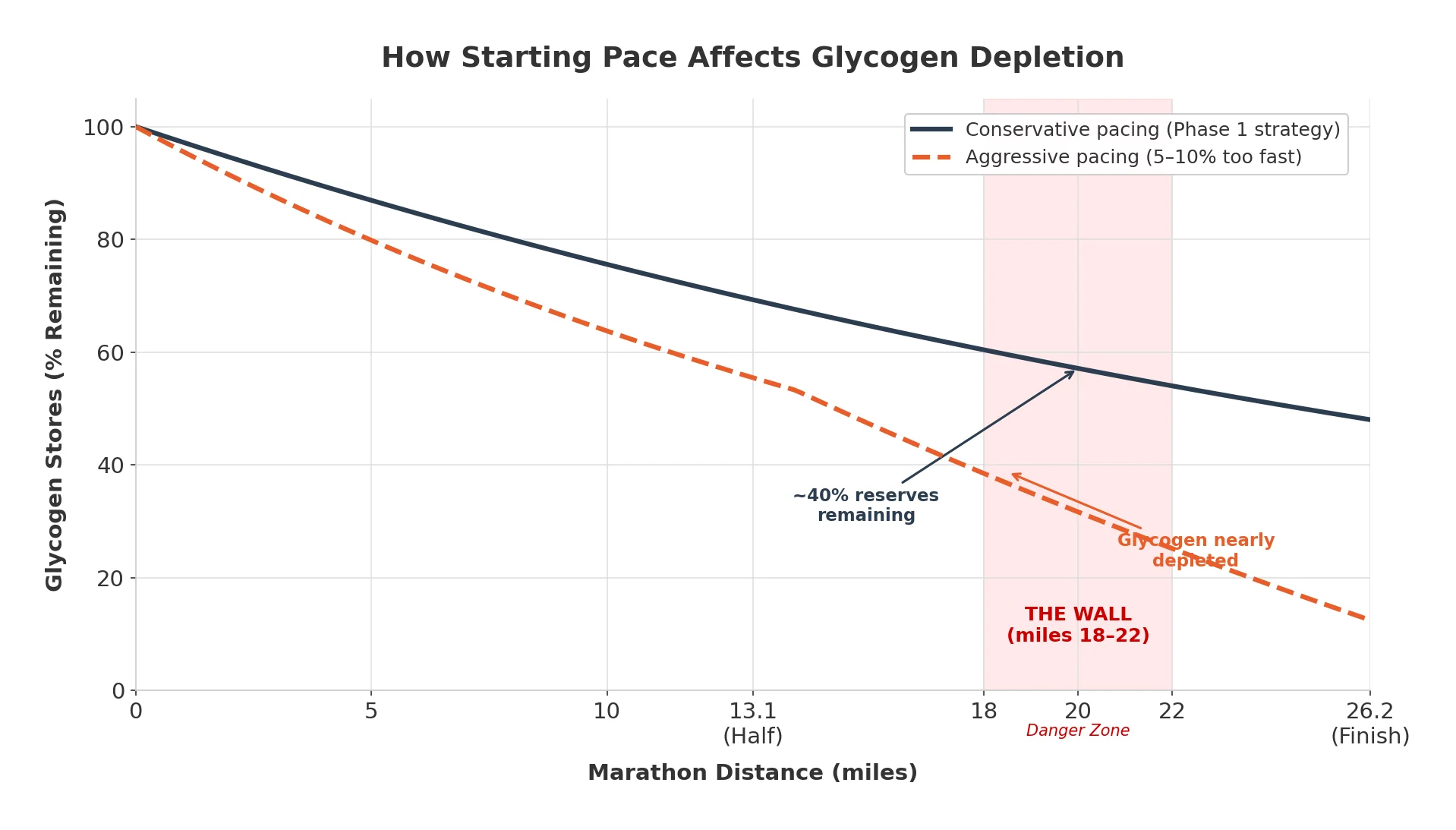
By mile 18, the glycogen deficit is irreversible and the wall arrives right on schedule.
A sound pacing strategy prevents this entirely, and the research on how to structure your effort is clear enough that you don’t need to guess.
In this article, you’re going to learn:
- Why starting too fast causes the metabolic crash between miles 18 and 22
- What negative splits are and why the physiology supports them for non-elite runners
- How the 10-10-10 marathon pacing strategy works, with pace tables for goal times from 3 hours to 5 hours
- The three training workouts that teach your body to accelerate when fatigued
- Race-day execution details that keep you on plan when adrenaline is pushing you faster
Why Do Most Runners Blow Up Between Miles 18 and 22?
The wall between miles 18 and 22 is a predictable glycogen failure caused by a pacing decision made in the first hour of the race.
Research has shown that runners who start 5 to 10% faster than their optimal pace deplete muscle glycogen stores up to 30% earlier, triggering the metabolic cascade that causes the wall.

Glycogen is your muscles’ primary fuel for efforts above easy pace, and you carry a finite supply of roughly 1,800 to 2,000 calories worth.
At an effort of 70% of max heart rate, your body burns glycogen and fat in roughly equal measure, which preserves your stores.
At 80% and above, the glycogen burn rate spikes and fat metabolism can’t keep pace.
Running 20 to 30 seconds per mile too fast in mile 1 doesn’t feel like much, but it shifts you from 70% effort to 80% effort before your body is even warmed up.
Multiply that glycogen overspend across 13 miles and you arrive at mile 18 with an energy deficit that no amount of gels can fix in real time.
Your gut can only absorb roughly 60 to 90 grams of carbohydrate per hour, and the calories needed to reverse a glycogen deficit come too slowly to prevent the slowdown.
If you’ve experienced dead legs in the final miles, this glycogen depletion pattern is almost certainly what happened.
What Is a Negative Split and Why Does the Research Support It?
A negative split means running the second half of the marathon faster than the first half.
In a 26.2-mile race, miles 14 through 26.2 are faster than miles 1 through 13.1.
The physiological logic is straightforward: when you run the first half 15 to 20 seconds per mile slower than goal pace, you burn glycogen at a lower rate and arrive at mile 13 with a larger energy reserve than runners who set out at goal pace from the gun.
That reserve is what powers your second-half acceleration.
Lactate accumulation is the second factor.
Hard early efforts cause hydrogen ions and lactate to accumulate in working muscles, sending fatigue signals that your central nervous system responds to by forcing involuntary deceleration.
A conservative first half delays that accumulation, so your muscles are functioning more efficiently when the race actually gets hard.
Studies have found that lactate threshold velocity accounts for up to 90% of performance variance among trained marathon runners, making it a stronger predictor than VO2 max.
When you run a conservative first half, you spend more of the race below lactate threshold, preserving your capacity to accelerate in the second half when other runners are slowing down.
What Is the 10-10-10 Marathon Pacing Strategy?
The 10-10-10 method divides the marathon into three distinct phases, each with a specific pacing objective.
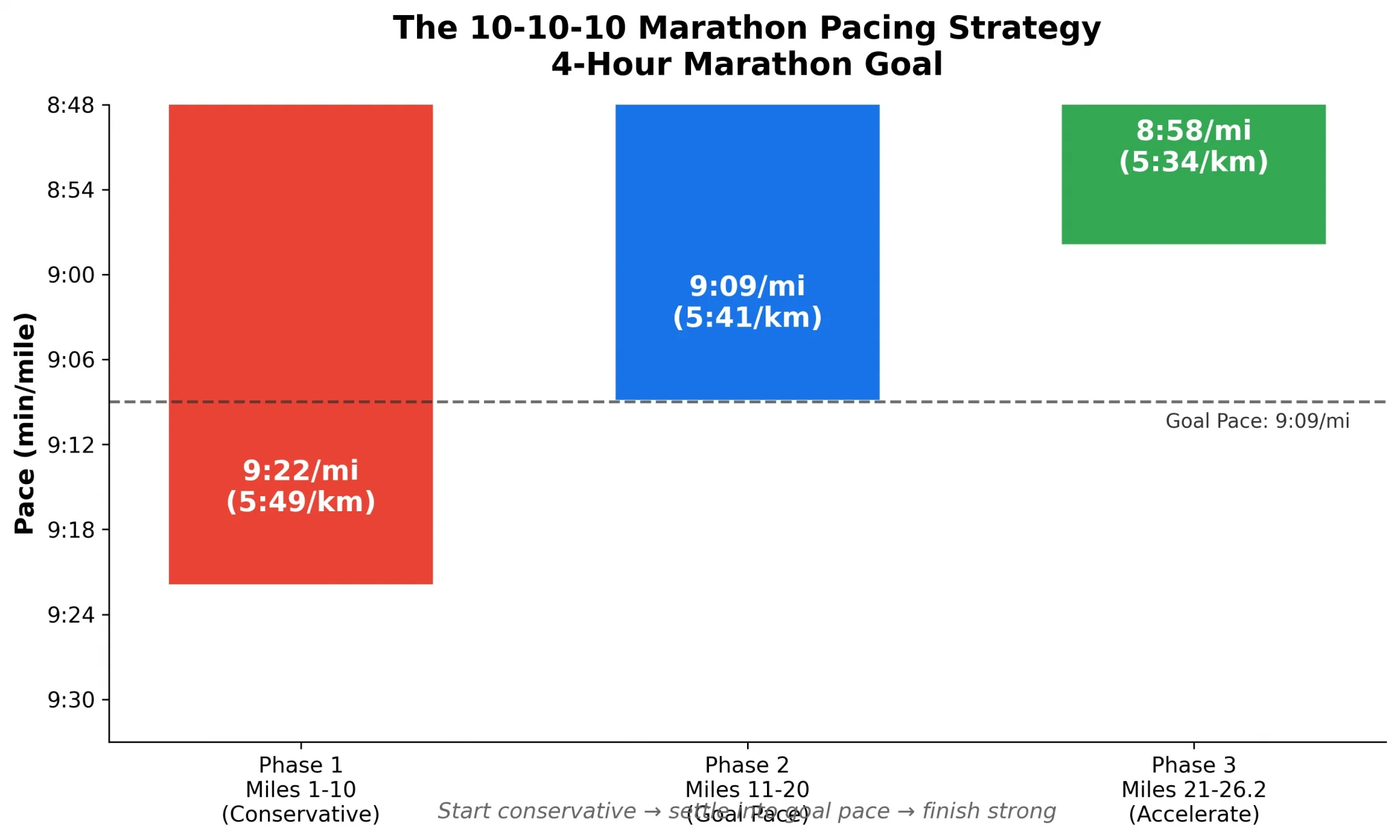
Phase 1 (miles 1 to 10): Run 15 to 20 seconds per mile slower than your goal marathon pace.
Phase 2 (miles 11 to 20): Settle into your goal marathon pace.
Phase 3 (miles 21 to 26.2): Hold goal pace or accelerate slightly if your energy levels allow.
The result is a race where miles 1 through 10 protect your glycogen, miles 11 through 20 demonstrate your fitness, and miles 21 through 26.2 are your payoff for running the first 20 miles correctly.
The 10-10-10 framework works because pace targets align with natural race milestones: the same split checks runners and spectators already track.
How to Calculate Your 10-10-10 Paces
Use the table below to find your phase targets based on your marathon goal.
| Goal Time | Goal Pace (per mile / per km) | Phase 1 Pace (miles 1–10) | Phase 2 Pace (miles 11–20) | Phase 3 Target |
|---|---|---|---|---|
| 3:00 | 6:52 / 4:16 | 7:10–7:15 / 4:28–4:31 | 6:52 / 4:16 | 6:40–6:52 / 4:09–4:16 |
| 3:30 | 8:01 / 4:59 | 8:20–8:25 / 5:11–5:14 | 8:01 / 4:59 | 7:50–8:01 / 4:52–4:59 |
| 4:00 | 9:09 / 5:41 | 9:25–9:30 / 5:51–5:54 | 9:09 / 5:41 | 8:55–9:09 / 5:33–5:41 |
| 4:30 | 10:18 / 6:24 | 10:35–10:40 / 6:35–6:38 | 10:18 / 6:24 | 10:05–10:18 / 6:16–6:24 |
| 5:00 | 11:27 / 7:07 | 11:45–11:50 / 7:18–7:21 | 11:27 / 7:07 | 11:15–11:27 / 6:59–7:07 |
These ranges assume a relatively flat course in moderate temperatures (45 to 60°F / 7 to 15°C).
On a hilly course, adjust Phase 1 targets by running uphill effort-based rather than pace-based, and expect Phase 2 paces to reflect net elevation rather than flat targets.
How Should You Train to Run Negative Splits?
Negative split racing isn’t a mindset shift you apply on race day.
Your body needs to learn how to sustain pace and then accelerate after prolonged effort, and that adaptation takes 8 to 12 weeks of consistent training.
Three workout types build this capacity.
Back-End Acceleration Long Runs
Run 14 to 18 miles total, with the first 10 to 12 miles at easy pace (90 to 120 seconds per mile slower than goal marathon pace) and the final 4 to 6 miles at goal marathon pace or faster.
This teaches your aerobic system to shift into a higher gear when glycogen is already partially depleted, which mimics exactly what miles 21 through 26 demand.
Do this once every 10 to 14 days, alternating with standard easy long runs.
Threshold Runs to Raise Your Aerobic Ceiling
Run 20 to 40 minutes at a comfortably hard effort, roughly the pace you could sustain for 60 minutes in a race.
Threshold runs raise the pace at which your body transitions from aerobic to anaerobic metabolism, making your goal marathon pace feel less taxing and giving you more headroom to accelerate late in the race.
Include one threshold run per week for 6 to 8 weeks before your marathon.
Pacing Practice Runs
Run 8 to 10 miles with the first 4 miles at easy pace and miles 5 through 10 at goal marathon pace, focusing on running consistently at that pace by feel, not just GPS.
Race day conditions, weather, and fatigue change how a given pace feels.
Runners who train pacing by perceived effort perform better under variable conditions because they’re not exclusively dependent on a watch.
Run one pacing practice run per week for 4 to 6 weeks before your target race.
When Do Even Splits Beat Negative Splits?
Elite runners often run even splits or slight positive splits, and that’s not a contradiction of negative split principles.
At a 2:05 to 2:20 marathon pace, runners are operating at 85 to 92% VO2 max, where glycogen depletion is determined primarily by absolute speed rather than pacing variance.
The glycogen-preservation advantage of a conservative first half is smaller at elite pace because the baseline burn rate is already so high.
On a completely flat course with no wind and optimal temperature, even splits are the mathematically fastest option for aerobically trained athletes.
For the non-elite runner targeting 3:30 to 5:00, the story is different.
Glycogen management is the primary limiting factor, not aerobic power, and a conservative first half directly reduces burn rate in the window where most runners blow up.
If you’re running your first marathon, start with an even-split goal as your baseline: run the first half exactly at goal pace and use the second half as data.
If you finish feeling like you had more left, your next race is where you deploy the 10-10-10 strategy.
What Pacing Mistakes Cost Runners the Most Time?
Each mistake below has a specific mechanism, and understanding the mechanism is what makes it avoidable.
Starting with the crowd instead of your plan.
Race energy pushes you into the pace of faster runners around you.
Use a GPS watch with pace alerts set to your Phase 1 target and run your pace regardless of who passes you in miles 1 through 3.
Setting an aspirational goal pace instead of a trained pace.
Your goal pace should be derived from recent race performances, not from a time you hope to achieve.
A 10K time multiplied by 4.65 gives a reasonable marathon time estimate for most runners with adequate long run training.
Under-fueling because you’re saving energy early.
Running conservatively in Phase 1 doesn’t mean skipping fuel.
Start taking calories at mile 4 and continue every 30 to 40 minutes. Running conservatively early means your gut is more receptive to absorption, not that you need less fuel.
Skipping pacing adaptation for hills and heat.
On a hilly course, Phase 1 targets are effort-based, not pace-based.
On a hot day (above 65°F / 18°C), add 20 to 30 seconds per mile to all pace targets. Trying to hit flat-course paces in heat accelerates glycogen burn and core temperature at the same time.
Accelerating in miles 8 through 12 because Phase 1 feels easy.
The conservative early pace is working if it feels easy. Hold Phase 1 paces through mile 10 regardless.
How Can You Execute a Negative Split on Race Day?
Write your three phase targets on your race bib or wrist before the start. Use specific numbers, not ranges.
A 4:00 marathoner writes three targets: 9:25 for Phase 1, 9:09 for Phase 2, and hold 9:09 for Phase 3.
Set pace alerts on your watch for each phase’s upper limit to catch drift before it becomes a problem.
Run the first 3 miles deliberately slower than your Phase 1 target even if it feels artificially easy.
Your glycogen stores are full, your legs are fresh, and race-day adrenaline makes every pace feel easy.
The pace that feels like 60% effort in mile 1 is actually 75%, and your body will tell you at mile 18.
Start fueling at mile 4 with 200 to 250 calories per hour (sports drink, gels, or real food that your gut handles in training).
If your pre-race meal included solid carbohydrate and your stomach is settled, you can push toward 300 calories per hour in Phase 2.
Good pre-race nutrition in the 24 to 48 hours before the marathon gives your glycogen stores a full start, which makes the Phase 1 conservation window even more effective.
At mile 13, take a 30-second honest self-assessment: note whether you feel controlled or labored, and whether your effort matches your planned Phase 1 target.
If you feel controlled and on pace, shift to Phase 2 and hold it through mile 20.
If you feel flat or labored, stay at Phase 1 pace through mile 15 before reassessing.
Miles 21 to 26.2 are where the investment pays out.
You’ve preserved glycogen, your accumulated fatigue is lower than runners who started fast, and the final 5K is where you can push your effort rather than just trying to survive.
Ready For More?
Get Our FREE Race Day Strategy Calculator!
You’ll learn how to calculate your exact splits for the marathon in both KM and miles.
The Bottom Line on Marathon Pacing Strategy
The runners who finish strong in a marathon are the ones who started conservatively enough to still be accelerating in mile 23.
Negative splits work because glycogen preservation in the first half directly determines your capacity to sustain pace in the second half, and that principle applies to every marathon runner from a 3-hour finisher to a 5-hour finisher.
The 10-10-10 framework gives that principle a structure: 15 to 20 seconds per mile conservative for the first 10 miles, goal pace for the middle 10, and an honest effort push through the final 10K.
Train it with back-end long runs, threshold work, and pacing practice runs for 8 to 12 weeks.
Then on race day, trust the plan through the point where it feels too easy. That feeling is exactly what you’ve been training for.