

Foam rollers. You’ve probably seen them at every gym and race expo you’ve been to.
So much so that it’s almost common knowledge that foam rollers are an essential part of your recovery.
But what if I told you that recent research analyzing 38 studies with over 1,100 participants found something shocking about foam rolling?
Well, that’s what we’re going to dig into today. Looking at the latest research, you’ll learn…
- The biggest foam rolling myths that are costing runners time and money, and what the research actually shows
- Why foam rolling works (when it does), and it has nothing to do with what you’ve been told
- Evidence-based protocols for different muscle groups that actually deliver measurable benefits
Foam Rolling Myths Busted
Myth #1: Foam Rolling Breaks Up Fascial Adhesions
The most persistent foam rolling myth involves the idea that rolling “breaks up” adhesions in your fascia.
A meta-analysis [1] suggests that the pressure required to deform firm fascial tissue is greater than what’s typically achieved by foam rolling.
What this means in plain English is that your fascia is just too strong to actually be “broken up” when using a foam roller.
What’s really happening during foam rolling has little to do with mechanical tissue changes.
Myth #2: Textured Rollers Work Better Than Smooth Ones
Runners often assume that expensive textured rollers with bumps and ridges provide superior benefits.
Recent research [2] comparing different roller textures found that the texture and hardness of the foam roller didn’t matter when treatment lasted at least 120 seconds.
Basically, as long as you’re foam rolling for 2 minutes or more, the type of foam roller you’re using doesn’t matter.
The marketing around “trigger point therapy” and specialized textures is largely unsupported by research.
Myth #3: Foam Rolling is Essential for Warm-Up
Perhaps the biggest revelation from recent research challenges foam rolling’s warm-up necessity.
A comprehensive 2024 meta-analysis [3] found no significant differences in range of motion improvements between foam rolling and other warm-up activities like walking, cycling, or calisthenics.
Simply put, foam rolling isn’t uniquely beneficial compared to other warm-up techniques.
Is Foam Rolling Better Than Calisthenics for Warm-Up?
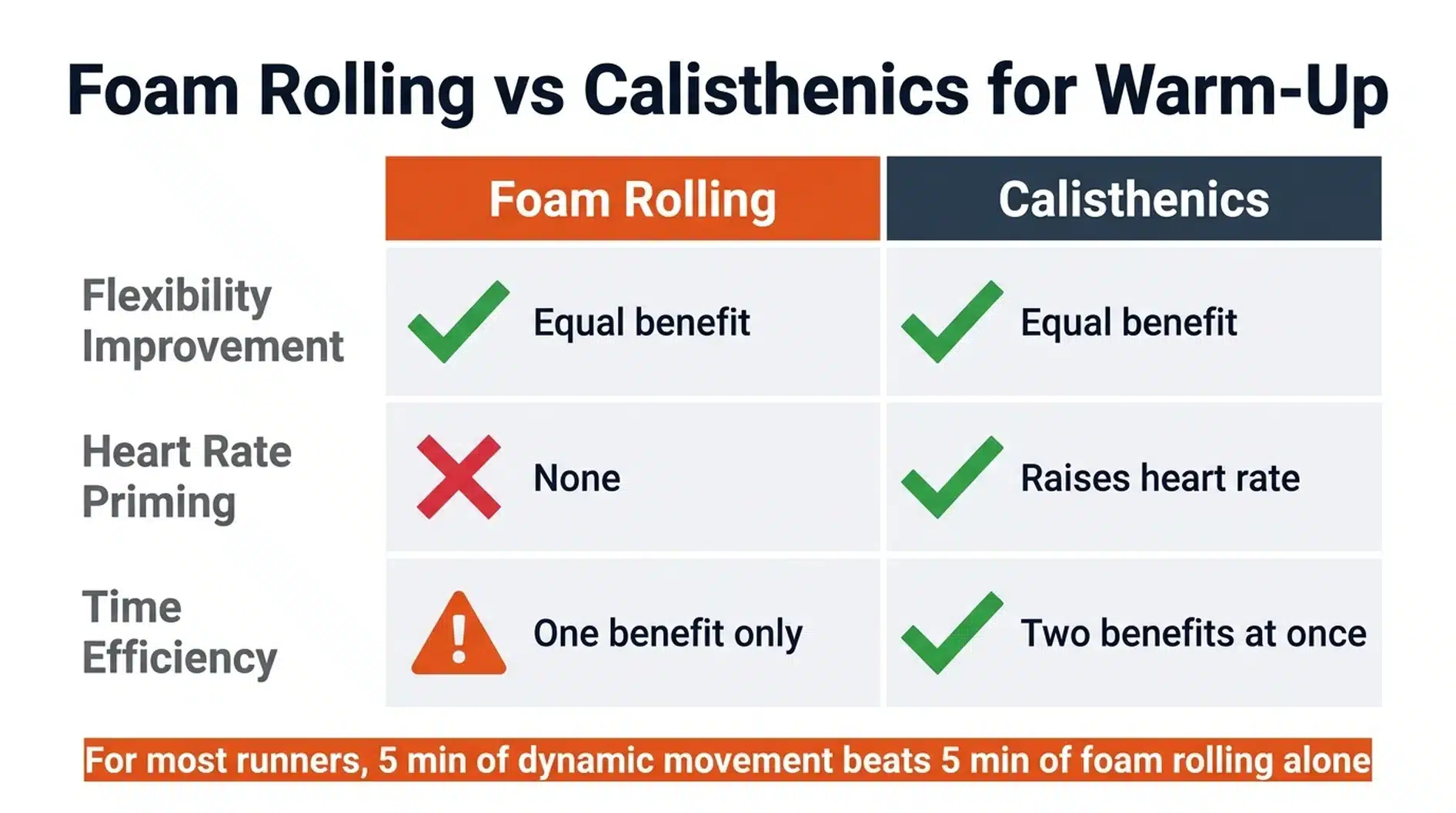
Calisthenics and foam rolling produce equivalent short-term flexibility improvements.
Research comparing foam rolling to dynamic stretching found no significant differences in flexibility or performance outcomes between the two methods when matched for duration.
Both approaches trigger a temporary reduction in perceived tissue tightness and increased range of motion through different pathways.
Calisthenics (leg swings, hip circles, bodyweight squats) raises muscle temperature through active contraction, softening connective tissue and improving joint range of motion.
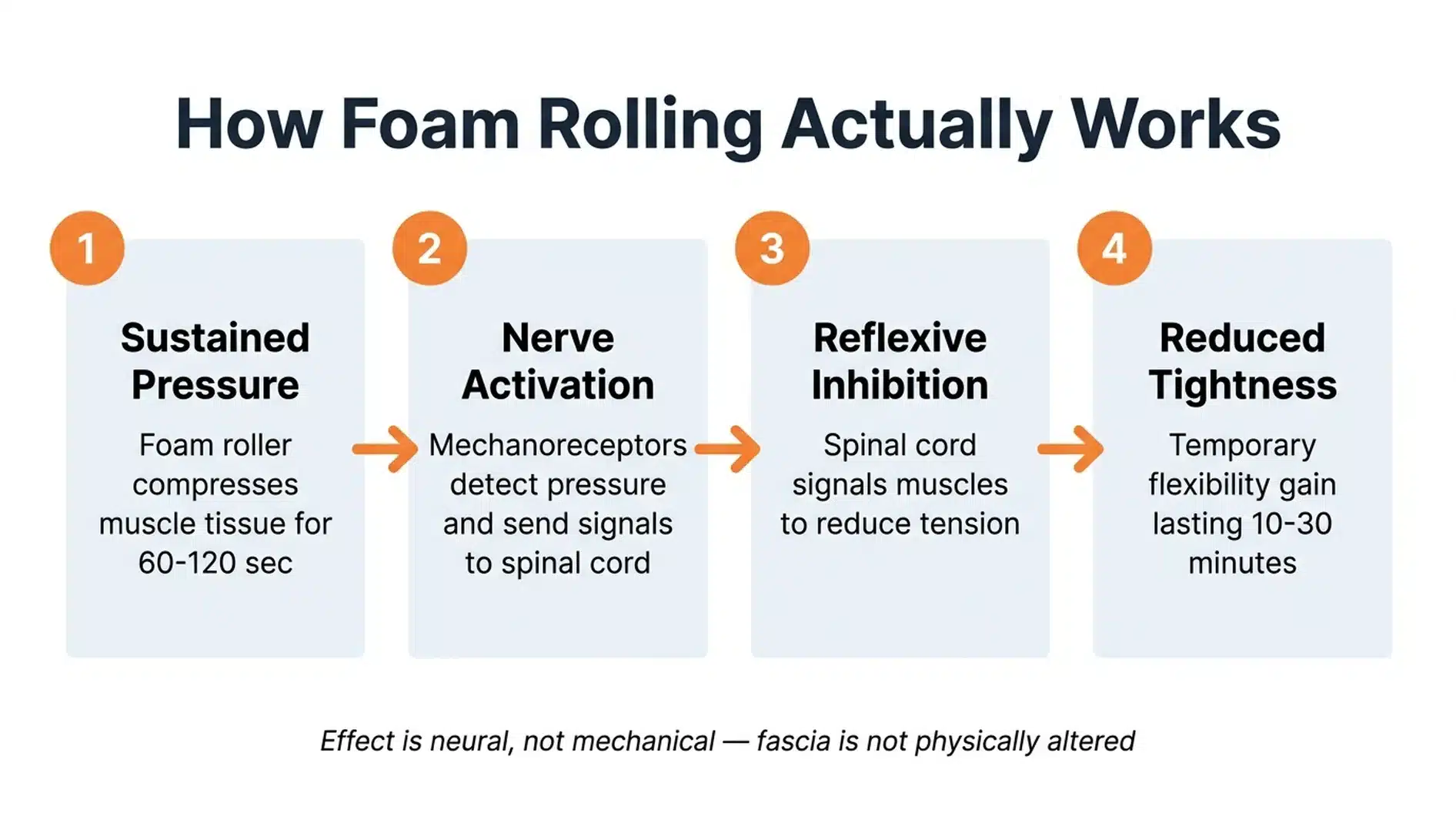
Foam rolling achieves the same end result through the neural pathway described in the section above: sustained pressure produces reflexive inhibition that temporarily reduces perceived tightness.
Which Is More Efficient for Runners?
Five minutes of dynamic calisthenics gives you the same flexibility benefit as five minutes of foam rolling, plus elevated heart rate and primed neuromuscular patterns for the run ahead.
Foam rolling provides range of motion improvements without the cardiovascular priming that running warm-ups require.
For most runners with limited warm-up time, dynamic movement delivers more per minute than foam rolling alone.
If you have a chronically tight area (hip flexors, quads, calves), pairing 60–90 seconds of targeted rolling with your dynamic warm-up adds value without adding meaningful time.
For more on building an effective pre-run routine, see 3 common myths about warming up before a run.
What the Science Actually Shows About Foam Rolling
Foam rolling does provide some legitimate benefits, though they’re more limited than commonly believed.
Meta-analysis data [4] shows foam rolling produces a large effect on range of motion with about 62% of people experiencing short-term flexibility improvements.
A systematic review [5] consistently demonstrates that foam rolling can increase joint range of motion at the hip, knee, and ankle without negatively affecting muscle performance when applied for 30 seconds to 2 minutes per muscle group.
The key finding: foam rolling works, but not for the reasons most people think.
Duration Matters More Than Intensity
The research reveals a clear protocol pattern for effectiveness.
Data from multiple studies [2] indicate significantly better recovery effects when rolling procedures last at least 120 seconds per muscle group.
For long-term improvements, research shows [6] that interventions longer than 4 weeks are needed to induce meaningful range of motion gains, with responses being muscle-specific.
Most runners roll too briefly and inconsistently to achieve measurable benefits.
The Neural Explanation: Why Foam Rolling Actually Works
The mechanism behind foam rolling benefits isn’t mechanical tissue change, it’s neurological.
Recent data suggest [7] that neural effects of myofascial manipulations are paramount to changes in perception and range of motion rather than structural tissue alterations.
Foam rollers work by bombarding the nervous system with high-intensity sensory input, causing reflexive inhibition of muscle tension.
This explains why the benefits are often temporary and why different tools can achieve similar results.
Evidence-Based Foam Rolling Protocols for Runners
Quadriceps and Hip Flexors Protocol
Your quads take the biggest beating from running impact and benefit most from targeted rolling.
Research shows [6] foam rolling increases joint range of motion when applied to quadriceps, while no improvement was observed for ankle dorsiflexion when applied to calf muscles.
Protocol: 90-120 seconds total rolling time, divided into 30-second intervals with 15-second active movement breaks.
Position the roller under your quads and support your upper body weight on your forearms.
Roll slowly from just above the knee to the hip crease, pausing on areas of increased tension for 5-10 seconds.
Hamstring and Glute Protocol
Posterior chain tightness responds well to foam rolling, particularly for runners dealing with sciatic-type discomfort.
Protocol: Position roller under your hamstrings while supporting your weight on your hands.
Cross one ankle over the opposite knee to increase pressure on the working leg.
Roll from just above the knee to the glute fold for 60-90 seconds per leg.
For glutes, position the roller under one hip and cross the ankle over the opposite knee, rolling in small circular motions.
IT Band Reality Check
The IT band deserves special mention because it’s the most commonly misunderstood area for foam rolling.
The IT band is a thick, fibrous structure that doesn’t respond to rolling pressure the way muscle tissue does.
Instead of rolling directly on the IT band, target the muscles that attach to it: your glutes, tensor fasciae latae, and vastus lateralis.
Protocol: Focus rolling on the outer quad muscle just inside the IT band, not on the band itself.
RunnersConnect Bonus
Download your FREE Foam Rolling for Runners program.
The guide includes detailed videos and instructions help you understand the “why” behind every movement and exactly how to execute so you’re confident you’re foam rolling correctly, avoiding common mistakes and you’re getting the most from your session.
Alternative Techniques That May Work Better
Percussive Therapy: The Massage Gun Revolution
Recent research [8] on percussion massage found that 15 minutes of treatment at 30 Hz frequency reduced echo intensity in fascial tissue, suggesting improved tissue hydration.
Massage guns offer several advantages over traditional foam rolling: targeted pressure, consistent application, and the ability to treat hard-to-reach areas.
Evidence-Based Protocol: Use 90-120 seconds per muscle group at moderate intensity (30-40 Hz frequency).
Focus on muscle bellies rather than bony prominences or joints.
Active Release Technique Principles
Research suggests that myofascial release techniques combining pressure with active movement are more effective for restoring range of motion than passive pressure alone.
Self-Application: Find a tender point in the target muscle, apply steady pressure, then actively move the joint through its range of motion.
This combination of pressure plus movement appears more effective than static rolling.
Heat and Movement Combinations
Since research shows [3] that any activity that increases core and muscle temperature may be used interchangeably to acutely increase range of motion, consider combining modalities.
Try 5-10 minutes of light jogging followed by targeted stretching.
Use warm-up drills that include dynamic range of motion rather than passive foam rolling.
Does Pre-Run Foam Rolling Improve Running Performance?
Foam rolling has no direct effect on running speed, power output, or endurance capacity.
Research on foam rolling and athletic performance found no significant performance improvement over other warm-up methods when matched for duration, meaning foam rolling produces no measurable physiological advantage over simply moving.

Pre-exercise rolling duration matters more than most runners realize.
Rolling a specific muscle group for more than two minutes immediately before a hard effort may briefly reduce peak force output in that muscle.
Keep pre-run rolling to 60–90 seconds per muscle group, consistent with the protocols in the section above.
Post-run is where foam rolling makes its strongest practical case: the short-term reduction in perceived soreness during the recovery window buys more quality between hard training days.
For a structured pre-race warm-up routine that incorporates foam rolling correctly, see how to warm up for a race.
The Practical Bottom Line for RunnersWhat Foam Rolling Can Realistically Do
Foam rolling provides short-term flexibility improvements that last 10-30 minutes.
It can help with perceived muscle soreness and may improve your subjective feeling of readiness.
A meta-analysis [4] suggests foam rolling may offer small short-term benefits in promoting flexibility without negatively affecting muscle performance.
What It Cannot Do
Foam rolling doesn’t “break up scar tissue” or permanently change fascial structure.
It’s not superior to other warm-up activities for preparing you for running.
It won’t prevent injuries or significantly impact long-term flexibility without consistent, long-term application.
The Time-Efficient Runner’s Approach
Given your limited recovery time, prioritize interventions with the strongest evidence base.
- If you enjoy foam rolling, limit it to 2-3 minutes total focusing on areas that feel subjectively tight.
- Consider 5-10 minutes of dynamic warm-up movements or targeted strength exercises addressing your specific imbalances.
- Try contrast showers, light movement, or progressive muscle relaxation for similar neurological benefits.
The research suggests that foam rolling isn’t the recovery miracle many believe it to be – but it’s also not harmful when done appropriately.
The key is managing expectations and using evidence-based protocols rather than following fitness industry marketing claims.