
Your ankle feels fine on the walk to the front door, then it tightens or aches a mile into your run.
Ankle pain is one of the most common complaints runners bring to a coach, and it rarely means something is broken.
Usually it points to how your ankles handle repeated load, an old sprain that never fully rehabbed, or the stability work your training has been missing.
Here is what you’ll learn about ankle pain when running:
- The 4 causes behind aching or sore ankles
- How to tell a sprain apart from a slow overuse injury
- The strengthening and load fixes that settle the pain down
- Why balance training cuts your risk of the next flare-up
- The warning signs that mean it is time to stop and see a doctor
Why do your ankles hurt when you run?
Ankle pain when running almost always traces back to load rather than one dramatic injury.
Your ankle absorbs several times your body weight with each stride, and it does that a few thousand times per mile.
When the tissue around the joint takes on more of that load than it is ready for, you feel the soreness or sharp catch mid-run.
These 4 causes account for the bulk of what runners feel.
Overuse and irritated tendons
The peroneal tendons on the outside of the ankle and the posterior tibialis on the inside get irritated when mileage or intensity climbs faster than they adapt.
This pain builds gradually over several runs rather than appearing all at once.
It often feels worst in the first mile, eases as you warm up, then returns stiffer the next morning.
A history of ankle sprains
A past sprain is the single strongest predictor of ongoing ankle trouble.
Researchers surveying active adults found that 73% had sprained an ankle more than once, and 59% still dealt with lingering pain or instability long after.

Those lingering symptoms are what coaches call chronic ankle instability, and they set up a feedback loop where each minor tweak makes the next one more likely.
Weak or stiff ankles
Ankles that lack strength or mobility force the surrounding tissue to compensate on every stride.
Beginners feel this often, because the small stabilizing muscles have not caught up to the pounding of regular running yet.
Limited ankle dorsiflexion, meaning how far your knee can travel over your toes, shifts stress onto the joint and the Achilles behind it.
Your shoes and running surface
Worn-out shoes and cambered or uneven ground change how your foot lands and load the ankle unevenly.
Running the same direction on a sloped road or track sends repeated sideways stress to the same ankle every lap.
Trail and cross-country runners face the added risk of rocks and ruts that roll the ankle without warning.
Is your ankle pain a sprain or an overuse injury?
Sorting your pain into the right category tells you how urgently to act, because a sprain and an overuse injury call for different responses.
A sprain is acute. It happens in a single moment when you roll or twist the ankle, and it usually brings swelling and bruising, with pain when you put weight on it.
An overuse injury is gradual. It builds over days or weeks of training and eases with warm-up before stiffening again afterward.
If you can trace the pain to one specific step or stumble, treat it as a sprain until proven otherwise.
The distinction matters because sprains carry a high reinjury rate when rushed.
Tracking elite track and field athletes showed that a poorly rehabbed lateral sprain frequently led to a repeat sprain within the same season.
For a fresh roll with swelling, our guide to treating a rolled ankle walks through the return-to-running steps in detail.
How do you fix ankle pain when you run?
Fixing ankle pain comes down to calming the irritated tissue, then rebuilding the strength that failed to protect it.
Full rest is rarely the answer. The joint needs some load to heal, and detraining creates its own problems.
Work through these steps in order.
- Cut load before you cut running. Drop your weekly mileage by a third and pause speedwork and hills until the sharp pain settles.
- Strengthen the calf and ankle. Build to 3 sets of heel raises daily, then add banded eversion and inversion to target the peroneals and posterior tibialis.
- Train single-leg balance. Stand on the sore leg for 30 seconds several times a day to activate the stabilizers that control each footstrike.
- Check your shoes. Replace any pair past 400 to 500 miles, and vary the direction and camber of your usual routes.
Give the tissue 2 to 3 weeks of consistent work before you judge whether it is improving.
Most everyday cases respond well once load and strength are back in balance.
RunnersConnect Insider Bonus
Download our free Calf Strain Injury Prevention Routine!
It’s a PDF with images and descriptions of the most effective prevention and rehab exercises for runners who suffer from calf strains.
Can balance training prevent ankle pain and sprains?
Balance training has the strongest evidence for preventing the next ankle setback.
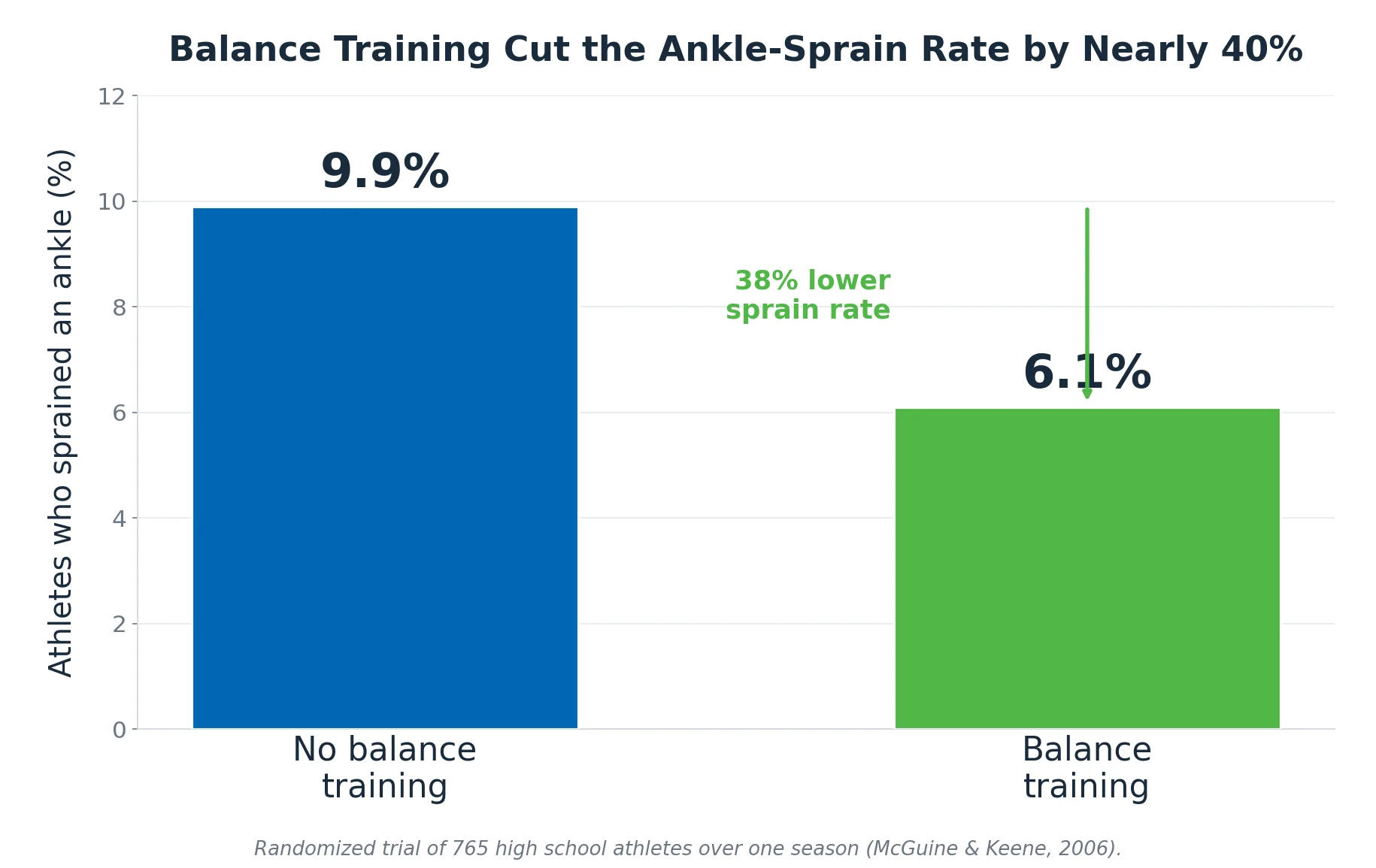
A randomized trial of 765 athletes cut the ankle-sprain rate from 9.9% to 6.1% with a simple balance program, and halved the risk for those with a prior sprain.
A separate controlled trial using wobble boards reached the same conclusion, with the biggest gains going to athletes who had sprained before.
The reason is that a sprained ankle loses some of its sense of position and motion.
Testing runners with repeat sprains found weaker balance and joint awareness on the injured side than on the healthy side.
Balance work rebuilds that awareness, which is why it protects the previously injured ankle most.
Follow the progression below a few times a week to rebuild that stability.
- Weeks one to two: Balance on one leg on flat ground, first with your eyes open, then closed.
- Weeks three and on: Add single-leg squats and slow leg swings while balancing.
- Progress the challenge: Move to a wobble board or cushion once the flat-ground work feels easy.
If you have sprained an ankle before, keep balance training in your week for good, well beyond the rehab period.
For a full routine, see our breakdown of balance training for runners.
When should you stop running and see a doctor?
Most ankle pain settles with load management and strength work, but a few signs call for professional care.
Stop running and get assessed if any of these apply.
- You cannot put weight on the ankle or walk without a limp.
- Swelling or bruising appears quickly after a roll or twist.
- The pain sharpens with every run despite 2 to 3 weeks of reduced load.
- You feel numbness or the ankle giving way underneath you.
- A specific spot on the bone is tender to the touch, which can signal a stress injury.
Catching these early keeps a manageable problem from turning into weeks off your feet.
| Cause | How it feels | First fix |
|---|---|---|
| Overuse tendon irritation | Builds over runs, worst in first mile | Cut load, strengthen calf and ankle |
| Old sprain / instability | Ankle feels loose or gives way | Balance training several times a week |
| Weak or stiff ankles | Tight, sore, common in beginners | Heel raises and mobility work |
| Shoes and surface | Uneven or one-sided ache | Replace old shoes, vary routes |