

You finished your last 20-miler two weeks ago and ran the final marathon-pace workout Tuesday.
The calendar shows 21 days until the start line.
Now you get to cut your mileage in half, run less than you’ve run in four months, and trust that the fitness you built is still there when the gun fires.
This is the marathon taper, and it is the most misunderstood three weeks of the training cycle.
The physical work is done, and what happens next is a managed trade between shedding accumulated fatigue and protecting the fitness you spent months building.
Taper too aggressively and you lose the aerobic sharpness that took you sixteen weeks to develop.
Taper too little and you arrive on race morning with tired legs, depleted glycogen, and nothing left to spend.
| Taper week | Mileage vs. peak | Long run | Key quality session |
|---|---|---|---|
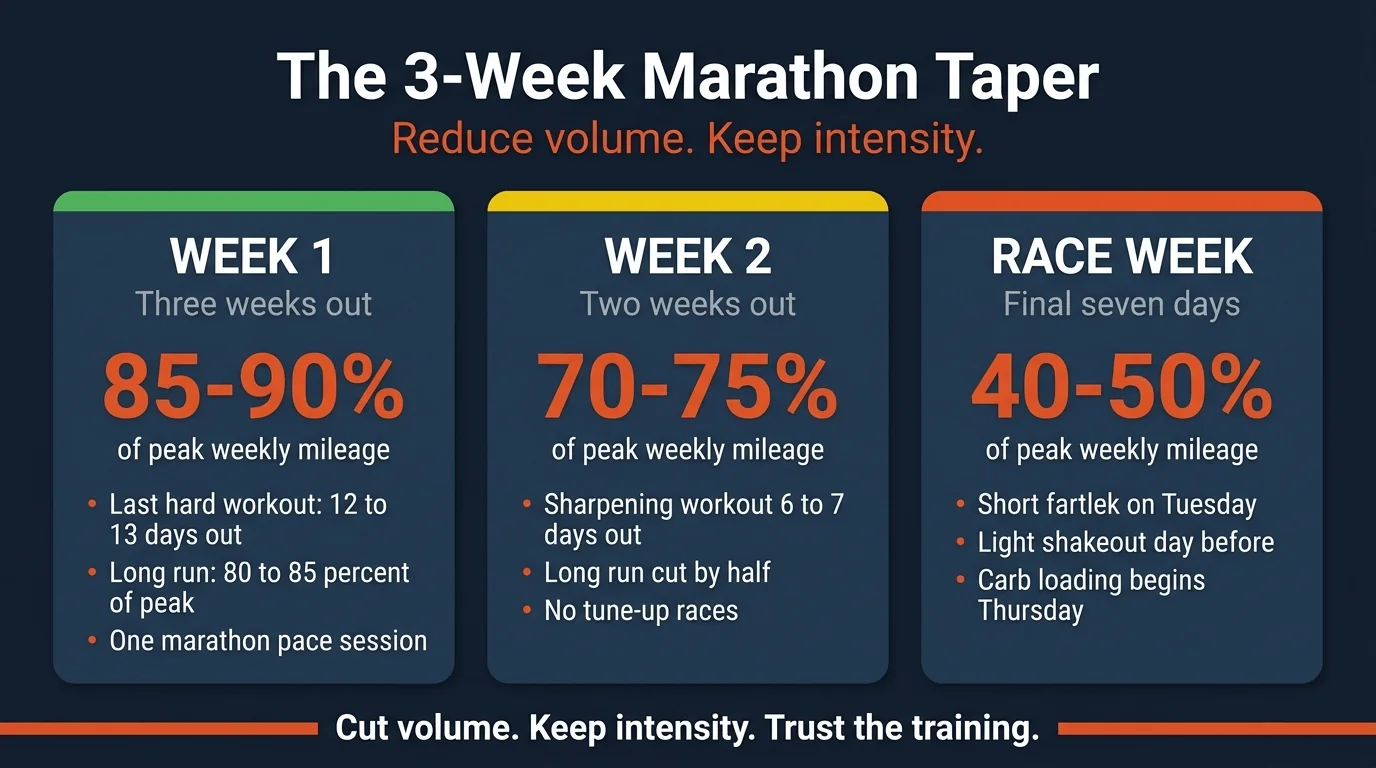
| 3 weeks out | 85–90% | 80–85% of peak long run | Marathon-pace run, 12–13 days before race |
| 2 weeks out | 70–75% | 50–60% of peak long run | Short tempo at marathon pace, 6–7 days out |
| Race week | 40–50% | None | 6–8 x 2 min at marathon pace (Tuesday) |
The rule behind every row in that table: cut volume, keep intensity. The sections below explain why each number is what it is.
How long should a marathon taper actually last?
The research answer is sharper than most runners expect.
A meta-analysis of 27 tapering studies found that the single best strategy for peak race performance is a two-week taper where training volume drops by 41 to 60 percent while training intensity and frequency stay the same.

Those numbers come from Bosquet and colleagues at the University of Montreal, and they remain the cleanest summary of what the evidence actually supports.
The reason marathoners typically stretch the taper to three weeks rather than two is race distance.
Longer races produce more accumulated muscle damage and deeper glycogen debt than the 5K or 10K distances that made up most of the studies in that meta-analysis.
Marathon training also tends to peak at higher total volumes, which means the fatigue you’re trying to shed is larger in absolute terms.
A separate review by Mujika and Padilla concluded that effective tapers range from four to more than 28 days, with longer tapers better suited to athletes carrying heavier training loads.
Three weeks is the window that gives a typical marathon runner enough time to recover from peak training without losing fitness.
Cutting that to two weeks is reasonable for lower-mileage runners or athletes who respond quickly to rest.
Stretching past three weeks starts to compromise the aerobic adaptations you spent months building.
The three weeks that follow break down into distinct jobs: the first week shaves volume while holding sharpness, the second starts the real cut, and race week is pure preservation.
What actually happens in your body during a marathon taper?
A well-executed taper is an active physiological process, and calling it rest is where most runners start to lose the plot.
The changes are measurable and coordinated.
A comprehensive review of taper physiology documented coordinated improvements across blood volume, muscle glycogen, red cell count, muscle power, testosterone-to-cortisol ratio, and mood, all happening simultaneously in the final two to three weeks before competition.
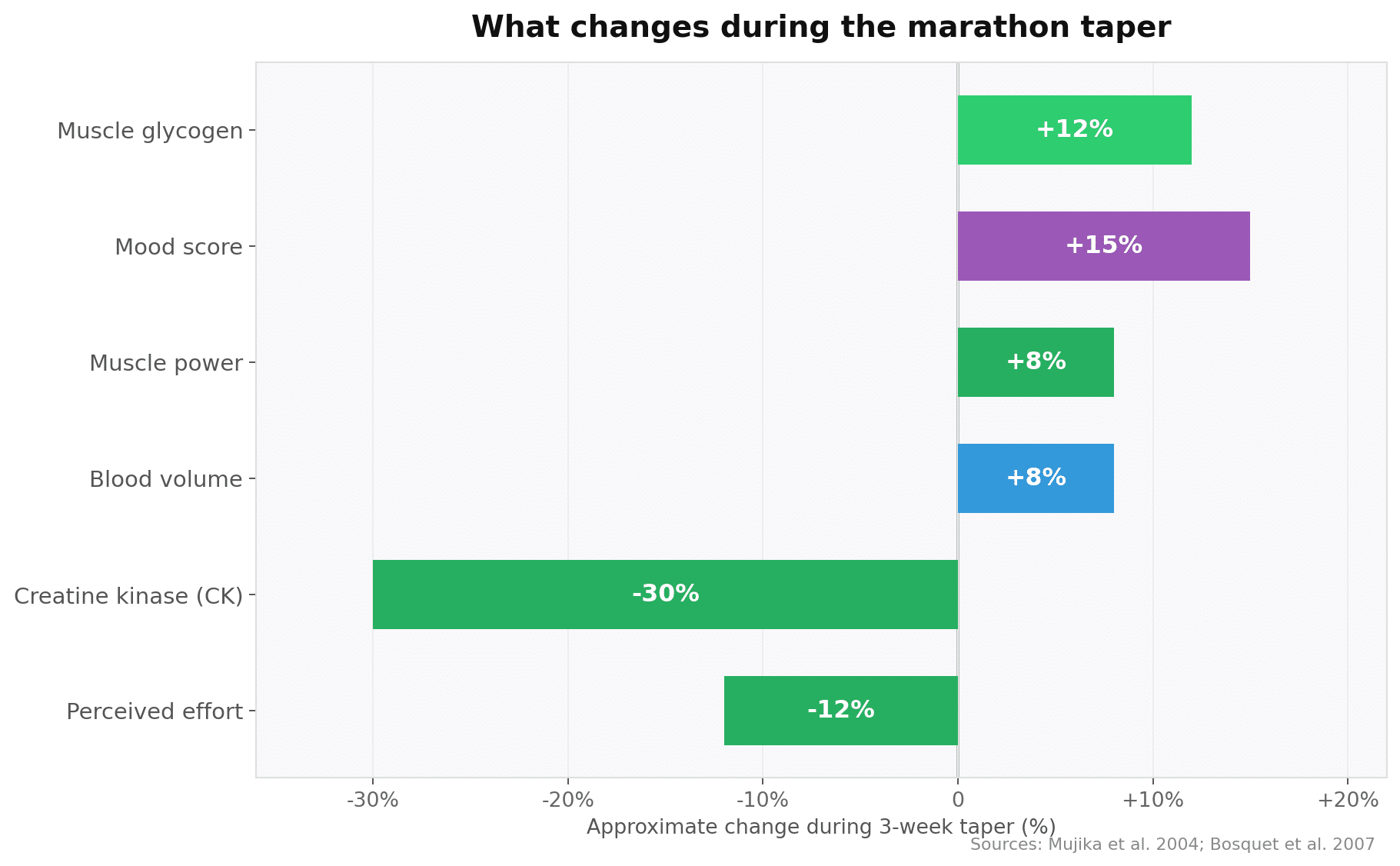
The muscular change that most directly affects marathon performance is glycogen supercompensation.
Peak marathon training keeps muscle glycogen partially depleted around the clock because hard sessions empty the tank faster than daily meals can refill it.
When volume drops during the taper, fresh carbohydrate starts landing in a muscle that has the appetite but no longer has the expenditure, and stored glycogen rises well above pre-taper levels.
This is why a runner who ate the same diet for sixteen weeks suddenly feels heavier and stiffer during taper.
That feeling is a muscle loaded with fuel, working exactly as it should.
Blood volume and red cell count also climb, which improves oxygen delivery at race intensity.
Creatine kinase drops as muscle damage from peak training finally clears, which is why the legs start to feel springy again in week two.
Muscle power output measured in the lab rises by five to ten percent across the taper in the same studies, and the strength gains are part of why a well-rested marathoner feels quick on strides even after cutting weekly mileage by half.
Mood scores climb, perceived effort at submaximal paces drops, and sleep quality typically improves.
Those psychological changes matter because the training you did for the previous four months only pays off if you show up to the start line with the capacity to access it.
Should you reduce volume or intensity during a marathon taper?
Reduce volume and keep intensity.
That single rule governs every decision you make in the next three weeks.
A study of competitive distance runners found that a seven-day taper with an 85 percent reduction in weekly volume combined with maintained interval intensity dropped 5K time by three percent and improved running economy at 80 percent of VO2max by six percent.
The runners who cut their mileage but did no intensity work at all held their performance steady without gaining.
The runners who cut both saw no benefit.
Only the group that cut volume while keeping the hard workouts hard improved.
The same pattern showed up in the Bosquet meta-analysis, where intensity maintenance produced a positive performance effect while any reduction in intensity tended to erase the benefit of cutting volume.
The practical translation is that your workouts in the taper should feel similar in pace to what you were running in peak training, but they will be much shorter and spaced further apart.
A 10 mile tempo at marathon pace in peak training becomes a 6 mile tempo at marathon pace in week two.
A mile repeat session at threshold becomes fewer repeats at the same pace, not slower repeats over the same distance.
The neuromuscular system needs the same stimulus signal to keep firing crisply, it just needs less of it.
Aerobic sharpness is lost within about 10 to 14 days of reduced intensity, which is why backing off the hard running too early is how runners end up running a slower race than they ran in training.
Cutting volume without cutting intensity is the rule that separates a successful marathon taper from a failed one, and the three weekly plans below are built around it.
Three weeks out: what does your first taper week look like?
Week one is the transition week, and it should barely feel like tapering.
Weekly mileage drops to about 85 to 90 percent of peak.
If your biggest training week was 50 miles, the target for week one is 43 to 45 miles.
That cut is small enough that it usually comes from trimming two or three miles from a recovery run and adding a second rest day.
Your last real workout of the training cycle falls on Monday or Tuesday of this week, roughly 12 to 13 days before the race.
The session should be marathon-specific rather than a VO2max effort.
A typical example is three to four miles at marathon pace inside a longer run, or a 6 to 8 mile progression run finishing at marathon pace.
This is not the session to chase a new personal best on, and it is not the session to skip because you are saving energy.
The purpose is to bank one more quality stimulus while there is still enough time to recover before race day.
Your long run this week drops to 80 to 85 percent of your peak long run.
A 20-mile peak becomes a 16 to 17 miler.
Run it at an easy effort with the final 3 to 4 miles picked up to marathon pace, which rehearses the last 6 kilometers of race-day pacing without adding further fatigue.
The mistake to avoid in week one is treating reduced mileage as permission to run everything faster.
Easy runs stay easy, long run stays conversational, and the one hard session is the one you planned.
Your final hard workout of the cycle should fall 12 to 13 days before race day, not inside the last two weeks.
Week one is also the right place to read the common tapering mistakes that runners make in the final three weeks, because the margin for error shrinks sharply as you move into week two.
Two weeks out: how do you sharpen without overreaching?
Week two is where the real cut begins.
Weekly mileage drops to 70 to 75 percent of peak, which for a 50-mile runner lands around 35 to 38 miles.
The biggest chunk of that reduction comes out of the long run and the hard workout, not the easy recovery days.
Your sharpening workout this week falls on Monday or Tuesday, roughly 6 to 7 days out from the race.
The total volume of this session drops by 60 to 70 percent compared with a normal hard day.
A normal 9 mile tempo becomes a 3 to 4 mile tempo at marathon pace.
Six by 1 mile at marathon pace with a short jog recovery is another common structure, and it lets you rehearse goal pace without accumulating the kind of fatigue that needs four days to clear.
Keep the pace honest and cut the volume hard.
This is the workout where most runners get into trouble by going faster than marathon pace because their legs feel fresh from the reduced volume.
Running faster here teaches your body the wrong pace and adds stress that you cannot recover from before race day.
The long run this week drops to 50 to 60 percent of your peak long run.
A 20-mile peak becomes a 10 to 12 mile run, kept at easy conversational effort the entire way.
This run serves mostly as a mental rehearsal and a way to keep your weekly rhythm intact, since additional fitness gains are no longer available in the final 14 days.
If you feel sluggish, cut it to eight miles without hesitation.
Everything else in the week stays at easy conversational pace, with an extra rest day inserted if the weather gets hot or sleep has been poor.
Every hard effort from this point forward should be at marathon pace or easier, with no VO2max work, no threshold intervals, and no tune-up races.
Race week: what should you do each day before the marathon?
Race week is where discipline matters more than fitness.
Weekly mileage drops to roughly 40 to 50 percent of peak, with the reduction spread across every run on the schedule.
An 8-mile recovery run becomes a 4 to 5 mile shakeout, and any optional run gets cut.
The daily template below works for a Sunday marathon and can be shifted one day earlier for a Saturday race.
Monday: 3 to 5 miles easy, or a full rest day if you ran the Sunday long run hard.
Tuesday: the final sharpening session, kept deliberately short.
A typical race-week Tuesday workout is a 15 to 20 minute easy warm-up, 6 to 8 repetitions of 2 minutes at marathon pace with 2 minutes easy running between, followed by a 10 to 15 minute easy cool-down.
This session should leave you feeling sharp and slightly energized, never fatigued.
Wednesday: rest day or 30 minutes of very easy running.
Thursday: 3 to 4 miles easy, mostly to keep the legs moving.
Friday: 2 to 3 miles easy plus 4 to 6 strides of 20 to 30 seconds at marathon pace or slightly faster, with full walking recovery.
Saturday (day before): 1 to 3 miles very easy, or a light 10-minute jog, which primes the central nervous system and promotes blood flow without adding fatigue.
Sunday: race.
Carbohydrate loading typically starts Thursday or Friday and runs through Saturday, which aligns naturally with the mileage cuts already built into the schedule.
This is also the week to avoid every unfamiliar variable.
New shoes, new caffeine routines, new foods, new supplements, and new stretching protocols all go on pause.
Race-week changes that felt clever on Tuesday are the ones that come back to haunt you at mile 20.
Do not introduce any food, shoe, supplement, caffeine protocol, or stretching routine during race week that you did not use during training.
RunnersConnect Bonus
Download your FREE Marathon Nutrition During Your Taper Guide.
The guide contains a plan of exactly what you should be eating in the 5 days to 3 hours before your race. We give specific food recommendations to make sure you are ready on race day.
How do you handle taper anxiety and phantom pains?
Phantom injuries and race-week anxiety are a normal part of the taper response for most marathoners.
The physiology review from Mujika and colleagues noted that mood improvements, lower perceived effort, and better sleep show up alongside the muscular and metabolic changes.
That extra mental energy has to go somewhere, and in most runners it redirects inward toward scanning the body for signs of injury.
A twinge in the knee that would have gone unnoticed in week 12 of training feels like a season-ender in week 19.
The practical rule is simple.
If a pain shows up during taper that was never present during peak training, treat it as noise for at least 48 hours before taking any action.
Most phantom pains resolve on their own once the nervous system calibrates to the reduced training load.
If a real pain does emerge, continuing to run through it in race week does more harm than taking an extra day off.
Anxiety around pace, weather, pacing strategy, and fueling tends to peak in the final 72 hours.
The research treats taper anxiety as a signal that the nervous system has switched into pre-competition mode, and most of the mental noise fades once the gun goes off.
A deeper breakdown of why this happens and how to work through it lives in the Runners Connect guide to phantom pains and race-week anxiety, which covers the psychology in more depth than this training guide can.
If a new pain appears during taper that was not present during peak training, assume it is noise until 48 hours of monitoring proves otherwise.



14 Responses
Thank you very much for this article. I like the way it was organized, very helpful.
One question: When you say marathon specific workout, what kind of workout are you talking about? Can you give me an example?
Thanks again!
Hi John,
Thanks for the comment, they are much appreciated. To answer your question:
A marathon specific workout is a type of workout that addresses the specific demands of the marathon race; fuel efficiency and aerobic threshold (i.e. running comfortably at marathon pace). Each distance from 5k to the marathon has very specific physiological challenges while also sharing training elements in common. So, whenever an article or a coach says a “distance specific workout” they mean workouts that target the physiological processes that are critical to that event.
An example of a marathon specific workout in the taper portion of a marathon segment would be 2 x 3 miles or 2 x 2 miles (depending on your total weekly volume) at 10-15 seconds faster than marathon pace with 3 minutes recovery.
Good luck if you’re running a Fall marathon!
Coach Jeff
I’m starting my taper for my first marathon (Space Coast). I’ve heard of people tapering their caffeine intake during this period, too, so that on race day a cup of coffee and the caffeinated gels really wake them up and give them a boost. But I’ve also heard that I shouldn’t make any changes leading up to the race. Can you give your opinion?
Great question, Sam. This is something I have experimented with (caffeine tapering) and didn’t find any real difference between remaining consistent and tapering intake levels on performance.
My recommendation is this: If you’re a heavy caffeine or no caffeine consumer, then you need to maintain that ritual during the taper. If you’re a light to moderate caffeine consumer, changing intake levels the week of the race won’t change much, so do whatever makes you most comfortable and confident.
Hope that helps!
I ran my first marathon last year and did a 3 week taper. This year I am running with my friend who is wanting to do a shorter taper. If we do our longest 20 mile run on May 18th and race day is June 1st is that a long enough taper?
That really depends on how well you handle long runs and probably your overall mileage. Someone running 70 miles per week and regular runs in the 18-20 range is going to recover pretty quick. If you’re doing 40mpw, it’s going to take you much longer to recover.
Thanks for this article! It answered so many of my questions about tapering. Another thing I was wondering about is if you’ve been doing strength training through out the training cycle then do you want to continue it during the taper and just decrease intensity or do you stop doing it? and if so at what point?
I usually taper the strength training starting 3 weeks out and then stop completely 5 days before the race. the last three weeks are basic, maintenance workouts.
Hi coach Jeff
I am writing to you from India and hoping you can help me sort out a lot of confusion in my mind! I am going to be running my first full marathon on 19 Jan 2014 (have previously run 4 half marathons with a PB of 1:59). I have been training hard this season with long runs, fartleks and intervals. My first question is regarding goal pace/goal time. I am just not sure what my race time target should be. If I look at my half marathon PB, I assume I should be aiming for a 4:10-4:15. But Im just not sure whether it quite works this way. So far my 20 miler practice has been 3:21 – but Im getting stronger and fitter and 3 days back I ran about 14 miles in 2:04. Could you guide me to a target time I should keep in mind and work towards? Most of my runs are now in the 9:09 – 9:40 per mile pace bracket and my intervals/fartleks are in the 7:10 – 8:00 per mile pace bracket
My other question was on taper (also the reason why Im on this page). Is it alright to do interval training 3 weeks out from the marathon (I understand you do not recommend this any closer than 3 weeks to the race). Is it okay 3 weeks out to cut back mileage but keep the intensity (pace) as high as it has been over the rest of training – or is it necessary to reduce the intensity along with the mileage as well?
Is a 3 week taper ideal in your experience? Or can it be 2 weeks without harming your race day prospects?
I look forward to hearing from you.
Thanks
Mangesh
Hi!
Great and very helpful article!
My question is about speed workouts, like tempo or intervals. When should I do my last speed session during 3-weeks of tapering? On a week two?
Thanks for the answer,
Evgeny
I have similar questions to Mangesh but cant see the answer. Is there anywhere his reply ? Thanks
Hi Patricia, the question about pacing is something you would need to sign up for as that is what we help with while coaching our athletes. You can do so here: https://runnersconnect.net/onlinerunningcoach/. If you were asking about the tapering question, we have given you our thoughts; it should be kept to three weeks as we talked about above. Hope this helps! Is there anything else I can help you with?
Coach Jeff,
This is my second marathon so I am down to 16 days before the big day. i am averaging 100 miles a week and my last big run last Saturday was 20 miles. This marathon is different as it is in a tropical climate in Southeast Asia so any advice and wisdom for me?