Plenty of runners treat a walk break as a small failure, something you only do when your legs give out and your goal for the day quietly slips away.
That belief costs more runners than it helps.
Walk breaks are a training tool, and used well they let you cover more distance and finish long races with less muscle soreness.
Here is what you’ll learn about using them:
- Whether walk breaks are bad for your running
- What the research says about walk breaks and your finish time
- When a walk break is the smart choice
- How long and how often your breaks should be
- How to phase walk breaks out once you’re ready
Walk breaks are not bad for your running. They are a pacing tool that lets you cover more distance and control your effort.
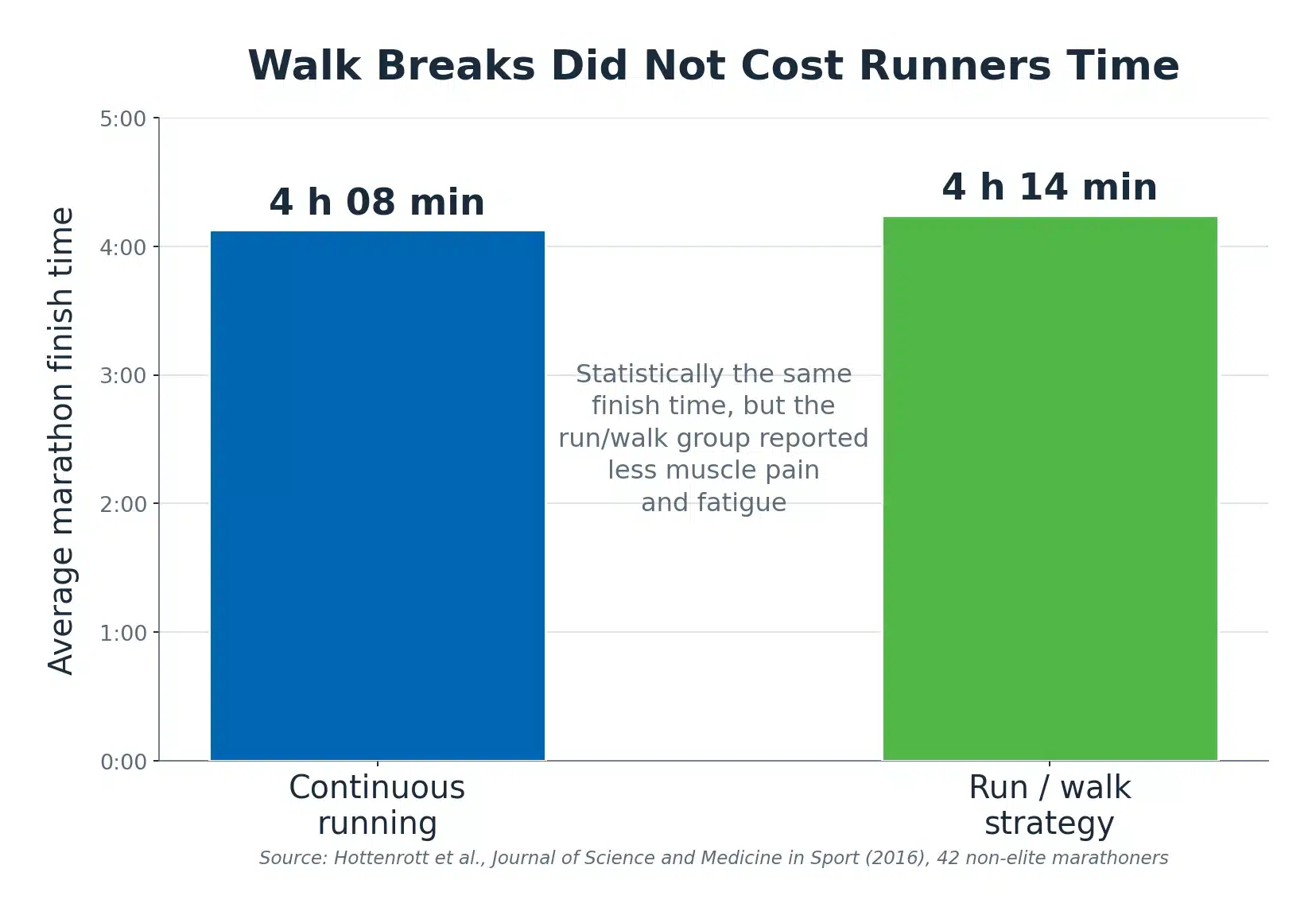
In a study of non-elite marathoners, run/walk runners finished in about the same time as continuous runners while reporting less muscle pain and fatigue.
Take walk breaks when you’re building distance, keeping an easy run easy, running steep hills, or dealing with heat.
Start with 30 to 60 seconds of walking every 5 to 10 minutes, and let your breathing and heart rate set the frequency.
For beginners, run-walk plans like Couch to 5K build mileage gradually and lower the risk of early injury.
Phase walk breaks out slowly by lowering your running pace first, then shortening each break.
Prefer to listen? One of our coaches answers this exact question in the episode below.
Are Walk Breaks Bad for Your Running?
Walk breaks are not bad for your running.
They are a deliberate pacing choice that lets you control effort and cover more distance than you could by grinding through nonstop.
The idea that stopping to walk signals weakness comes from racing culture.
Your muscles and cardiovascular system adapt to the total quality work you do, and a well-placed walk break protects that quality instead of wasting it.
A walk break taken on purpose is pacing, and pacing is a skill every distance runner has to build.
The one time a walk break works against you is when you use it to run the fast parts too hard and then recover.
On an easy run, surging and then walking turns a steady aerobic effort into a string of hard efforts, and you lose the calm, conversational stimulus the run was meant to give you.
Do Walk Breaks Make You Slower?
Walk breaks do not automatically slow you down, and over a long race they often keep you from fading in the final miles.
Researchers put this to the test with 42 non-elite marathoners, splitting them so one group ran continuously and the other took short walk breaks through the race.
A 2016 study found that run/walk marathoners finished in statistically the same time as continuous runners, about 4 hours 14 minutes against 4 hours 8 minutes, while reporting less muscle pain and fatigue afterward.

The finish times were close enough that the difference was not statistically meaningful.
What separated them was how they felt at the end, with the run/walk runners reporting noticeably less muscle soreness and fatigue.
That matters most in the second half of a long race, when continuous runners tend to slow and walk-break runners can hold a more even effort.
For a beginner or anyone stepping up to a new distance, a walk-break strategy often produces a faster overall time than starting too hard and fading.
RunnersConnect Bonus
Download your FREE Long Run and Aerobic Pacing Calculator now.
Need help converting your race times to your optimal easy and long run pace? Download our FREE calculator and we’ll do the math for you.
When Should You Take Walk Breaks?
Walk breaks earn their place in a handful of specific situations where they protect the purpose of the run.
Building up your distance. When you’re pushing a long run beyond what feels comfortable, walk breaks let you add minutes and miles your legs aren’t ready to run in one block.
Keeping an easy run easy. If your easy pace still pushes your breathing or heart rate too high, a short walk brings the effort back down to where an easy run belongs.
Running hills. Holding an easy effort uphill is hard, and walking the steepest sections keeps you from turning a recovery day into a hard workout.
Heat and rough days. On a hot day or a day when your body is fighting you, a walk break is the difference between finishing the run and cutting it short.
The test is simple: if a walk break protects the goal of the run, take it without a second thought.
How Long and How Often Should Your Walk Breaks Be?
Your walk breaks should be short enough to keep your rhythm and frequent enough to keep your effort under control.
A common starting point is 30 to 60 seconds of walking every 5 to 10 minutes of running, adjusted to how you feel.
Let your breathing and heart rate be the guide rather than a rigid timer.
If your breathing is labored or your heart rate is climbing too high, the walk break is doing its job and you should take it.
As your fitness improves, you can run 8 to 10 minutes between breaks instead of 5, and keep each walk to 30 seconds or less.
A beginner might run 3 minutes and walk 1, while a more experienced runner might run 10 minutes and walk 30 seconds.
If you want a proven structure to follow, the Galloway run-walk-run method lays out ratios by pace and experience level.
There is no single correct ratio, only the one that keeps this particular run at the effort you meant it to be.
Do Walk Breaks Help Beginners Avoid Injury?
For new runners, walk breaks are part of building up gradually, which is one of the strongest protections against early injury.
A large survey of everyday runners looked at who ended up hurt and what set the injured group apart.
Research on 1,145 runners found that beginners who followed a self-made plan were more likely to get injured than those who used a structured program like Couch to 5K, which builds mileage through run-walk intervals.
Those structured beginner plans are built almost entirely on walk breaks, alternating short runs with walking and slowly tilting the balance toward running over several weeks.
That gradual loading gives your muscles and connective tissue time to adapt to the pounding of running.
Skipping the walk breaks and trying to run every step from day one is exactly the rushed approach that leaves so many new runners hurt.
Walk breaks let you get the aerobic minutes your fitness needs while keeping the impact load inside what your body can handle.
Walking itself is useful training, and there are real benefits of walking for runners at every level.
How Do You Phase Out Walk Breaks?
You phase out walk breaks gradually, and only once running continuously stops feeling like a strain.
The first move is to slow your running pace instead of stopping.
If you can drop your pace enough to keep running through a stretch where you used to walk, do that instead of running hard and then walking to recover.
From there, chip away at the breaks in small steps.
You might cut each walk from 60 seconds to 30, then to 15, or keep the breaks only for the uphill sections of your route.
Quality sessions are the exception worth pushing on, because a tempo run or a workout loses its purpose when you break it up with walking.
If you can get through those runs by easing the pace instead, do that first.
Reaching the point where you run a route start to finish is a real milestone, and it will build your confidence for the next step up in distance.
| Situation | Walk break call |
|---|---|
| Building up your long run distance | Take them freely to add safe volume |
| Easy run effort creeping too high | Slow down first, then walk if needed |
| Steep hills | Walk the steepest sections to hold easy effort |
| Hot or rough day | Use them to finish the run safely |
| Tempo runs and workouts | Ease the pace instead of walking |
| New runner, first weeks | Follow a run-walk plan like Couch to 5K |
Frequently Asked Questions
Is it bad to take walk breaks while running?
No, walk breaks are not bad for your running. They are a deliberate pacing choice that helps you control effort and cover more distance than you could by running nonstop. The only time they work against you is when you use them to run the hard parts too fast and then recover, which turns a steady easy run into a series of surges.
Do walk breaks make you a slower runner?
Not usually. In a study of 42 non-elite marathoners, the run/walk group finished in statistically the same time as the continuous runners while reporting less muscle pain and fatigue. For beginners and anyone stepping up to a new distance, a walk-break strategy often produces a faster overall time than starting too hard and fading in the second half.
How often should I take walk breaks when running?
A common starting point is 30 to 60 seconds of walking every 5 to 10 minutes of running. Let your breathing and heart rate guide the frequency rather than a rigid timer. A beginner might run 3 minutes and walk 1, while a more experienced runner might run 10 minutes and walk 30 seconds. Adjust the ratio to keep the run at the effort you intended.
Are walk breaks good for beginner runners?
Yes. Walk breaks are the foundation of structured beginner plans like Couch to 5K, which alternate short runs with walking and gradually build toward continuous running. Research on 1,145 runners found that beginners using a structured program were less likely to get injured than those following a self-made plan. Gradual loading gives your tendons, bones, and muscles time to adapt.
Should I take walk breaks on hills?
Walking the steepest sections of a hill is often the smart choice on an easy or recovery run. Holding an easy effort uphill is difficult, and running hard up a climb can turn a recovery run into a hard workout. Walking the steepest parts keeps your effort where it belongs and protects the purpose of the run.
How do I stop needing walk breaks?
Phase them out gradually and only once running continuously stops feeling like a strain. Start by slowing your running pace instead of stopping, since a slower steady effort usually beats running fast and then walking to recover. From there, shorten each break in small steps or keep them only for uphill sections until you can run a route start to finish.
Do walk breaks reduce the benefit of an easy run?
Only if you use them to run too fast between breaks. An easy run is meant to be a calm, conversational aerobic effort. If your pace keeps pushing your breathing too high, slowing down is the first fix, and a short walk break is the second. Both keep the run easy, which is the whole point of the session.
References
Hottenrott, Kuno, et al. “Does a run/walk strategy decrease cardiac stress during a marathon in non-elite runners?” Journal of Science and Medicine in Sport, vol. 19, no. 1, 2016, pp. 64-68.
Linton, Linda, and Stephanie Valentin. “Running with injury: A study of UK novice and recreational runners and factors associated with running related injury.” Journal of Science and Medicine in Sport, vol. 21, no. 12, 2018, pp. 1221-1225.