

Hard workouts break muscle fibers down.
Recovery is when your body builds them back stronger — and most runners spend almost no time thinking about what happens between runs.
Here’s what you’ll learn:
- What’s actually causing the soreness and why it peaks on day two
- The 30-minute window after you finish that returns the most for your effort
- Whether ice baths are worth it — and when they actively hurt adaptation
- Why sleep beats every other recovery tool on this list
- How long to wait before your next hard session
What’s Actually Causing Your Sore Muscles?
The soreness you feel after a hard run is called delayed onset muscle soreness, or DOMS.
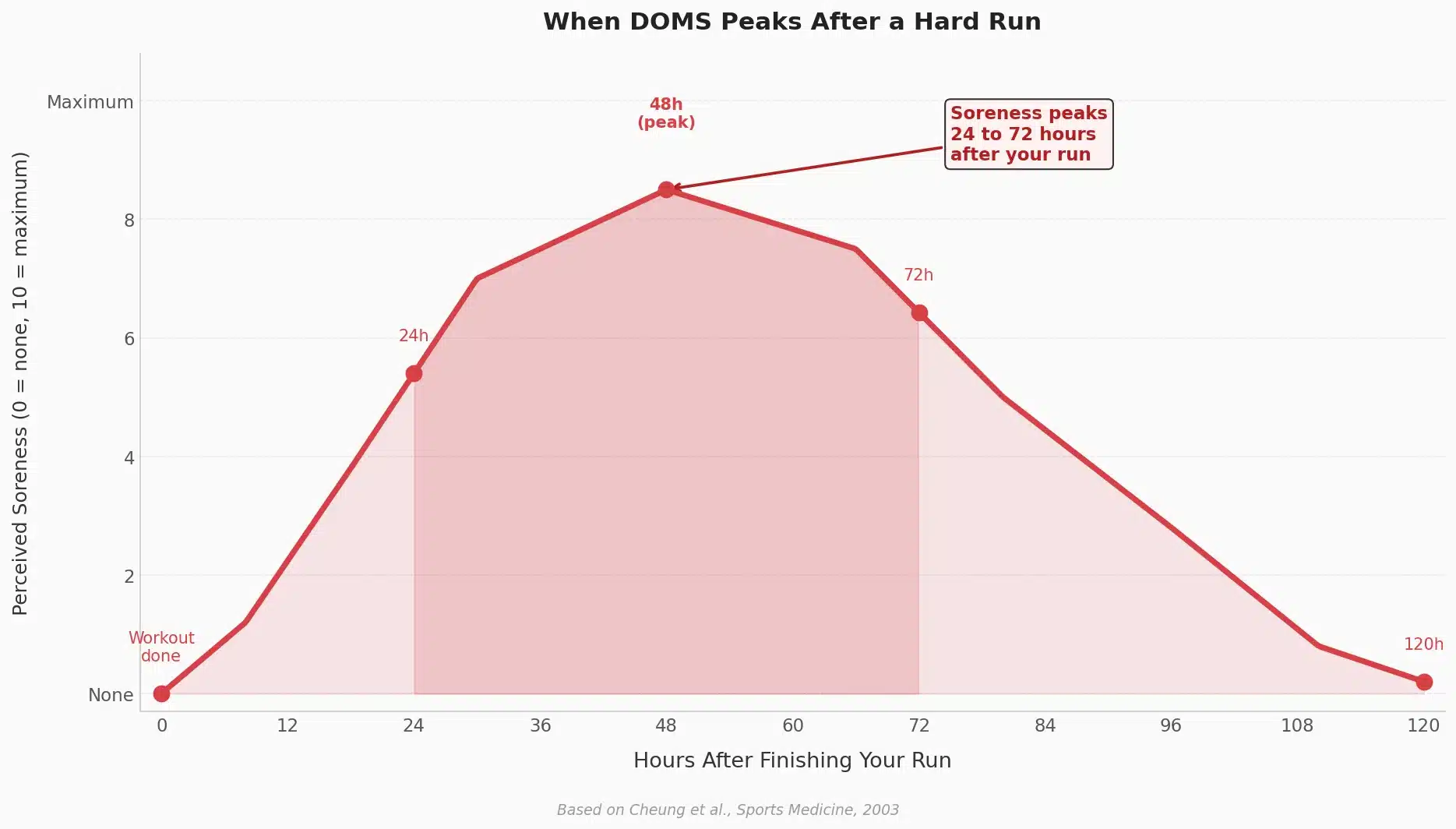
A comprehensive review in Sports Medicine confirmed that DOMS peaks between 24 and 72 hours after the triggering exercise and is caused primarily by eccentric muscle contractions — the lengthening-under-load that occurs every time your foot lands during a run.

Every footstrike forces your quads, glutes, and calves to decelerate your body weight against gravity.
That controlled lengthening under load creates microscopic tears in the muscle fibers.
The inflammation that follows is what you feel the next morning — and often more acutely on the morning after that.
The tears are not damage in the injurious sense.
They are the signal your body uses to build back stronger, with denser myofibrils and more fatigue-resistant fiber.
DOMS that peaks on day two and fades by day three to five is a normal adaptation response. Soreness that worsens past day three, is localized to a joint, or produces swelling warrants a rest day and closer attention — that pattern points toward injury, not adaptation.
The First 30 Minutes: Your Highest-Return Recovery Window
The 30 minutes after you stop running are when your muscles are most primed to absorb what they need to repair.
Glucose transporters are elevated, protein synthesis machinery is activated, and your body routes nutrients directly to the damaged tissue.
Research on carbohydrate timing shows that glycogen resynthesis is fastest in the first two hours after exercise, at a rate of 1–1.2 g of carbohydrate per kg of body weight per hour — roughly double the rate achievable later in the day.
For a 150-pound (68 kg) runner, that’s 68–80 grams of carbohydrate within the first two hours.
Pair that with 20–25 grams of protein to trigger muscle protein synthesis.
Chocolate milk hits both targets with the right ratio and is easy on a post-workout stomach.
A banana with Greek yogurt or a smoothie with fruit and protein powder works just as well.
For hydration: aim for 16–24 ounces of fluid in the first 30 minutes, with electrolytes if you ran longer than 60 minutes or in heat.
You don’t need a perfect meal immediately after every run. You do need something. Skipping the post-run window after your hardest days slows the rebuild by hours at exactly the moment your body is most ready to use what you give it.
Should You Do an Ice Bath After a Hard Run?
Ice baths reduce the perception of soreness, but they don’t meaningfully speed performance recovery.
A 2016 meta-analysis of cold water immersion research confirmed a significant reduction in muscle soreness compared to passive rest, but found no consistent improvement in subsequent performance — and noted that repeated use during training blocks may blunt the adaptation signals that make hard workouts productive.
The mechanism is vasoconstriction: cold narrows blood vessels, reduces swelling, and numbs the nerve endings that signal soreness.
The inflammation it suppresses is the same inflammation that drives adaptation.
This is why ice baths are most useful in back-to-back competition — multi-day races, tournaments — when you need to feel better for tomorrow, not in a training block when you’re building fitness across weeks.
If you use them, 10–15 minutes at 55–60°F (13–15°C) is the protocol with the best evidence.
Avoid ice baths in the 48 hours after a breakthrough workout during a build phase. You need that inflammation to adapt. Save them for race weeks and competition blocks — not every Thursday after a track session.
Why Sleep Is the Most Powerful Recovery Tool
Sleep is when the repair actually happens.
Research on sleep and muscle recovery found that 90% of daily growth hormone secretion occurs during slow-wave sleep — the deep-sleep stage that dominates the first half of the night — and that disrupting this stage significantly impairs muscle protein synthesis.
Growth hormone drives the repair of the micro-tears created during hard running.
Every hour you cut from your night reduces time spent in slow-wave sleep and compresses the repair window.
Runners in heavy training blocks need 8 to 9 hours.
Three things protect sleep quality: a dark, cool room (65–67°F / 18–19°C); a consistent bedtime within 30 minutes each night; no screens in the 60 minutes before bed.
A 20-minute nap is a legitimate tool when night sleep is short — it cuts cortisol and allows a brief deep-sleep cycle in athletes who can fall asleep quickly.
If you regularly get fewer than 7 hours during a training block, no amount of protein, ice baths, or foam rolling will compensate. Sleep is the recovery system itself — not a supplement to it.
How Easy Movement Helps You Bounce Back Faster
Sitting still after a hard workout feels intuitive, but it slows clearance.
Research comparing active and passive recovery found that blood lactate cleared significantly faster during active recovery at 40–60% of VO2max than during passive rest — and that the rate of clearance directly predicted readiness for subsequent high-intensity effort.
Moving at easy effort increases blood flow to fatigued muscle tissue, which delivers oxygen and nutrients while flushing metabolic waste.
A 20–30 minute walk, a casual bike ride, or a recovery jog at conversational pace the day after a hard workout all qualify.
Aqua jogging is the best option when legs are very sore — the water provides compression and removes impact stress while still driving blood flow.
The intensity ceiling matters: if you’re breathing hard, you’ve crossed out of active recovery into a second training stimulus.
Active recovery is not a bonus step — it’s a practical tool for accelerating what’s already happening between workouts.
What to Eat in the 24 Hours After a Hard Workout
Recovery nutrition doesn’t end at the 30-minute post-workout window.
Your second meal — 1.5 to 2 hours after the post-workout snack — should continue the repair process.
Focus on four things:
- Protein at every meal. 20–30g per sitting maximizes muscle protein synthesis. Eggs, Greek yogurt, chicken, fish, and cottage cheese all work. Total daily target during hard training: 1.6–2.2g per kg of body weight.
- Carbohydrates to restore glycogen. Rice, pasta, sweet potato, oatmeal. Prioritize lower-fiber sources in the first few hours if your gut is sensitive post-exercise.
- Anti-inflammatory foods. Tart cherry juice has the most direct research support for reducing DOMS. Fatty fish, leafy greens, and ginger also reduce the inflammatory load from hard training.
- Fluid and electrolytes throughout the day. Target light yellow urine by the time you go to bed.
RunnersConnect Bonus
Download our FREE recovery foods guide, with the top 10 foods for each of the essential recovery vitamins, minerals and macro nutrients. Plus a sample 1-day meal plan!
One thing to avoid: alcohol in the first 8 hours after a hard run impairs muscle protein synthesis.
A beer the night after a race is fine. A beer two hours after a track session is not.
Does Stretching Actually Help Sore Muscles?
Static stretching produces smaller reductions in DOMS than most runners expect — several studies show no benefit at all.
Foam rolling has more consistent evidence behind it.
The mechanical pressure from a roller releases fascial tissue surrounding sore muscles, reducing the compression that amplifies the soreness signal.
10–15 minutes of foam rolling on the quads, hamstrings, glutes, and calves after a hard run reduces DOMS in the 24–48 hours that follow.
RunnersConnect Bonus
Download your FREE Foam Rolling for Runners program.
The guide includes detailed videos and instructions help you understand the “why” behind every movement and exactly how to execute so you’re confident you’re foam rolling correctly, avoiding common mistakes and you’re getting the most from your session.
Gentle dynamic movement — leg swings, hip circles, short walks — does more for stiff tissue than a sustained static hold on a cold muscle.
If you stretch, do it after you’ve already warmed the tissue: after your run or after a few minutes of walking.
Cold static stretching before a run contributes nothing to recovery and may temporarily reduce force production.
How Long Should You Wait Before Running Hard Again?
For most hard sessions — track workouts, tempo runs, long runs with surges — 48 to 72 hours before the next hard effort is the standard window.
Races need more: 7 to 10 days for a half marathon, 10 to 14 days for a marathon.
Three signals tell you you’re ready before the clock does:
- Resting heart rate is within 3–5 bpm of your normal morning reading
- Legs feel springy on an easy warmup — not heavy and flat through the first mile
- Energy and motivation are at your normal baseline, not suppressed
Easy running the day after a hard workout is not only allowed — it often helps, as the light movement accelerates clearance.
Easy means conversational pace: aerobic effort only, no hills, no pickups.
The common mistake: taking a full rest day and then running hard at 48 hours because you “feel fine.” You feel fine because you rested — that’s not the same as being recovered. Use the three signals above, not how you feel after 24 hours of no running.


13 Responses
FOR THE EPSOM BATH, WHY USE BAKING SODA??
Great question, Richard. Baking soda, which is technically sodium bicarbonate, has an alkalizing effect on the body. This is important because doing lots of speed work actually increases the acidity levels in the muscles. Baking soda help neutralize this acidic effect. Plus, it had a rejuvenating affect on the skin, which can generally make you feel more rested.
Hey, great article. I had also written on similar lines but yours is in appropriate details. You surely know your stuff. Keep it up.
Good article however in some previous articles you mentioned there were no scientific proven results that ice baths work or epsom salt helped with recovery. Regarding the baths it was more noted that it was putting the legs in “deep” water (such as in a pool) because it helps remove the pooled blood after a run, temperature of the water notwithstanding. Regarding the epsom salts again there was no evidence that it helped with recovery. Please comment.
I always use a golf ball muscle roller to massage my muscles and take biosteel supplements which really helps my muscles recover.
Thanks for sharing Paige, we are big fans of using self therapy tools such as foam rollers and golf balls. As long as you are careful not to go too deep and spend too much time in any one area. Thanks for sharing!
I have read about substituting the ice bath with the Epsom salt bath, but it looks like you say to do both. What are the benefits of each, can they be used interchangeably in your opinom, or do they each have exclusive benefits. I know, I tried Epsom salt as a substitute for an ice bath, and I definitely didn’t feel like it did the same thing, but I know others who say the Epsom salt bath replaces the ice bath in their running recovery routine.
-Tim | http://blog.runnersonthego.com/2015/03/running-recovery-sleep-is-the-key/
Hi Tim, thanks for sharing, we actually posted about epsom baths in addition to contrast baths, you can take a read here: https://runnersconnect.net/running-injury-prevention/epsom-salt-treatment-running-injuries/ and https://runnersconnect.net/running-injury-prevention/contrast-bath-therapy-for-runners/
Hopefully this is what you are looking for! Thanks for reaching out, best of luck with your training!
I’ve been running a lot more lately (I used to focus only on lifting weights) and I’ll definitely bookmark this for reference. Quick question though, you say to eat 1-2 hours after a run. Should I eat 1-2 hours before a run or is like 30 minutes okay? Thanks.
Hi Billy, thanks for reaching out. Glad you enjoyed reading the post. As for eating before, that is up to you, different people have different preferences, and you will have to try what works for you. If you can eat comfortably 30 mins before, then that is okay! We wrote about this more in our article on what to eat before running https://runnersconnect.net/running-nutrition-articles/what-to-eat-before-a-run/ Hope this helps! Best of luck, and let us know if we can help with anything else!
In a previous article I read that ice baths weren’t good because they decrease the natural inflammation your body does to recover, hindering the recovery process. Is this only true directly after a run?
I think supplementing with amino acids i.e. BCAA or L-Glutamine will hel you to reduce muscles soreness as they promote muscle recovery.
https://astra-hc.com/urgent-care-near-me.html