

Most runners treat a foam roller like a rolling pin for tight muscles, so they press as hard as they can and stay on the sorest spot the longest.
So when your IT band is still sore 2 days later, or a bruise shows up where you rolled, it’s easy to assume you didn’t roll hard enough.
But the research on how foam rolling works suggests you should roll lighter, longer per muscle and in different places than you probably do.
So, which foam rolling habits are holding you back, and what should you do instead?
To give an evidence-based answer, let’s look at the research on:
- What a foam roller does to your muscles and fascia
- How much pressure and how many seconds each muscle needs
- Which body areas you should avoid rolling, and what to roll instead of an injured spot
- Whether foam rolling helps you more before a run or after it
How Does Foam Rolling Actually Work?
A foam roller most likely eases sore and tight muscles by changing how your nervous system reads pain from them.
The old explanation was that rolling “breaks up” knots and adhesions in your fascia, the connective tissue that wraps your muscles.
But a 2008 modelling study of the forces needed to change fascia found that compressing the thick fascia on your outer thigh by just 1% would take forces outside the body’s normal range.
A 2015 study of 150 people with a tender spot in one calf found that rolling the opposite calf raised the pain threshold of the tender spot by 21%, almost as much as the 24% from rolling the tender calf itself.

Rolling one leg can’t change the tissue in the other leg, so the researchers suggested that the 21% came from your nervous system turning down the pain signal from that spot.
So the job of a foam roller is to make a sore or tight muscle less tender, which helps it move more freely.
Most of the mistakes below come from treating it as a tool for breaking up tissue.
This breakdown of what foam rolling can and can’t do for runners compares it with other warm-up and recovery options.
RunnersConnect Bonus
Download your FREE Foam Rolling for Runners program.
The guide includes detailed videos and instructions help you understand the “why” behind every movement and exactly how to execute so you’re confident you’re foam rolling correctly, avoiding common mistakes and you’re getting the most from your session.
Does Foam Rolling Need to Hurt to Work?
Foam rolling works just as well at a firm, tolerable pressure, so pressing as hard as you can stand is the first mistake.
A 2018 study that had 16 adults roll their quads at light, moderate and hard pressure found that passive knee range of motion rose by about 15% no matter which pressure they used.
The light pressure in that study felt like about a 4 out of 10 for pain, and the hard pressure felt like an 8 out of 10.
That means you get the same loosening from a pressure that feels like a firm massage as you do from one you have to grit your teeth through.
If your roller feels too hard, take some of your weight on your hands or your other leg, or switch to a softer roller.
Sharp pain, numbness or tingling is different from the dull ache of a tight muscle, and it’s your cue to stop rolling that spot.
Which Body Areas Should You Avoid Foam Rolling?
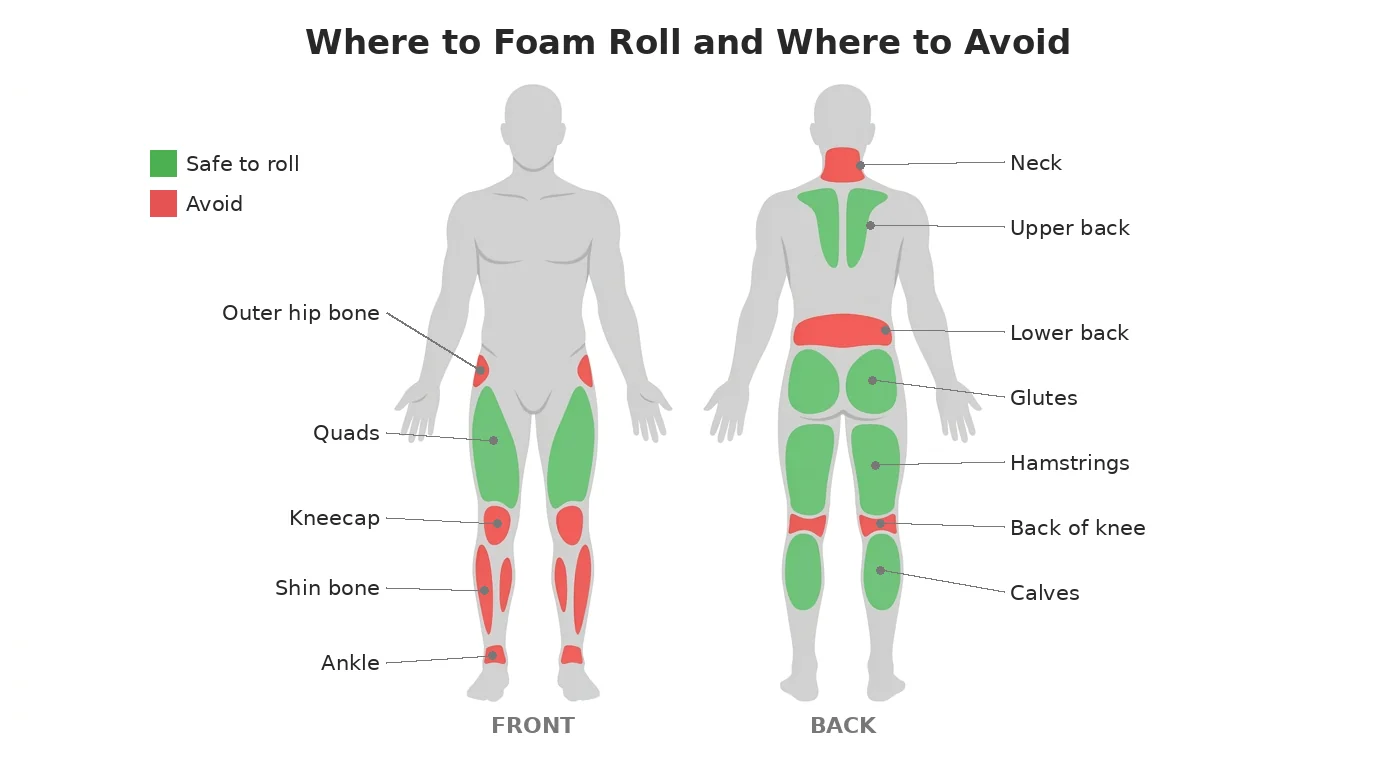
Keep the roller on the thick muscles of your calves, hamstrings, quads, glutes and upper back. Rolling directly over an injury, a joint or a bone is the second mistake.
As a general guide, avoid rolling these areas directly:
- Your lower back. Your lower spine has no ribs around it to spread the pressure, so roll your glutes and upper back instead.
- The back of your knee. Nerves and blood vessels run close to the skin there, with little muscle covering them.
- Your neck. It has little muscle over its nerves and blood vessels, so stretch it instead.
- Bony points such as your shin bone, kneecap, ankle and the outer point of your hip.
- A fresh injury, including a muscle strain in its first few days, a deep bruise, or any spot where you suspect a stress fracture.
A sore IT band falls in the same group.
Your IT band is a thick band of connective tissue rather than a muscle, so it doesn’t loosen the way a muscle does under a roller.
Roll the muscles around a sore spot, such as your glutes and quads for IT band pain, rather than grinding on the spot itself.
This guide on using a foam roller to manage running injuries covers which muscles to work for common problem areas.
How Long Should You Foam Roll Each Muscle?
Aim for at least 90 seconds per muscle group, because giving each muscle a few quick passes is the third mistake.
A 2019 review of 22 foam rolling studies found that 7 of the 8 studies measuring muscle soreness reported less soreness after rolling, and 90 seconds per muscle appeared to be the minimum time that helped.
A couple of 10-second passes over each leg falls well short of that 90 seconds.
Spread those 90 seconds across a few slow passes, and spend most of them on the muscles that feel sorest.
Your rolling speed is less of a concern.
A 2020 analysis of 26 foam rolling trials found that how fast people rolled didn’t change how much range of motion they gained.
Can You Foam Roll Too Much?
Research hasn’t found an upper limit on total rolling time, so the fourth mistake is parking on one tender spot for minutes at a time.
That same 2019 review found no upper limit on rolling time for easing soreness.
As an example, a 2015 study of 8 active men used 20 minutes of foam rolling right after a hard squat session and again 24 and 48 hours later.
Those 20-minute sessions reduced quad tenderness over the following days.
Holding heavy pressure on one small area for minutes is where runners run into trouble, because it can bruise the tissue underneath.
As a general guide, keep any single spot to about 20 to 30 seconds, then move on and come back to it later if it still feels tight.
If you see bruising the next day, lighten the pressure and shorten the time on that spot in your next session.
Should You Foam Roll Before or After a Run?
Foam rolling helps a little before a run and a little after it, and the fifth mistake is expecting rolling before a run to make you faster.
A 2019 meta-analysis of 21 foam rolling studies found that rolling before exercise improved flexibility by 4% but sprint performance by just 0.7%, while rolling after exercise reduced how sore people felt by 6%.
The same 2020 analysis on rolling speed also found that foam rolling loosened muscles no more than stretching did.
So a short roll before a run can loosen you up about as much as stretching would, with little gain in speed.
After hard workouts and long runs, the roller is a reasonable way to take the edge off sore legs.
If you like rolling before you run, keep it to a few minutes and follow it with leg swings and some easy jogging.
RunnersConnect Bonus
Download our Active Stretching Maintenance Routine
It’s a PDF and video with images and descriptions of the most effective active stretches for runners.
Does Your Form Matter When You Foam Roll?
Your form matters, and letting your posture collapse while you roll is the sixth mistake.
Foam rolling is hard work, and rolling the quads is basically the plank position.
It’s easy to let your form slip, especially if you are tired after a run.
When your abs relax during quad work, your lower back sags, and when you roll the side of your hip, your supporting shoulder ends up holding most of your weight.
Keep your core braced and your hips level the whole time, and if you’re too tired after a hard workout to hold your position, roll later in the day instead.
You can also film a session on your phone, which gives you quick feedback on whether your hips sag or your shoulders shrug.
What Should You Do Instead of Each Foam Rolling Mistake?
Here’s a quick recap of each mistake and its fix.
| Mistake | What to do instead |
|---|---|
| Pressing as hard as you can stand | Use a pressure around 4 to 6 out of 10 for discomfort |
| Rolling an injury, joint or bone | Roll the muscles around the sore spot and skip your lower back, the back of your knee and your neck |
| A few quick passes per muscle | Give each muscle group at least 90 seconds in total |
| Parking on one spot for minutes | Keep any single spot to about 20 to 30 seconds |
| Rolling before a run to get faster | Use a short roll to loosen up, and rely on rolling after hard runs for soreness |
| Letting your form collapse | Brace your core, keep your hips level and roll later if you’re too tired |



6 Responses
Good article because I see people use this tool wrong every day. I do have to question the part about the glute being a tight muscle though. I have been training and doing running assessments for ten years now and have yet to have someone with tight glutes. With all the sitting that people do and bad movement patterns it tends to be a weak inactive glute that is the problem, hence all of the core/glute work that we want runners doing. It would also be nice to put in contradictions to using the foam roller, such as if you are haveing cancer treatment, on blood thinners or have a blood disease or osteoperosis. I follow your posts regularly and feel that you do an awesome job but wanted to point out what I saw in this last one. I would love to hear your feedback and more in depth analysis. Thank you
Hi Nate,
I agree this is a very good article and highlights the pitfalls that many athletes fall into when they are introduced to a foam roller. I find that rather than “glute” tightness being an issue many runners/athletes are over active and tight in the hip external rotators, primarily piriformis. Therefore myofascial release over the piriformis and even the tensor fascia latae muscle bulk can be an excellent intervention for IT band issues or anterior knee pain.
Love the point about foam rolling being “hard work”. It definitely is. In my experience, it works best if you consider it an extension of your workout vs. a time to relax. My nightly routine is to stretch, foam roll, then a hot shower before hitting the hay. Highly recommend this to anyone who has trouble sleeping at night. Great artice, Jeff!
I agree with everything except for a maximum of holding 20 seconds on a spot, SMR (self myofacial release) can take up to 2 minutes applied pressure to release the trigger point..no need to go over 2 minutes however
Mistake 3 is so true, I laughed when I read this and saw myself – there is no middle ground for runners, it is all or nothing…
Hi. I definitely have at least 1 super tight calf but foam rolling doesnt seem to work.
Its on the upper portion 2/3rds up on the meaty part of the calf. Should I just concentrate on the trigger point or just slowly roll up and down? I feel the tightness as a sore spot when walking or running.