This one mistake is killing your strength training.
It’s pretty simple too. But, most programs don’t include it at all.
So, what’s this magical strength training secret?
PROGRESSION
In this video, I’m going to explain exactly what progression is, why it’s important, and show you how to add it to your strength training plan.
So, what is progression?
The concept is simple. To continually improve, your body needs a continual change of stimulus – a new type of demand for the muscles and body.
Here’s an example.
When you perform something like a bicep curl, the tension and stress on the muscle causes small micro tears in the muscle itself. The larger the stress, the more muscle fibers get torn.
Your body then dispatches blood and nutrients to your muscles to repair them. By this process, they make the muscle fibers stronger to better adapt to you performing bicep curls.
Over time, however, your muscle fibers are strong enough to perform the bicep curl and thus there’s very little, if any, adaption occuring.
Thus, once your body gets accustomed to a specific workout it stops making progress.
That’s where progression comes in.
You need to methodically add stress or new stimulus at the right time so your body continues to make progress
And this is the big mistake runners make with their strength training.
Many runners, whether it be from lack of knowledge or just not putting the proper emphasis on planning their strength training, simply repeat the same routines and exercises, week after week, month after month, with no change in stimulus.
Think about that for a second….
How many times have you performed the same core routine?
Did you add volume? Make the exercises more difficult? Adapt the routine to the race distance you are training for?
If you didn’t, here’s why this is a problem.
Let’s take for example you’re suffering from an IT band injury and you know strengthening your hip is the best way to heal your injury.
By the way, this is proven. I’ll show you the research on how improving hip strength can cure 90% of runners with IT band syndrome in the 3rd video of this series.
You go online and find a good hip strengthening routine for the IT band and start performing 3-4 days per week.
Like we discussed earlier, initially your body adapts and begins to build strength in your hip.
You start to feel better and go out on a test run….No more pain after 2 miles! Oh, how good it feels to be running again.
So, you keep up with the same hip routine and begin to cautiously get back into your training.
But, even though you’re super cautious increasing your training back to normal, after a week or two that IT band starts to flare up again!
This is the absolute worst feeling in the world.
Why is it that hip strengthening is working for 90% of other runners, but not me!
The reason?
Your body has adapted to the hip strengthening routine you’ve been doing, which has given you enough strength to get back to running a few miles each day.
But, that’s where progress stalled.
Without further progression, your hip still isn’t strong enough to keep you healthy at the training volume you want.
And that’s why progression is so critical.
Whether you’re using strength work to stay injury free or to improve performance. If you don’t constantly create new stimulus, you’re just stagnating or wasting your time.
So, now the question is, how do you add progression to your strength training?
There are three ways we can continually progress strength training for a runner.
First, we can add resistance – either through weights or bands or something like that.
Second, we can increase time under tension – so doing 60 seconds of an exercises rather than 30 or 15 reps instead of 12.
Finally, we can add a more dynamic component or make the exercise type more challenging. For example, with core you can add a swiss ball or just more dynamic exercises.
Now, how do you know when to add progression and what type is best?
That’s where the use of phases, just like we would in a training schedule comes in.
So, in one phase you would focus on “endurance” and therefore increase the number of repetitions sets.
Then you would move to a “power” phase and decrease the reps but increase the resistance.
Finally, you would have a race specific phase that uses more dynamic and specialized exercises to target the exact demands of your race distance.
Each phase might last 4-6 weeks. And that’s how you build a 12-18 week progression for your specific race.
Now, are you one of the runners I mentioned at the beginning of this video who have been doing the same strength routines over and over and now realize you aren’t making any progress?
Or maybe you’ve been doing strength work for your injuries but still can’t seem to get healthy?
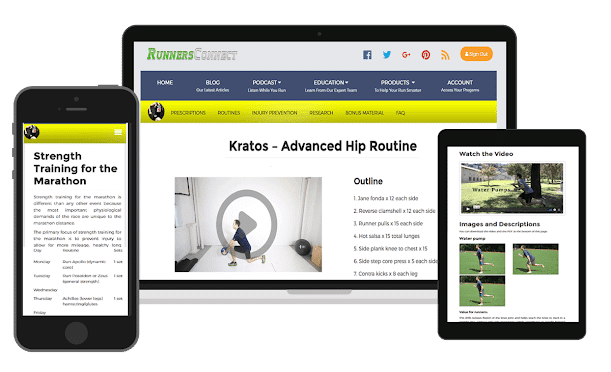
Then our strength training for runners program can solve all of those problems for you.
The program contains specific prescriptions that tell you which days you should do your strength work, how many repetitions and sets for each day, shows you how to do each exercise, and automatically adds progression in so you can constantly make progress towards your goals.
There’s routines for 5k, 10k, HM, Marathon, and ultra marathons. General strength training, losing weight, if you’re short on time.
Plus, there are specific programs for every running injury imaginable.
And it’s all digital, accessible on your phone, tablet and computer anytime.
This is the exact program that has helped thousands of runners stay healthy and improve their performance through strength training.
It’s widely considered the best strength training program designed for runners by numerous running coaches.
If you’re interested in grabbing your copy, click the link below