


If you have been in the endurance world long enough, you have likely gone to great lengths to improve your ability to run further, run faster, and achieve a personal best.
You may even use advanced metrics to track your performance such as a heart rate monitor, power meter, or wearable to determine your recovery between sessions.
However, while these devices can provide precise and useful information to help track and monitor your fitness, there is one metric is can’t accurately measure: VO2 max
VO2max is a term that is so common, and yet so often misunderstood and misused.
Maybe you’ve heard it’s the “gold standard of endurance”, a measure of athletic success, or you just want to know, “What is a good VO2 max?”.
Regardless, VO2 max is a hot topic, and we have A LOT to dive into
In this ultimate guide, I am going to unravel the questions surrounding VO2max so that you can learn how to train optimally and perform when it matters most.
What is VO2 max?
To begin, we must first understand what VO2 max is.
VO2 max is the maximum amount of oxygen the body can utilize during exercise. It’s a combination of how much oxygen-rich blood your heart can pump and the heart’s efficiency in extracting and utilizing oxygen
By training the appropriate energy system to use more oxygen, you will be able to train more, run longer, and race faster.
How is VO2max Measured?
VO2max is measured in ml/kg/min, i.e. milliliters of oxygen per kilogram of body weight per minute, with essentially two determining factors:
- How much blood the heart pumps to the muscles each beat (cardiac output)
- How efficiently the muscles extract oxygen from the blood and utilize it
Since oxygen is critical to running fast, a high VO2 max can be a great representation of your fitness.
Essentially, the faster your body can process oxygen, the faster you, potentially, will be able to run.
However, while the potential is there, there are many factors that influence outcome on race day.
While your VO2 can tell how big your aerobic engine is, it doesn’t tell you what you can actually do with it.
For example:
You can have two runners training at the same speed but one runner is using less oxygen than the other at that given pace. The runner who is using less oxygen to maintain that pace is using oxygen more efficiently, thus running a faster race.
Which runner would you assume has the higher VO2max?
Common sense would suggest it was the faster runner.
Not exactly.
The faster runner can have a lower VO2 max and still be the superior runner.
Why is that?
It boils down to how well the runner can effectively use the oxygen taken in.
One can have a bigger engine (capacity for oxygen) but actually have a poor ability to use it to produce energy.
This begs the question:
Is VO2max a poor indicator of endurance performance?
What Are Typical VO2 max Values?
When it comes to defining physiological norms, there are always exceptions. However, research has shown that VO2 max can be associated with general aerobic fitness.
Standard values for healthy individuals are noted in the following VO2 max chart:
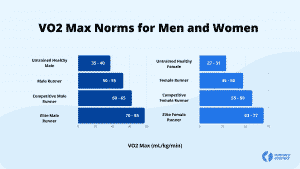
Judging from this chart, It’s easy to make the assumption that a high VO2 max is related to faster performances!
But there is more to this.
Why a Higher VO2 Max Doesn’t Equal a Faster Performance
During the Sub-2 Marathon Project by Nike, researchers witnessed an inverse relationship between VO2 and running economy. Those who had high VO2 maxes we’re less economical, and those with a high economy had lesser VO2 maxes.
For athletes trying to crack 2 hours in the marathon, having a higher running economy was a signifncant advantage if they wanted a chance of acheiving the feat.
Out of all the world class marathoners, only a select few hit the “genetic lottery” in having a high VO2 max and Running Economy.
We can guess one of these lottery winners is sub-two-hour marathoner and world record holder, Eliud Kipchoge.
What intrigues me about this study is, of all the athletes lined up for the race, only a few would even have a chance to run sub 2 based on lab tests!
Could you imagine getting ready for your goal race, excited and ready to tackle a PR, and the physiologist presenting you with test results states, “You have no chance at running that time.”!? Ouch.
When it comes to performance, running economy plays a considerable role in performance. Running economy includes:
- The ability for your body to use available oxygen
- The ability to recruit muscle fibers
- The ability to generate more force while minimizing energy cost
This explains why just having a high VO2 max doesn’t guarantee race wins.
If your goal is to improve running economy, incorporating strength training and plyometrics can give you an edge. If your goal is to improve your running efficiency, drills are an excellent way to improve your form.
If your goal is to improve your VO2 max, this next section will walk you through the 4 key components that affect your improvement.
What Affects VO2 max?

Age: After about the age of 30, VO2 max declines at a rate of 1-2% per year.
Training: Training inherently teaches your body to become stronger aerobically, which will affect your VO2 max scores. The greatest increase in VO2max scores are noted in beginning runners with gains slowly tapering off as training advances. Basically, the more you train, the less drastic the increases in VO2 become
Gender: Naturally, men will have higher VO2 maxes than women. Men typically have more muscle mass and higher hemoglobin levels, which can affect VO2 max outcomes.
Altitude: Due to the decrease in oxygen content, aerobic capacity is reduced at higher elevations. This results in decreased performance times. If you’re planning on training at altitude, you may want to reconsider your approach to training so you get the maximal effect.
How Does Training VO2 max Help Me?
Training at VO2 intensity or the vVO2 (the speed at which you reach your max), can help a runner in ways including:
- increase in maximum oxygen uptake in all muscle fibers
- increase in capillaries to all muscle fiber types
- increased ability to slow the build-up of waste products (not just lactic acid!) that will slow down your performance
Additionally, VO2 max training can increase the efficiency of your running and improve your form. Since VO2max workouts are much faster than normal training, they force you to run more efficiently.
Want to know the best part?
Training at VO2 max also increases leg-muscle strength and power, which improves running economy.
When muscles become stronger, fewer muscle fibers are needed to hit a particular pace; thus the energy expenditure is lower. This can improve your fuel-burning efficiency during a marathon or help propel you to faster times in the 5k.
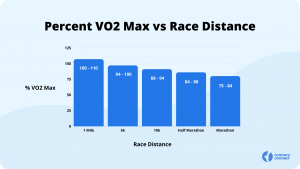
What Other Factors Contribute to Improvements in VO2max?
-
Threshold Training – If VO2 max measures your aerobic potential, lactate threshold determines how much of that potential you tap into during a race. If two runners have the same VO2max value but one has a higher lactate threshold, the latter is more likely to win.
-
Motivation and Mental Training – Yep! An incredible limitation to improving can be attributed to the ability of our brains to communicate with our bodies! If we don’t have the drive nor ability to push ourselves through pain, VO2 max will suffer.
- Lifestyle Factors – These include smoking, diet, and body composition.
VO2 max testing – Worth it? What is it?
In a VO2 max test, you’re hooked up to a breathing mask while undergoing a progressively more-difficult treadmill test.
To determine the validity of the VO2 max test, it’s important you surpass specific criteria including:
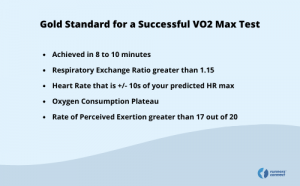
Your VO2 max occurs when oxygen consumption redlines—this usually happens at a speed slightly faster than 5k race pace.
At this point, your heart rate is also maxed out, and you’re working pretty hard.
After doing math involving rate of oxygen consumption during the test and your body weight, a physiologist determines a number expressing oxygen consumption when running your hardest.
This number is your VO2max.
Would Every Runner Benefit From a VO2 max Test?
I don’t think so.
You can obtain a good estimate of your VO2 max, or at least your velocity at VO2 max, from your 5k or 10k PR, assuming you’ve raced one recently.
Charts or online calculators an help crunch the math.
Knowing your VO2 max (and your velocity at VO 2max) is only important if your training plan demands it.
Unfortunately, after a certain point, VO2 max loses its value as a performance indicator. Highly-trained individuals may drop a few points, even if they are training faster than ever!
This demonstrates while VO2 max can be a marker of cardiorespiratory fitness, it doesn’t necessarily relate to endurance training as a whole. You are much better training to the specifics of your race distance and demands versus a single, calculated variable.
Outside of this, VO2 max is a nice measurement for scientific research, as it can be used to identify and isolate improvement from training.
Is Your VO2 max High Enough to Prevent Heart Disease?
Cardiovascular health is an integral part of long term well-being.
Individuals with a healthy VO2 max are more likely to experience promising health benefits such as: increased lifespan, reduced risk for stroke, heart disease, diabetes, and cancer.
On the contrary, in a study, published by Susan Lakoski and colleagues in JAMA Oncology, individuals with low VO2 max scores were shown to be at greater risk of heart disease, and specific types of cancer,. The study tracked almost 14,000 men over a period of 38 years to determine the correlation between aerobic fitness and serious health complications.
These findings shouldn’t come as a surprise. We all know endurance is an excellent preventative measure of cardiovascular disease and underlying illness.
We also understand its significant role in mental health as well.
So, whether you’re a competitive runner or someone who runs for “the health of it”, you can rest assured you are taking strides to protect and care for your long term wellbeing.
Specific VO2 max Workouts you can Implement
Now on to everyone’s favorite: the training details!
VO2 max for the 5k
Out of the most common race distances, VO2 max is most important in the 5k.
While the first portion of 5k training will focus on building aerobic endurance, think of this phase as building the foundation of a house. The last 1/3rd of a 5k training plan, however, will emphasize VO2 max workouts – think of this as the roof.
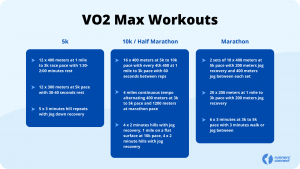
A few excellent examples of 5k specific VO2 max workouts are:
-
12 x 400 meters at 1 mile to 3k race pace w/1:30-2:00 minutes rest
-
12 x 300 meters at 5k pace w/ 30-40 seconds rest
-
5 x 3 minutes hill repeats with jog down recovery
Looking for more information and workouts for training for a 5k? Check out our 5k Specific Training post. Or, how about our Base Training for 5k and 10k post?
VO2 max for the 10k and half marathon
The specific demands of the 10k and half marathon aren’t heavily reliant on VO2 max, but it is still an important component to round out fitness.
In the 10k and half marathon, you should have a VO2 max workout scheduled every 2-3 weeks to keep the system in check and support other energy systems (aerobic development and threshold training).
My favorite workouts to blend into 10k training are:
- 16 x 400 meters at 5k – 10k pace with every 4th 400 at 1 mile-3k pace w/ 60 seconds between reps
- 4 miles continuous tempo alternating 400m at 3k-5k pace and 1200 meters at Marathon pace
- 4 x 2 minutes Hills w/ jog down recovery, 1 mile on a flat surface at 10k pace, 4 x 2 minute Hills w/ jog down recovery
We have a great article on Specific Training for the 10k here, and a 6 week 10k specific training plan for applying the adaptation principle. You can also take a glance into the 10k training of an elite runner or half marathon specific training.
VO2 max for the Marathon
Unfortunately (or fortunately, depending on how much you like lung-busting interval workouts), VO2max is not a big component of marathon training.
However, It is still useful and important to include some VO2 max workouts and speed work in your training plan every 3-4 weeks to help your form and efficiency.
My marathon go-to’s are as follows:
-
2 sets of 10 x 400 meters at 5k pace w/ 200 meters jog rest and 400 meters jog between each set
-
20 x 200 meters at Mile to 3km pace w/ 200 meters jog recovery
-
6 x 3 minutes at 3k to 5k pace w/ 3 minutes walk or jog between
Make sure you check out the best marathon workout.
Conclusion
Now that you understand what VO2 max is and how it influences performance and health, how will you implement it?
If your goal is to run a faster 5k, VO2 max training will serve to directly influence your speed and strength..
If your goal is to run a Marathon PB, you may want to include VO2 max workouts to support the heavy aerobic demanding work you do.
Ultimately, VO2 max is just one of the many components of successful endurance training. It can be a helpful representation of aerobic conditioning, but it comes with its limitations. Just like every other component of training, it shouldn’t be the sole focus of your preparation, but rather, a small piece of the bigger picture.







4 Responses
Hi
I was wondering if there are any online courses that review how the V02 Max test is administsered
A simple fact about running know by the old coaches, is that when your unable to talk while running, you have hit your vo2max, slow your speed and see if you can talk again.
Thanks for the comment Luis. Very true, when it comes to easy running, you should be able to have a conversation, which means you are running slow enough for your body to be able to recover.
Just wishing to take a vo2 test just to see how my asthma effects my ability to compete in cycling events.